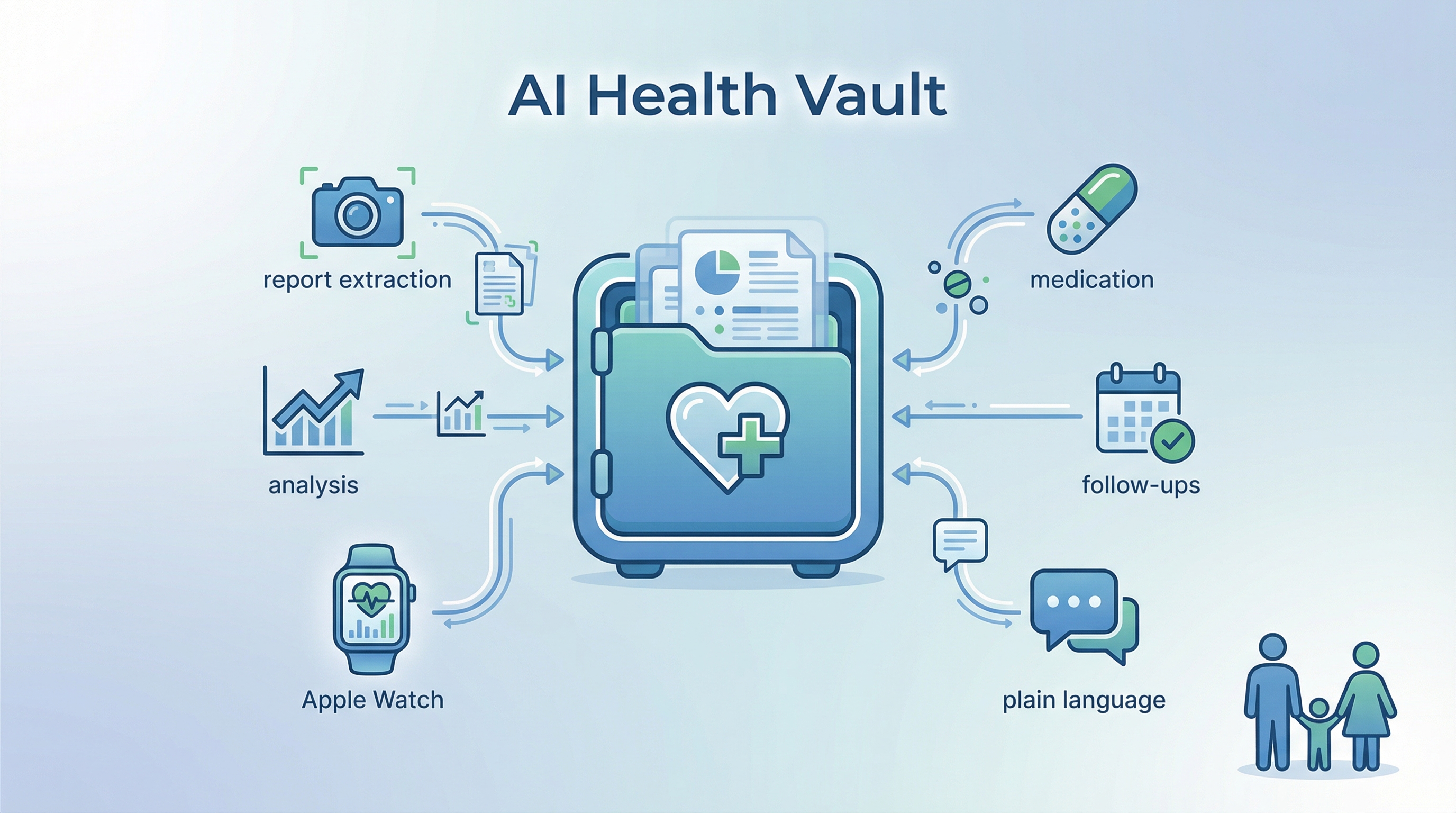
Your parents’ medical reports are scattered across hospitals. Nobody tracks medication changes or follow-up dates. Commercial health apps want your data on their servers. AI Health Vault solves this with a different approach: an Obsidian vault with templates, prompts, and 8 Claude Code skills that turn your local folder into a private, AI-powered health archive for your whole family.
Source: GitHub — runesleo/ai-health-vault
Why This Exists
The problem is real and personal:
- Medical reports scattered across hospitals — no one tracks trends for you
- Parents can’t remember their own medications, dosages, or follow-up dates
- Commercial health apps require uploading private health data to their servers
- You just need local templates where the data stays on your machine
How It Works
Photo of medical report
        │
        ▼
Claude Code skill: extract
        │
        ▼
Structured Obsidian note
(per-person, per-checkup)
        │
        ▼
┌───────────────────────────────────┐
│  AI Health Vault (local Obsidian) │
│                                   │
│  📁 Family Member A               │
│  ├── Checkup 2026-03-15          │
│  ├── Checkup 2026-01-10          │
│  └── Medications (CSV)           │
│                                   │
│  📁 Family Member B               │
│  ├── Surgery Record              │
│  ├── Condition History           │
│  └── Apple Watch Data            │
│                                   │
│  📊 Trend Analysis               │
│  📅 Follow-up Calendar           │
│  💊 Medication Recognition       │
└───────────────────────────────────┘
8 Pre-Built Claude Code Skills
The vault ships with 8 skills in .claude/skills/ that auto-load when you open Claude Code in the vault directory:
| Skill | What It Does |
|---|---|
| Report Extraction | Photograph a medical report → structured note with all values, ranges, and flags |
| Medication Recognition | Photo of pill box → drug names, dosages, interactions |
| Trend Analysis | Compare multiple checkups → spot anomalies and changes over time |
| Doctor Visit Prep | Generate pre-visit checklist: questions to ask, records to bring, history summary |
| Apple Watch Analysis | Parse health data exports → actionable insights on heart rate, sleep, activity |
| Plain Language Conversion | Convert medical jargon into family-friendly explanations |
| Calendar Generation | Extract follow-up dates → Obsidian calendar entries with reminders |
| Daily Health Plan | Personalized daily plan based on conditions, medications, and lifestyle |
30-Minute Setup
# Clone the vault
git clone https://github.com/runesleo/ai-health-vault.git
cd ai-health-vault

# Open in Obsidian
# File → Open Vault → select vault/ folder

# Fill in family member names in the central hub
# Then: photograph a report → send to Claude → done
For Claude Code users:
cd ai-health-vault
claude
> "Help me analyze this checkup report" (attach photo)
The 8 skills auto-load — no manual prompt copy-paste needed.
Privacy Model
| Approach | Privacy Level | How |
|---|---|---|
| Anthropic API | High | Anthropic does not use API inputs for model training |
| ChatGPT (training off) | Medium | Disable training in settings |
| Local models (Ollama/LM Studio) | Maximum | Nothing leaves your machine |
All data lives in your local Obsidian vault. The AI only sees what you explicitly send it (e.g., a photo of a report). No persistent cloud storage, no account, no data harvesting.
What Makes This Interesting
This isn’t a complex engineering project — it’s 8 well-crafted prompts + a folder structure. But that’s exactly why it matters:
- Skills as the product — The entire value is in the Claude Code skills and Obsidian templates. No backend, no database, no deployment. This is what “software is prompts” looks like in practice.
- Family-scale AI — Most AI tools target individual productivity. This targets family health — a use case where data privacy and long-term continuity matter more than features.
- Obsidian as platform — Shows Obsidian’s potential as more than a note-taking app: with the right templates + AI skills, it becomes a domain-specific application.
How LearnAI Team Could Use This
- Build an internal privacy-first health-record demo showing how local vaults, templates, and AI skills can become a practical domain app.
- Use the project as a case study for prompt-packaged workflows: skills, folder structure, and repeatable outputs instead of a traditional SaaS backend.
- Adapt the pattern for other sensitive-document workflows such as insurance, elder care, school records, or legal paperwork where local-first storage matters.
Real-World Use Cases
- Adult children organizing parents’ checkups, medication lists, follow-up dates, and doctor-visit notes in one local vault.
- Families comparing lab reports over time to spot changes worth discussing with a clinician.
- Caregivers preparing concise visit summaries and question lists before appointments.
- Privacy-conscious users extracting structured notes from medical reports without storing a full health history in a commercial app.
Links
- GitHub: runesleo/ai-health-vault
- Chinese README: README_CN.md