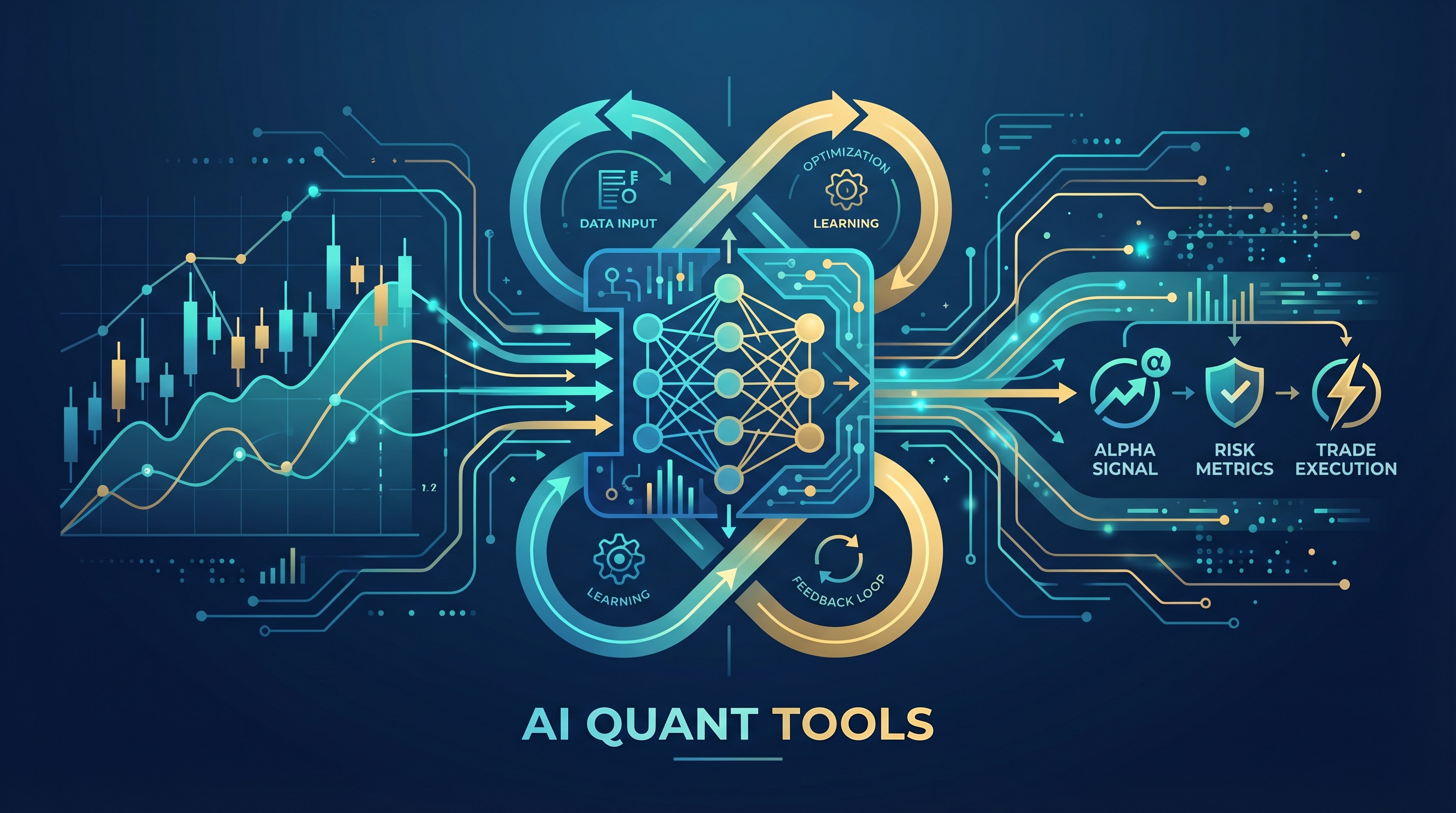
Two open-source AI tools targeting quantitative finance research: Kronos, a foundation model for financial time series (AAAI 2026), and Midas, an LLM-powered Alpha signal discovery framework with dual-loop architecture. Both represent the trend of bringing foundation model capabilities into specialized financial domains.
| *Source: Kronos Paper (AAAI 2026) | Kronos GitHub | Midas GitHub* |
Kronos — Financial Time Series Foundation Model
A foundation model from Tsinghua University that treats financial candlestick (K-line) data as a language. Instead of feeding raw price numbers into a generic model, Kronos tokenizes market data — open, high, low, close, volume — into discrete token sequences, then trains a causal transformer to predict what comes next. The same idea that powers GPT for text, applied to market microstructure.
| Detail | Value |
|---|---|
| Published | AAAI 2026 (arXiv:2508.02739) |
| Authors | Yu Shi, Zongliang Fu, Shuo Chen, Bohan Zhao, Wei Xu, Changshui Zhang, Jian Li |
| Architecture | Decoder-only causal transformer with specialized K-line tokenizer |
| Training Data | 12+ billion K-line records from 45 global exchanges |
| Code | github.com/shiyu-coder/Kronos |
How It Works
Raw Market Data (OHLCV candles)
        │
        ▼
┌──────────────────────┐
│  K-Line Tokenizer    │  Discretizes continuous price/volume
│                      │  into token sequences, preserving
│                      │  both price dynamics and trade
│                      │  activity patterns
└──────┬───────────────┘
       │
       ▼
┌──────────────────────┐
│  Causal Transformer  │  Autoregressive pre-training
│                      │  (like GPT, but for markets)
│                      │  Learns temporal + cross-asset
│                      │  representations
└──────┬───────────────┘
       │
       ▼
┌──────────────────────┐
│  Downstream Tasks    │  Price forecasting, volatility
│                      │  prediction, synthetic data
│                      │  generation — all zero-shot
└──────────────────────┘
Why It Matters
Most general-purpose time series foundation models (like Amazon’s Chronos) are trained on diverse data — weather, energy, traffic. They treat financial data as “just another time series.” Kronos argues that financial markets have unique structure: K-line patterns encode specific trader behavior, volume spikes signal regime changes, and cross-asset correlations carry information that generic models miss.
Key Results
| Task | Improvement | Compared To |
|---|---|---|
| Price forecasting (RankIC) | +93% | Best existing TSFM |
| Price forecasting (RankIC) | +87% | Best non-pre-trained baseline |
| Volatility prediction (MAE) | -9% | Previous best |
| Synthetic K-line generation | +22% fidelity | Previous best |
The model shows strong zero-shot performance — it generalizes to unseen financial instruments without task-specific fine-tuning, which is the key promise of foundation models applied to finance.
Midas — LLM-Powered Alpha Research Framework
An end-to-end quantitative research platform that integrates signal discovery, backtesting, and monitoring into one framework.
┌──────────────────────────────────────────┐
│           DUAL-LOOP ARCHITECTURE          │
│                                          │
│  Offline Loop          Online Loop       │
│  ┌──────────┐         ┌──────────┐      │
│  │ LLM as   │         │ Monitor  │      │
│  │ "Quant   │         │ feature  │      │
│  │ Researcher"│        │ decay +  │      │
│  │ discovers │         │ trigger  │      │
│  │ new Alpha │         │ kill     │      │
│  │ signals   │         │ switch   │      │
│  └──────────┘         └──────────┘      │
│       ↓                    ↑             │
│  Knowledge base: learns from every       │
│  failure and success                     │
└──────────────────────────────────────────┘
Key Features
- Dual-loop: offline LLM discovers signals + online monitors feature decay and triggers kill switches
- LLM-driven feature proposals: supports DSL expressions for fast validation and generation
- Multi-agent evaluation: covers IC, half-life, transaction costs, simulated compliance across 6 dimensions
- Knowledge persistence: auto-records learnings, threshold configs, and feature state
- Supports OpenAI/Anthropic: CLI for rapid deployment, only needs a
compute(expression)interface - Install:
pip install -e .with synthetic data demo included, no API key needed to start
How LearnAI Team Could Use This
- Teaching AI applications in finance — Both tools illustrate how foundation models extend beyond NLP into domain-specific applications. Good case studies for an “AI Applications” course module.
- Time series research — Kronos’s approach of treating financial data as language connects to broader time series forecasting methods applicable to any sequential data.
- Agent architecture example — Midas’s dual-loop (discovery + monitoring) and multi-agent evaluation are transferable patterns for any domain requiring continuous AI monitoring.
Real-World Use Cases
- Quantitative research teams — Midas automates the tedious cycle of signal discovery → backtest → monitor → replace decayed signals
- Academic finance research — Kronos provides a pre-trained foundation model for financial time series experiments
- Algorithmic trading firms — The dual-loop architecture ensures signals are monitored in production and automatically flagged when they decay