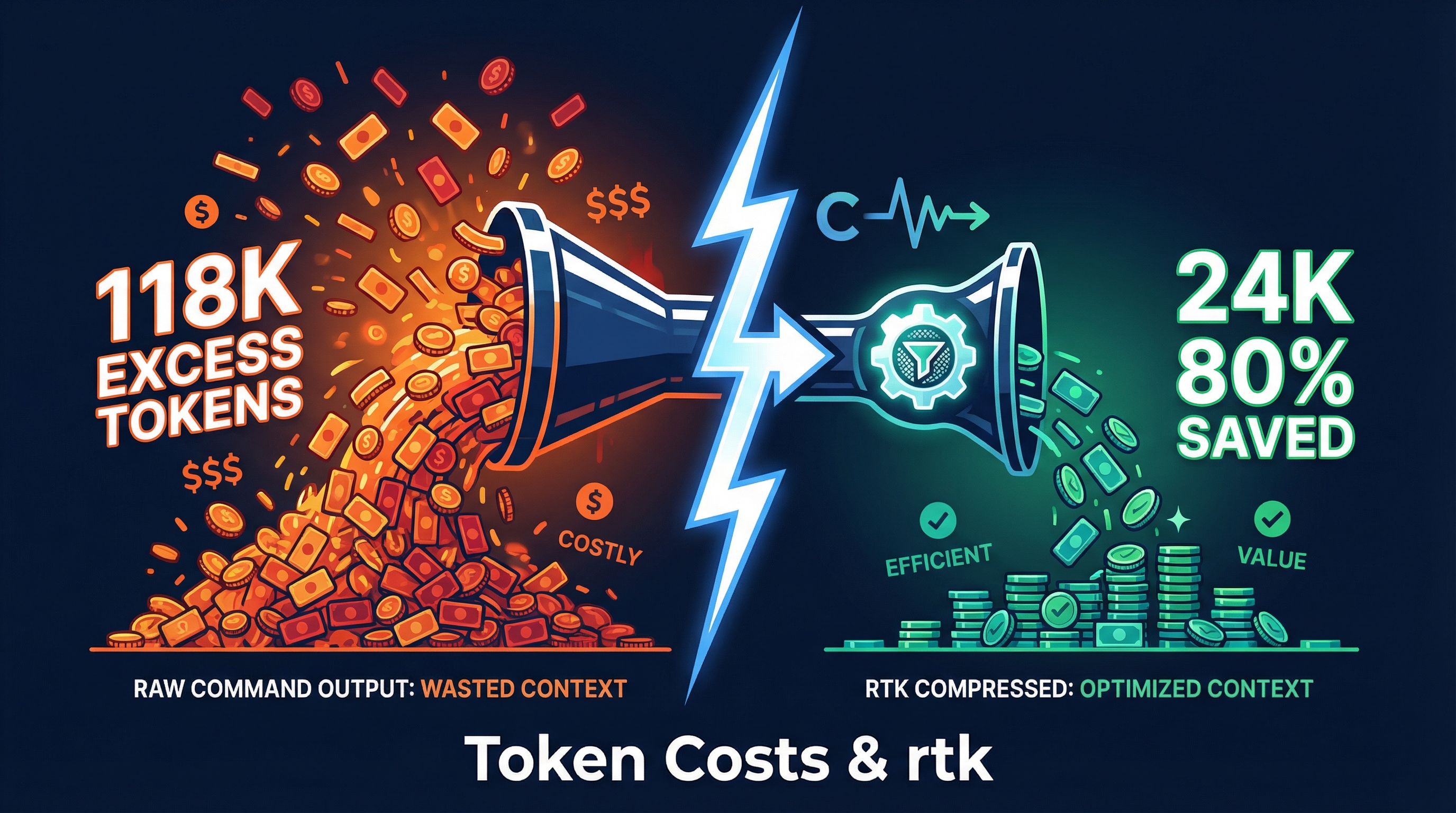
Every bash command Claude Code runs has a hidden token cost. git status outputs ~3,000 tokens. cargo test can output 25,000 tokens. A typical medium project development cycle burns through 118,000 tokens just on command output — and with a 1M context window, that cost compounds silently until your daily quota vanishes.
| *Source: Reddit — “Saying hey cost me 22% of my usage limits” | GitHub — rtk-ai/rtk | Kilo-Org Discussion — Saved 10M tokens (89%)* |
The Problem: Token Billing is a Black Box
A user tracked GitHub issue #16157 and found a striking case: 92% of tokens in a session came from cache reads, actual output tokens were near zero, yet the API charged $1.50 — which counted as $65 of usage against their quota.
Why This Happens
The 1M context window is an amplifier. Key pain points:
| Issue | What Happens |
|---|---|
| Cache reads count | Every message includes full conversation history — cached tokens still count toward usage |
| Silent retries | When Claude encounters service instability, it silently retries requests, each retry re-reads the full context |
| Overnight sessions | One long session can eat your entire daily quota by morning |
| No transparency | Same operation might use 20% today, 89% tomorrow — no warning, no predictability |
Quick Workarounds
/compact— Compress context before it gets too large; don’t wake old sessions, start fresh/costor/stats— Monitor token consumption in real-time- Don’t revive stale sessions — Opening yesterday’s conversation reloads the entire history
The Solution: rtk — CLI Proxy That Saves 80% of Tokens
rtk (Rust Token Killer) is a single Rust binary that sits between Claude Code and your shell commands. It intercepts command output, compresses it, and sends Claude only the essential information.
Before rtk:           After rtk:
git status → 3000 tokens    → 150 tokens (95% saved)
cargo test → 25000 tokens   → 2500 tokens (90% saved)
ls -la     → 800 tokens     → 150 tokens (82% saved)
─────────────────────────────────────────────────
Total: 118,000 tokens  →  23,900 tokens (80% saved)
How rtk Works: 4-Step Compression
Raw command output
       │
       ▼
┌─────────────────────┐
│ 1. Smart Filtering   │  Remove comments, whitespace, boilerplate
├─────────────────────┤
│ 2. Grouping          │  Cluster similar items (e.g., files by directory)
├─────────────────────┤
│ 3. Truncation        │  Keep useful info, cut the rest
├─────────────────────┤
│ 4. Deduplication     │  Fold repeated log lines into one + count
└─────────────────────┘
       │
       ▼
Compressed output → Claude
Setup: One Command
# Install on macOS
brew install rtk

# Then initialize globally
rtk init --global
After this, git, cargo/npm test, docker, kubectl, eslint/ruff/pylint, jest/vitest/playwright, pip/pnpm — all common dev commands are automatically intercepted. Claude sees only compressed versions, completely transparently.
Real Savings: Why It Matters Beyond Cost
Token savings aren’t just about money:
- More context space — Compressed outputs mean more room for code history, more context for better Agent decisions
- Longer sessions — Same conversation can stay productive longer before hitting limits
- Better agent performance — Less noise in context = more focused, accurate responses
Limitations
| Works With | Doesn’t Work With |
|---|---|
| All Bash commands (git, npm, cargo, docker, kubectl, etc.) | Claude Code’s built-in tools (Read, Grep, Glob) — these bypass the shell |
| Custom shell commands | Completely unknown/custom commands — rtk passes these through raw |
Workaround for built-in tools: Use shell equivalents explicitly — cat/head/tail instead of Read, rg/grep instead of Grep — when you want rtk compression. Or explicitly call rtk read.
Supported Platforms
Claude Code, OpenCode, Gemini CLI — install is one command, config lives at ~/.config/rtk/config.toml.
The Other Side: Cut Output Tokens with claude-token-efficient
rtk cuts input tokens (command output → Claude). But Claude also wastes tokens on output — filler phrases, flattery, restating your question, unsolicited suggestions. claude-token-efficient is a CLAUDE.md snippet that eliminates this waste.
| *Source: 陆三金 on Weibo (2026-03-31) | 爱可可-爱生活 on Weibo (2026-04)* |
The Problem: Default Claude Output Is Bloated
By default, Claude:
| Waste Pattern | Example |
|---|---|
| Opens with filler | “Sure!”, “Great question!”, “Absolutely!” |
| Restates your question | “You’re asking about how to…” |
| Ends with fluff | “I hope this helps! Let me know if you need anything!” |
| Uses decorative formatting | Em dashes, smart quotes, Unicode characters |
| Adds unsolicited suggestions | “You might also want to consider…” |
| Over-engineers | Adds abstractions you didn’t ask for |
| Agrees with wrong statements | “You’re absolutely right!” (even when you’re not) |
All of this wastes tokens. None of it adds value.
The Fix: One File in Your Project
Drop the snippet into your CLAUDE.md. Claude immediately becomes more concise — fewer tokens per response, faster output, cleaner parsing.
# Add to any project
curl -O https://raw.githubusercontent.com/drona23/claude-token-efficient/main/CLAUDE.md
# Or just add the rules to your existing CLAUDE.md
When to Use vs When Not To
| Good For | Not Good For |
|---|---|
| Automated pipelines (1000+ calls/day) | Single ad-hoc queries (CLAUDE.md loading cost dominates) |
| Structured output for agent parsing | Exploratory/architectural discussions |
| Code generation workflows | When you need Claude to push back or explain tradeoffs |
| Repetitive tasks | When you need detailed explanations |
| Teams with multi-turn automation | Complex architecture design |
Combined Strategy: rtk + claude-token-efficient
Input tokens:   rtk compresses command output      → 80% saved
Output tokens:  claude-token-efficient cuts filler  → 30-50% saved
─────────────────────────────────────────────────────────────
Combined:       Both sides optimized                → significant cost + quota savings
Use both together for automated pipelines. For interactive work, rtk alone is usually enough — you probably want Claude’s explanations when you’re learning.
How LearnAI Team Could Use This
- Teach token cost literacy as part of AI engineering practice.
- Use rtk examples to show how tool output affects agent performance and budget.
- Build classroom exercises where students compare raw versus compressed command output.
Real-World Use Cases
- Reducing token burn during test-heavy coding sessions.
- Keeping long Claude Code sessions usable on medium or large repositories.
- Teaching teams to monitor and compress noisy CLI output before it enters agent context.