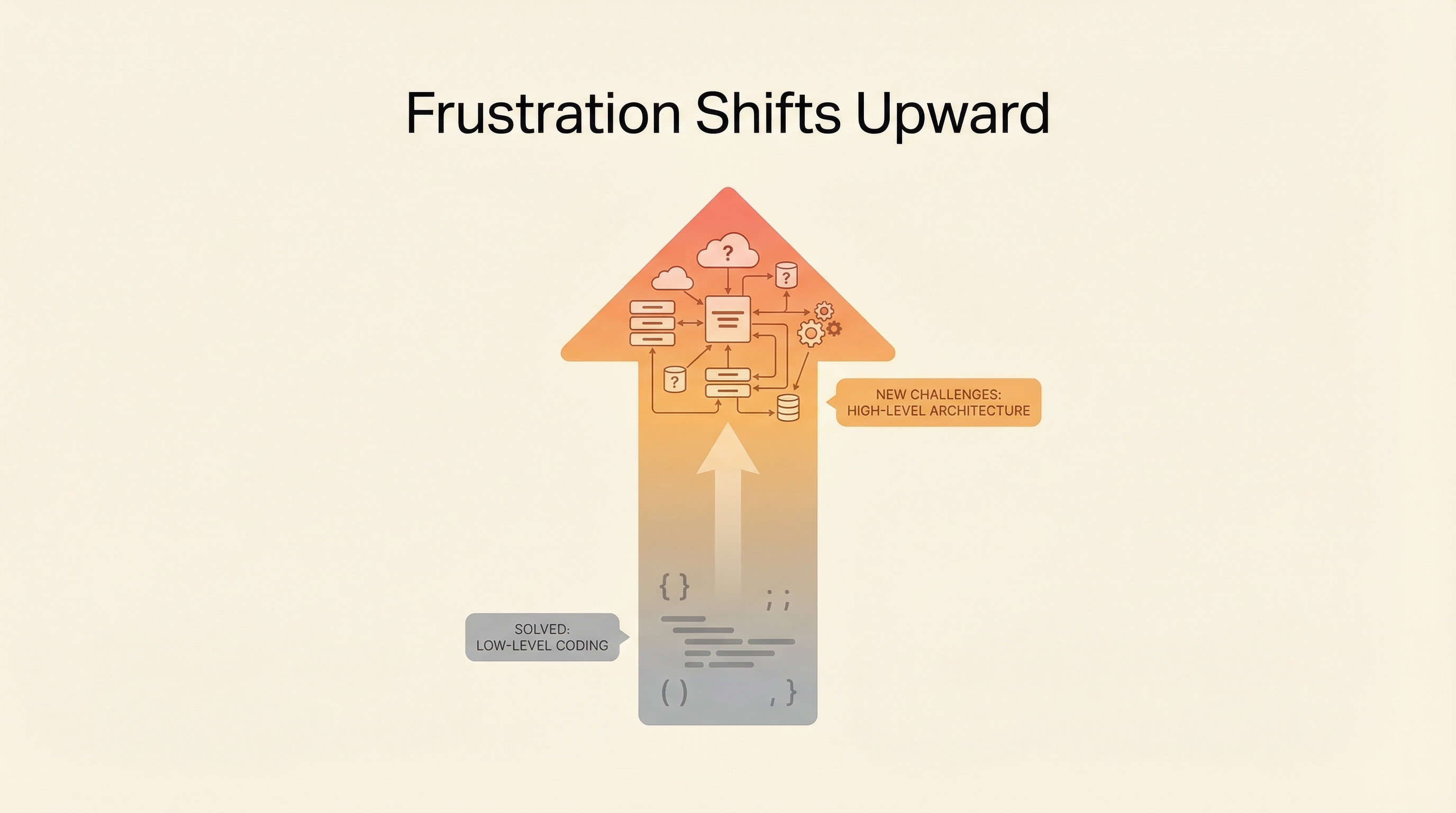
A developer put it bluntly: “AI helps you write code faster, but it also helps you hit architectural problems faster.” The design flaws that used to take a year of experience to encounter? You now hit them in weeks. The micro-frustration of “how do I write this?” is gone — replaced by the macro-frustration of “is this even the right direction?” The Chinese developer community coined a term for this: 挫败感上移 — frustration shifts upward.
| *Source: X post by @snowmaker | MIT Technology Review: AI Coding Is Everywhere | IT Brief: AI Coding Reset Towards Architecture* |
The Shift
Before AI coding:
  Frustration layer: "How do I implement this?"
  Time to hit:      Immediate (every day)
  Skill needed:     Syntax, patterns, libraries

After AI coding:
  Frustration layer: "Is this the right architecture?"
  Time to hit:      Faster than ever (weeks, not years)
  Skill needed:     Systems thinking, diagnosis, strategy
AI didn’t remove difficulty — it moved it. You solve small problems effortlessly now, but you crash into the real problems (architecture, design trade-offs, system integration) much faster because there’s no slow ramp-up period of manual coding to cushion the learning curve.
The Community Insight
The most insightful comment wasn’t the original post — it was the community response. Practitioners converged on a term: “frustration shifts upward” (挫败感上移). This precisely names the experience:
| Old World | New World |
|---|---|
| Stuck on syntax | Stuck on architecture |
| “How do I write this?” | “Should I write this at all?” |
| Frustration at the “how” layer | Frustration at the “why” and “what” layer |
| Skill: coding proficiency | Skill: systems thinking |
| Role: skilled worker | Role: architect / diagnostician |
What This Means for Developers
The requirements for developers are shifting from “skilled worker” (熟练工) to “architect” (架构师) and “diagnostician” (诊断专家):
- Architects design systems, not code. They decide what to build and how the pieces fit together.
- Diagnosticians figure out why things are broken. When AI-generated code fails in production, someone needs to understand the system well enough to find the root cause.
If you’re choosing between getting better at writing code or getting better at thinking about systems — choose systems. The code part is increasingly handled.
The Paradox of AI-Assisted Learning
There’s a subtle trap: if you use AI to write code without understanding the architecture, you’re not learning — you’re just postponing confusion. The article warns:
“If you feel like you’re solving small problems smoothly with AI, but sometimes fall into a deeper maze — like not being sure if the overall direction is right, or spending hours trying to ‘understand’ a complex system AI generated — you’re not stuck, you’ve just moved from the tactical layer to the strategic layer.”
The solution isn’t to stop using AI. It’s to recognize the shift and deliberately invest in the skills that now matter: architecture, trade-off analysis, and the ability to ask “why” before “how.”
For Educators
This has direct implications for CS education. The traditional curriculum front-loads syntax and implementation skills. But if AI handles implementation, the curriculum should front-load:
- Systems thinking — How do components interact?
- Trade-off analysis — Why choose X over Y?
- Diagnostic reasoning — What went wrong and why?
- Specification writing — How do you clearly define what to build?
The skills that used to come from years of experience now need to be explicitly taught, because students won’t develop them organically through manual coding practice.
How LearnAI Team Could Use This
- Curriculum design — shift AI-coding instruction from syntax completion toward architecture, debugging, and trade-off reasoning.
- Workshop framing — help learners understand why AI removes some coding friction while exposing harder system-design questions sooner.
- Assessment design — evaluate students on specifications, diagnosis, and architectural justification instead of only implementation output.
- Faculty development — give instructors language for explaining why AI-assisted coding still requires deep technical judgment.
Real-World Use Cases
- Junior developer onboarding — teams can pair AI coding tools with architecture reviews so new developers learn system boundaries, not just code generation.
- CS classrooms — instructors can ask students to critique AI-generated designs before implementing features.
- Engineering training — bootcamps can teach debugging, observability, and design review as core AI-era skills.
- Project planning — teams can use AI to accelerate prototypes while explicitly budgeting time for integration and architecture decisions.