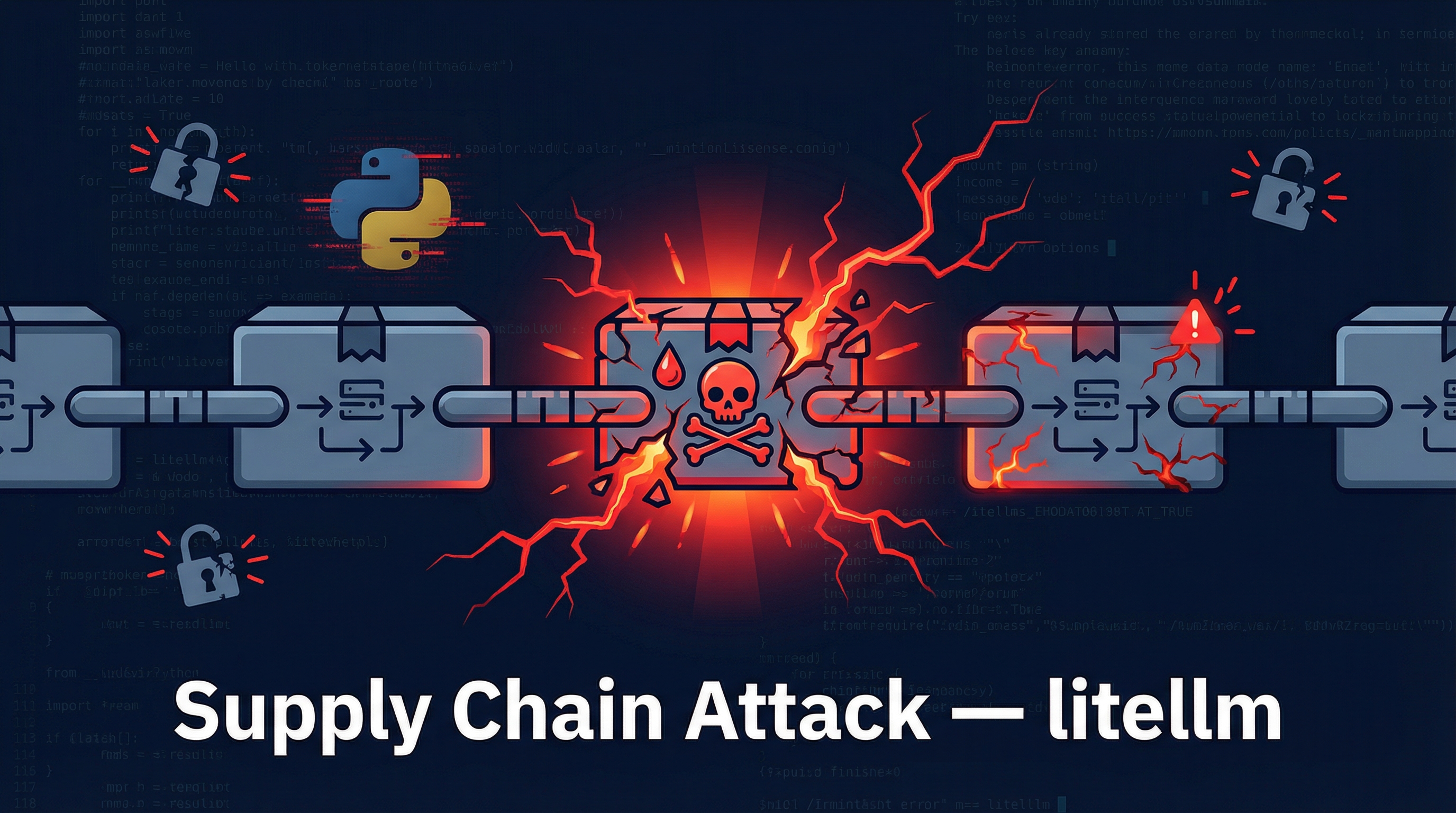
On March 24, 2026, one of the most widely-used Python libraries in the AI ecosystem — litellm (97M downloads/month, 40K+ GitHub stars) — was poisoned with credential-stealing malware on PyPI. The attack was live for about 3 hours. Andrej Karpathy called it “basically the scariest thing imaginable in modern software.” If the attacker hadn’t accidentally introduced a bug that crashed machines, it could have gone undetected for days or weeks.
| *Source: FutureSearch: litellm PyPI Supply Chain Attack | Snyk: How a Poisoned Security Scanner Backdoored LiteLLM | Kaspersky: Trojanization of Trivy, Checkmarx, and LiteLLM | litellm Security Update* |
What Happened
The Kill Chain
March 19: TeamPCP compromises Trivy (security scanner)
    │      ↓ steals PyPI tokens via Trivy's CI/CD
March 23: TeamPCP compromises Checkmarx KICS
    │      ↓ lateral movement through stolen credentials
March 24: TeamPCP publishes poisoned litellm to PyPI
    │
    ├── 10:39 UTC: litellm 1.82.7 (malicious source injection)
    ├── 10:52 UTC: litellm 1.82.8 (malicious .pth file)
    │
    ~3 hours later: PyPI quarantines the package
Two Different Attack Vectors
| Version | Technique | Trigger |
|---|---|---|
| 1.82.7 | Base64-encoded payload in proxy_server.py |
Fires when anything imports litellm.proxy |
| 1.82.8 | litellm_init.pth file in site-packages |
Fires on every Python process start — no import needed. Even pip, python -c, or IDE language servers trigger it |
The .pth technique is especially terrifying: it runs automatically every time Python starts, creating a fork-bomb-like effect that’s nearly impossible to avoid once installed.
What the Malware Stole
The malicious code systematically collected everything on the host:
- SSH keys
- AWS/GCP/Azure cloud credentials
- Kubernetes configs
- Environment variables (all your API keys)
- Shell history
- Crypto wallets
- SSL private keys
- CI/CD secrets
- Database passwords
All collected data was encrypted and sent to attacker-controlled domains. In Kubernetes environments, the malware also deployed privileged pods on every node for lateral spread across the entire cluster.
How It Was Discovered
The attacker made a mistake. The .pth file in version 1.82.8 triggered on every Python subprocess, creating exponential process spawning — essentially a fork bomb. Callum McMahon at FutureSearch was using an MCP plugin in Cursor that pulled litellm as a transitive dependency. When 1.82.8 installed, his machine ran out of RAM and crashed.
Without this bug, Karpathy noted:
“If the attacker didn’t vibe code this attack, it could have been undetected for many days or weeks.”
The Silencing Attempt
After community members reported the issue on GitHub (#24512):
- Within 102 seconds, the attacker used 73 stolen accounts to post 88 spam comments to bury the discussion
- Then used a stolen maintainer account to close the issue entirely
- The community had to open a new issue and move discussion to Hacker News
Why This Is So Dangerous
litellm is the unified API proxy that lets you call any LLM (OpenAI, Anthropic, Google, etc.) through one interface. 2,000+ packages depend on it, including DSPy, MLflow, and Open Interpreter.
You install Tool X
    └── Tool X depends on Framework Y
            └── Framework Y depends on litellm
                    └── litellm 1.82.8 installs
                            └── Every Python process now steals your credentials
You may never have typed pip install litellm — but if any tool in your dependency tree depends on it, you were vulnerable.
What To Do Right Now
# Check if litellm is installed and which version
pip show litellm

# Safe version: 1.82.6 (last clean release)
# Compromised: 1.82.7 or 1.82.8
If you had 1.82.7 or 1.82.8 installed at any point:
- Assume all credentials on that machine are compromised
- Rotate all API keys, SSH keys, cloud credentials immediately
- Check Kubernetes clusters for unauthorized privileged pods
- Review CI/CD pipeline logs for unusual activity
- Scan all systems reachable from the compromised machine
Karpathy’s Takeaway
Karpathy used this incident to reinforce his growing skepticism of dependency culture:
“Supply chain attacks are the scariest thing in modern software. Every time you install a dependency, you could be pulling a poisoned package deep inside its dependency tree.”
His recommendation: increasingly prefer using LLMs to generate simple functionality as code rather than importing external dependencies. When it’s simple enough and possible, write it yourself — or have your AI write it — instead of adding another link to the supply chain.
“Classical software engineering would have you believe that dependencies are good (we’re building pyramids from bricks), but this has to be re-evaluated.”
How LearnAI Team Could Use This
- Add dependency-risk checks to internal AI tooling reviews before adopting new packages.
- Use the incident as a training example for supply-chain security in AI workflows.
- Build guidance for pinning versions, auditing transitive dependencies, and rotating exposed credentials after suspected compromise.
Real-World Use Cases
- Engineering teams can audit whether compromised litellm versions were installed directly or transitively.
- Security teams can use the incident to update credential rotation and CI/CD incident-response playbooks.
- AI product teams can reassess dependency policies for LLM gateways, agent frameworks, and developer tools.