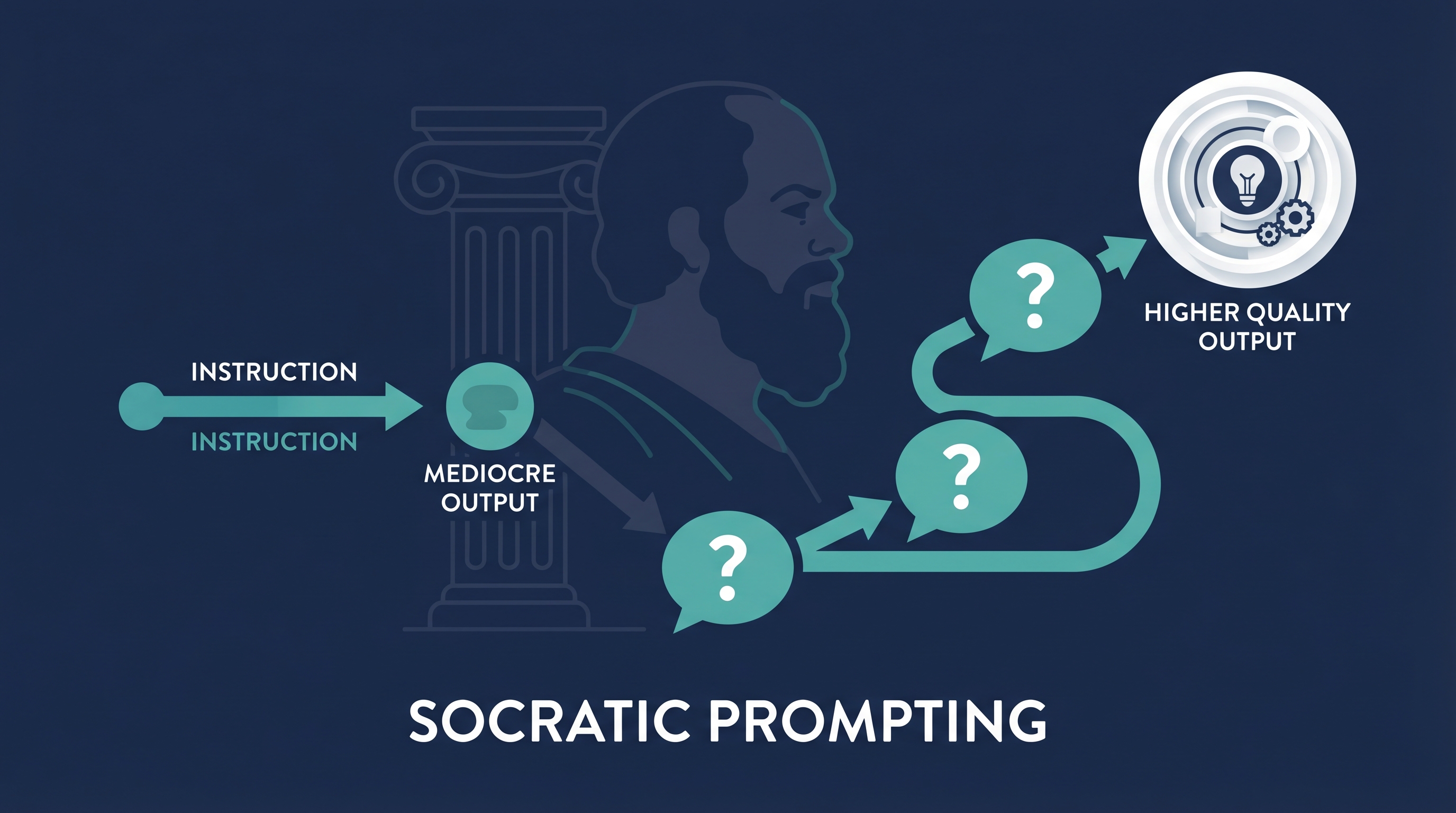
Direct instructions activate an LLM’s completion mode — it fills in the blanks with plausible defaults. Questions activate its reasoning mode — it examines premises before producing output. Socratic prompting is the systematic application of this insight: instead of telling the AI what to do, you ask it questions that force it to think first. Amazon Science found this approach helped models solve 74% of problems they initially failed. Practitioners report going from 3-4 correction cycles down to 0-1 per task.
| *Source: Chang 2023 — arXiv | Amazon SoHF | SOCREVAL (NAACL 2024) | SocraticLM (NeurIPS 2024)* |
The 6 Types of Socratic Questions (Applied to LLMs)
Each type forces the model out of “plausible default” mode in a different way:
1. Clarification — Remove Ambiguity
I want to improve my app's performance. Before suggesting anything,
ask me: What kind of app? What metric defines "performance"?
What's the current baseline? What's the target?
2. Assumption-Probing — Surface Hidden Beliefs
I think microservices will solve our scaling problems. Act as a
Socratic questioner: what assumptions am I making? Challenge each
one. What if the opposite were true?
3. Evidence and Reasoning — Demand Justification
You recommended React for this project. Walk me through your
reasoning chain. What evidence supports React over alternatives?
Label each point as fact vs. inference.
4. Perspective — Break Single-View Thinking
I'm considering a NoSQL database. Present the strongest case FOR it,
then the strongest case AGAINST it, then the strongest case for a
third option I haven't considered. Steelman all three.
5. Implication — Map Second-Order Effects
We're switching from REST to GraphQL. Don't just list pros/cons.
Walk through: what breaks immediately? What improves in 3 months?
What new problems emerge in a year? Who on the team is most affected?
6. Meta-Questions — Challenge the Question Itself
I asked "how do I make my API faster?" But before answering: is that
the right question? Reframe into 3 better versions, explain why each
is better, then answer the best one.
5 Real-World Use Cases: Before vs. After
1. Code Generation (MediatR Handler)
| Prompt | Result | |
|---|---|---|
| Before | “Create a MediatR handler to create a new product.” | Wrong assumptions about DbContext, validation, DTOs. 3-4 correction cycles. |
| After | “I need a MediatR handler. Before writing code, ask me questions one at a time. Present options as A/B/C tables.” | AI asks 4-5 quick questions (user just picks A/B/C). Code is 99% correct on first try. |
Source: Dan Does Code
2. Writing and Content Strategy
| Prompt | Result | |
|---|---|---|
| Before | “Write a blog post about renewable energy trends.” | Generic, one-sided, forgettable. |
| After | “I want to write about renewable energy for industry professionals. Ask me questions before you write.” | AI asks about audience level, relevant sectors, contrarian positions. Output reflects actual expertise. |
Source: The AI Corner - Claude Best Practices 2026
3. Decision-Making
| Prompt | Result | |
|---|---|---|
| Before | “I’m overwhelmed with AI news. How should I manage my time?” | Standard productivity advice (Pomodoro, time-blocking). |
| After | “Don’t give me solutions. Act as Socratic questioner. Challenge my assumptions. One question at a time.” | Discovered the real problem: an unchecked assumption that comprehensive coverage was necessary. Led to strategy pivot. |
Source: Wyndo/AI Maker
4. Debugging
| Prompt | Result | |
|---|---|---|
| Before | “My API returns 500 errors intermittently. Fix it.” | Scattershot guesses at common causes. |
| After | “Don’t suggest fixes. Ask diagnostic questions one at a time. After each answer, tell me what that eliminates.” | Structured elimination: “Only under load” → eliminates null refs → narrows to connection pool. Root cause in 3 exchanges. |
5. Learning a New Codebase
| Prompt | Result | |
|---|---|---|
| Before | “Explain how the auth module works.” | Wall of text. Passive reading. Low retention. |
| After | “Teach me via Socratic method. Ask leading questions. If I’m wrong, don’t tell me the answer — ask a question that reveals why.” | Active learning. Deep retention. Works across Claude, Mistral, ChatGPT. |
Source: koaning.io / Vincent Warmerdam
Step-by-Step Practical Guide
The Universal Template
I want to [TASK] so that [SUCCESS CRITERIA].

Before executing:
1. Ask me clarifying questions — ONE AT A TIME
2. Wait for my answer before asking the next
3. If there are options, present them as A/B/C table
4. After gathering answers, restate the problem + list assumptions
5. Show me your plan before executing
6. Only then, produce the output
Critical rule: Always say “one at a time.” Without this, the LLM dumps 10+ questions and kills the flow.
4 Ready-to-Use Prompt Templates
Task Execution:
I want to [TASK] so that [SUCCESS CRITERIA].
Ask me questions before you execute. One at a time.
After my answers, state your assumptions. Show plan. Then execute.
Critical Thinking Partner:
Act as a Socratic Sparring Partner. Challenge my assumptions about [TOPIC].
One question at a time. Don't agree prematurely. Demand evidence.
Learning Tutor:
Teach me [SUBJECT] using the Socratic method. Ask questions, don't explain.
Wait for my response. Guide me to discover the answer myself.
Debugging:
[ERROR CONTEXT]. Don't suggest fixes. Ask diagnostic questions one at a
time. After each answer, tell me what that eliminates. Narrow to root
cause before suggesting any fix.
Measured Results
| Study | Finding |
|---|---|
| Amazon SoHF | Socratic feedback → models solved 74% of problems they initially failed |
| SOCREVAL (NAACL 2024) | GPT-4 correlation with human judgment: 0.40 → 0.58 (+45%) |
| Maieutic Prompting | Up to 20% better accuracy than SOTA prompting |
| SocraticLM (NeurIPS 2024) | “Significantly outperforms GPT-4” on teaching tasks |
| Practitioners | Code generation: 3-4 correction cycles → 0-1 |
Software Engineering Patterns
Architecture Decisions
I'm designing the data layer for an e-commerce platform.
Act as senior architect using Socratic method:
- Ask about requirements, challenge assumptions about scale
- Help me discover the right architecture through dialogue
- Don't recommend anything until I've thought through tradeoffs
Code Review as Learning
Here are 4 code files. Focus on API call patterns.
Use the Socratic method: ask guiding questions, challenge assumptions,
help me develop deeper understanding through dialogue.
System Prompt for AI Copilots
Add to your CLAUDE.md or copilot-instructions.md:
When the user gives a vague coding request:
1. Ask clarifying questions before generating code
2. Present architectural options in a table (A/B/C)
3. Ask ONE question at a time, wait for the answer
4. State assumptions explicitly, then generate code
Classroom Applications
AI as Socratic Tutor (Scalable Office Hours)
You are a tutor for [COURSE]. When a student asks a question:
- Do NOT give the answer directly
- Ask a guiding question that helps them discover it
- If stuck, give one small hint, then ask another question
- Only reveal the answer after 3 genuine attempts
- Praise reasoning process, not just correct answers
Student Prompt-and-Critique Exercise
- Student develops a prompt about a course topic
- AI generates a response
- Student applies Socratic questioning TO the AI’s response:
- “What assumptions is this answer making?”
- “What evidence would contradict this?”
- “What perspective is missing?”
- Student writes critique with supporting evidence
Ethical Discussion Facilitation (NSTA Four-Stage Model)
- Generate dilemmas — “Create a scenario about AI predicting disease risk with racial bias”
- Set norms — Students must distinguish human vs. machine reasoning
- Facilitate — AI as devil’s advocate when discussion stalls
- Assess — Rubric includes “Critical AI Analysis” as a category
Common Mistakes
| Mistake | Fix |
|---|---|
| Asking all questions at once | Say “one at a time, wait for my answer” |
| Being too vague | Provide specific context for the Socratic dialogue |
| Skipping assumptions check | Always add “restate problem + list assumptions” before output |
| Bailing too early | Commit to 3-5 exchanges minimum |
| Using for trivial tasks | Reserve for complex decisions, debugging, learning |
| Confusing with chain-of-thought | CoT clarifies reasoning; Socratic challenges premises |
| One-directional only | Best results: AI questions YOU and you question AI (bidirectional) |
How LearnAI Team Could Use This
- AI literacy curriculum — The 6 question types map to a 6-session workshop on effective AI interaction. Each session practices one type with hands-on exercises.
- Student coding with AI — Add the “System Prompt for AI Copilots” to student project CLAUDE.md files. Forces Claude to ask before assuming.
- Scalable office hours — Deploy the Socratic Tutor prompt for course chatbots. Students learn reasoning, not just answers.
- Research methodology — “What makes a strong literature review? What criteria separate comprehensive from superficial? Now review these 10 papers.” Produces rigorous output.
- Faculty development — Teach colleagues the three-step framework (theoretical → framework → application) for their own AI interactions.
- Critical thinking assessment — The student prompt-and-critique exercise is a ready-made assignment for any course using AI.
Real-World Use Cases
- Any knowledge worker — The three-step framework works immediately with ChatGPT, Claude, or any LLM. Zero setup.
- Google DeepMind LearnLM — Uses Socratic prompting in UK classroom AI tutoring RCT for student self-correction.
- Amazon code generation — SoHF guided models to solve 74% of initially-failed coding problems through Socratic feedback.
- Consulting — “What does the client actually need? What question should they be asking? What are we assuming about their constraints?” before writing recommendations.
- Medical education — Socratic AI tutors for clinical reasoning — students diagnose through guided questioning instead of pattern matching.