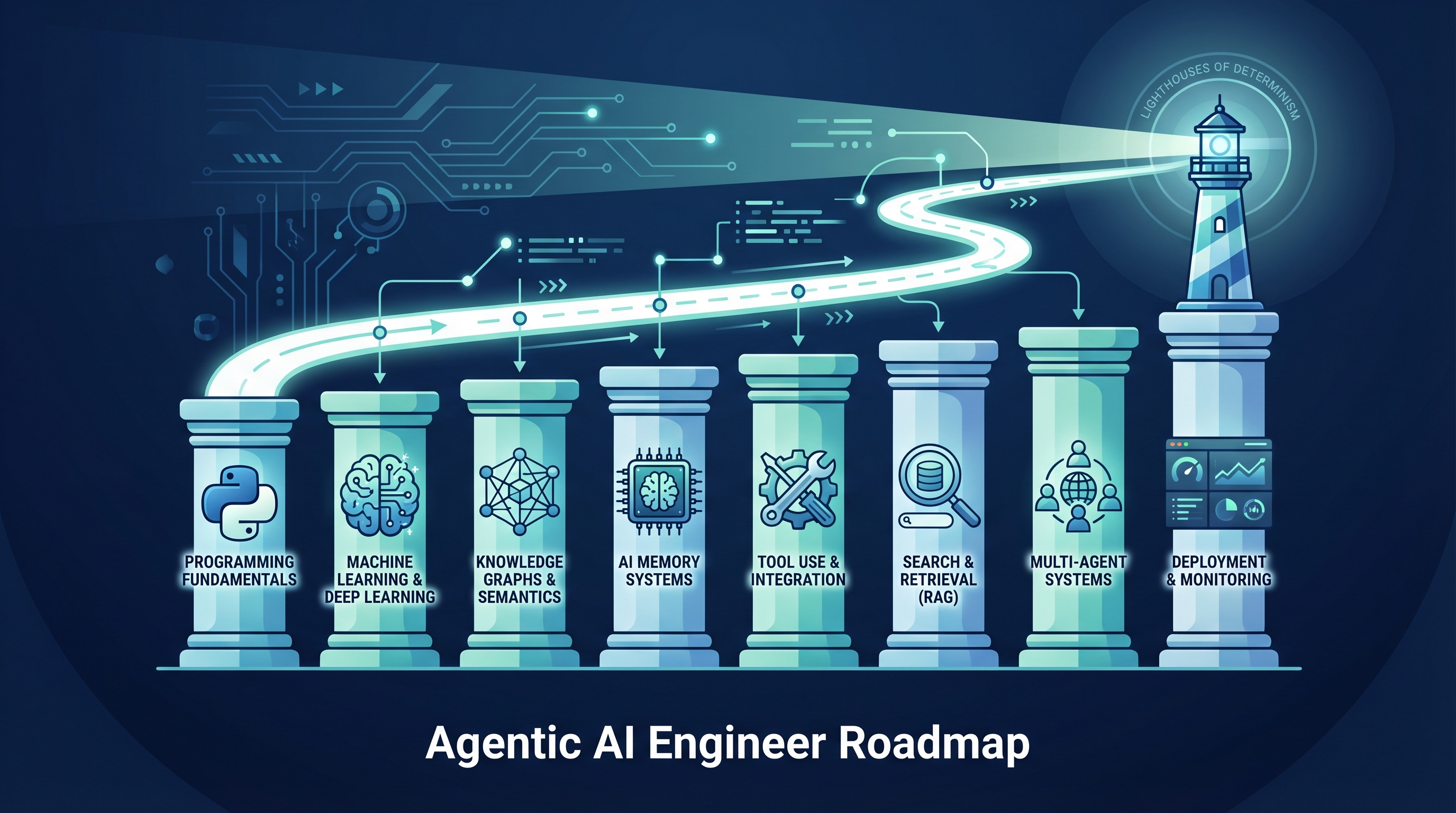
In a field where everyone is chasing the newest model release, the “Roadmap to Become an Agentic AI Engineer in 2026” by Lamhot Siagian takes a different stance: the core competitiveness of an agent engineer isn’t in prompt writing — it’s in building deterministic systems on top of probabilistic foundations. The roadmap identifies 8 pillars, from Python engineering foundations to production observability. It’s a survival guide, not a tech checklist.
| *Source: Google Drive PDF | Lamhot Siagian — AI/ML Engineer, ex-Apple, ex-HP | Shared via Weibo @爱可可-爱生活; add original post URL/date if available.* |
The 8 Pillars
1. Solid Python Engineering Foundations
Agent engineers must be software engineers first. Python isn’t scripting — it’s the foundation for complex systems.
| Skill | Why It Matters |
|---|---|
| Pydantic type validation | Type safety at system boundaries |
| Async/Await + high-concurrency I/O | Agents wait on many external calls |
| Dependency injection | Testable, modular agent components |
Modular architecture (app/, core/, agents/, tools/) |
Prompt and tool logic stand independently |
“Agent failures aren’t because LLMs aren’t smart enough — they’re because the exception handling at the code layer is too fragile.”
2. Rethink LLMs
Stop treating LLMs as magic black boxes. They’re probabilistic reasoning engines.
- Context Budgeting is the lifeline of agent design — learn summarization, compression, and retrieval strategies to keep the most important information in limited windows
- Inference is pattern-based prediction — provide structure, tools, and constraints instead of praying the model “understands”
“In an agent system, you MUST provide structure, tools, and constraints — not just hope the model figures it out.”
3. From Chains to Graphs
2026’s trend: linear chains → stateful graphs.
- LangGraph-style graph orchestration is increasingly common in production agent systems because it models agents as state machines — with cycles, human-in-the-loop, and backtracking
- The biggest anti-pattern: copying demo code directly. The real architecture is your state model, data contracts, and safety rules — frameworks are just implementation tools
4. Agent Long-Term Memory
| Memory Type | Location | Challenge |
|---|---|---|
| Short-term | Context window | Limited size, auto-compaction |
| Long-term | External storage | Recency vs. relevance tradeoff |
“Only store what you can prove is factually correct. Agent memory must NOT become a breeding ground for hallucinations.”
Advanced strategy: for uncertain content, prefer a “don’t store” policy over storing and risking hallucination propagation.
5. Tool Integration Standards
An agent-friendly tool must have:
- Clear name and narrow scope
- Typed input (Schema) and deterministic output
- Safety red line: never let agents execute high-risk operations directly — use Policy Gates, Sandboxing, and human confirmation
6. Industrial-Grade RAG
Simple vector search is the 2024 baseline. 2026 RAG is hybrid retrieval + re-ranking.
- Metadata filtering is the enterprise safety floor — prevents cross-user data leakage
- RAG isn’t just for “supplementing knowledge” — it provides evidence chains for agent decisions. No citations = untrustworthy in production.
7. Multi-Agent Collaboration
When tasks are too complex for one agent → introduce the Supervisor pattern.
- Standardized “intelligence protocol” for inter-agent communication: clear goals, constraints, context
- This reduces communication overhead and allows model swapping without breaking workflows
8. Production Readiness: Observability
The last mile: you can’t improve what you can’t measure.
| Metric | What It Measures |
|---|---|
| Task success rate | Does the agent actually complete tasks? |
| Tool call accuracy | Are the right tools called with correct params? |
| Safety compliance rate | How often does the agent violate rules? |
- Structured logging + chain tracing is the only way to debug “the agent got weird”
- Build automated test sets, not just vibes
“2026’s Agent Engineer is building lighthouses of determinism on beaches of uncertainty.”
How LearnAI Team Could Use This
- AI systems course curriculum — The 8 pillars map directly to 8 weeks of an “AI Agent Engineering” course. Each pillar is a module with clear learning objectives.
- Student project scaffolding — Use the modular architecture pattern (
app/,core/,agents/,tools/) as the required project structure for student agent projects. - Research methodology — The RAG evidence chain concept applies to research tools: every AI-generated claim needs a citation trail. Teach this in AI literacy courses.
- Teaching production thinking — Most CS courses stop at “it works.” This roadmap’s Pillar 8 (observability, testing, tracing) teaches students to think about deployment from day one.
- Program analysis connection — The “determinism on uncertainty” framing connects directly to Q’s research: formal verification of probabilistic systems, type-safe agent interfaces.
Real-World Use Cases
- Career development — Engineers transitioning from ML/data science to agent engineering get a structured skill progression instead of random tutorial hopping.
- Team training — Engineering managers use the 8 pillars as a competency matrix for hiring and upskilling agent teams.
- Architecture reviews — The pillars serve as a checklist: Does our agent system have proper memory? Are tools typed? Is RAG citation-grounded? Is there observability?
- Startup technical due diligence — Investors evaluate agent startups against these 8 pillars to assess engineering maturity.