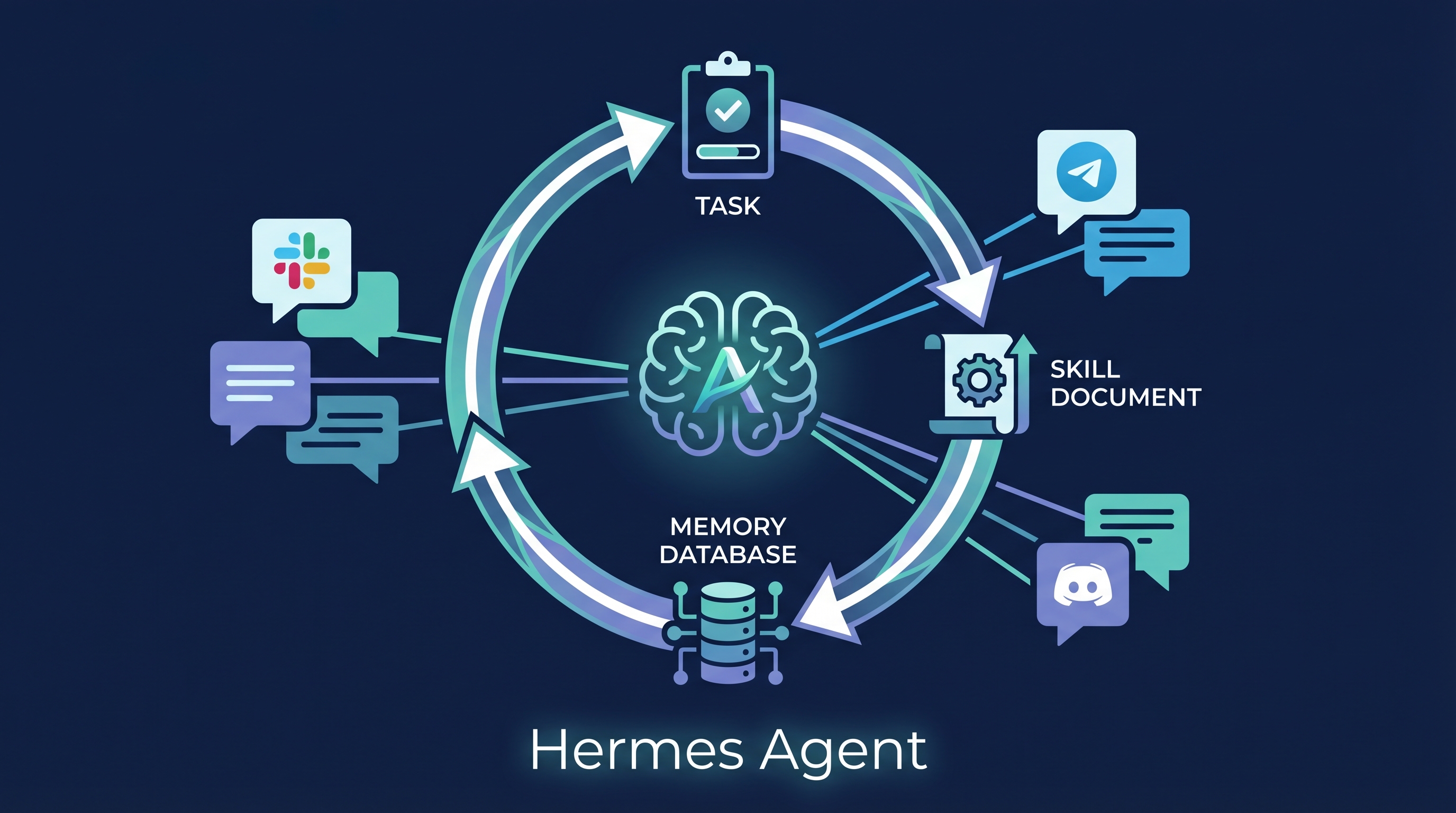
Most AI agents do what you tell them. Hermes Agent does what you tell it, then learns how it did it, writes a reusable skill, and gets faster next time. Built by Nous Research (136k+ GitHub stars, MIT licensed), it’s the first widely-adopted agent with a genuine self-improvement loop — task execution → skill extraction → skill refinement → persistent memory. The key distinction from tools like OpenClaw: “OpenClaw is you directing it; Hermes gets smarter on its own.”
| *Source: GitHub — NousResearch/hermes-agent (136k stars) | Official Docs | NxCode Complete Guide* |
How Self-Improvement Works
  Task → Execute → Extract Skill → Store
   ↑                                  │
   │    Next similar task              │
   └──── Inject skill ← Refine  ←────┘
- Task execution — Agent solves a problem using tools
- Skill extraction — Autonomously writes a reusable skill document capturing the pattern
- Skill injection — On future tasks, matching skills are injected into the system prompt
- Skill refinement — Skills self-improve as the agent encounters edge cases
- Memory persistence — SQLite with FTS5 search; periodic nudges trigger knowledge consolidation
- User modeling — Honcho dialectic modeling builds a deepening profile across sessions
Result: Nous claims 40% faster task completion on repeated research tasks using self-created skills.
Key Features
| Feature | Details |
|---|---|
| Self-improving skills | Auto-generated from completed tasks, refined during use |
| Persistent memory | SQLite/FTS5 + ChromaDB, cross-session recall |
| 15+ platforms | CLI, Telegram, Discord, Slack, WhatsApp, Signal, Matrix, Email, SMS, and more |
| 47 tools | Web search, browser automation, code execution, file ops, vision |
| 200+ models | Via Nous Portal, OpenRouter, OpenAI, and others — no lock-in |
| 6 terminal backends | Local, Docker, SSH, Daytona, Singularity, Modal |
| Cron scheduler | Natural language scheduling for automated tasks |
| MCP integration | Extend via Model Context Protocol servers |
Architecture
┌──────────────────────────────────────────────┐
│              HERMES AGENT                     │
│                                               │
│  ┌────────────┐  ┌──────────┐  ┌──────────┐ │
│  │  Prompt     │  │ Provider │  │   Tool   │ │
│  │  Builder    │  │ Router   │  │ Dispatch │ │
│  │ (persona,   │  │ (18+     │  │ (47 tools│ │
│  │  memory,    │  │ providers│  │  20 sets)│ │
│  │  skills)    │  │  200+    │  │          │ │
│  └──────┬─────┘  │ models)  │  └────┬─────┘ │
│         │        └──────────┘       │        │
│  ┌──────v───────────────────────────v─────┐  │
│  │           Memory Layer                  │  │
│  │  SQLite/FTS5 + ChromaDB + Compression  │  │
│  └────────────────────────────────────────┘  │
│  ┌────────────────────────────────────────┐  │
│  │           Gateway (long-running)        │  │
│  │  15+ platform adapters, session routing │  │
│  └────────────────────────────────────────┘  │
└──────────────────────────────────────────────┘
Hermes vs OpenClaw vs Claude Code
| Dimension | Hermes Agent | OpenClaw | Claude Code |
|---|---|---|---|
| Philosophy | Self-improving autonomy | Breadth of integration | Anthropic’s native CLI |
| Stars | 136k | 358k | N/A (proprietary) |
| Self-improvement | Autonomous skill creation | Manual curation | Project memory (CLAUDE.md) |
| Models | 200+ (any provider) | Multi-model | Claude only |
| Platforms | 15+ messaging channels | 6 channels | CLI only |
| Memory | Multi-level persistent | Per-assistant isolated | Session + CLAUDE.md |
| Cost | Free (MIT) + model API | Free/managed tiers | Subscription |
| Best for | Solo operators, long-term autonomy | Teams, multi-channel | Developers, coding tasks |
Migration from OpenClaw
hermes claw migrate              # Auto-detect and migrate
hermes claw migrate --dry-run    # Preview first
Migrates: persona files, memory, skills, messaging configs, API keys, workspace instructions.
Honest Limitations
- Self-evaluation is unreliable — “It always thinks it did a good job. ALWAYS.” (Reddit, 107 upvotes)
- Auto-skills can overwrite manual ones — User-created skills may be modified by the agent’s refinement loop
- Fast-moving release history — The project is evolving quickly, so setup details and limitations may change between releases
- Smaller ecosystem — Fewer integrations and community tools than OpenClaw
How LearnAI Team Could Use This
- Research assistant that learns — Set up Hermes for a research project. Over weeks, it learns your paper search patterns, citation style, and analysis preferences. The claimed 40% speed gain on repeated tasks could be useful for literature review workflows if it holds in LearnAI’s usage.
- Course content automation — A Hermes agent that generates quiz questions, formats slides, or creates code examples. It learns your course style and gets better each semester.
- Student project mentor — Deploy on Discord/Slack for a course channel. Students ask questions, the agent learns common misconceptions and builds skills to address them proactively.
- Cross-platform teaching — Same agent accessible via Telegram (students), Slack (TAs), and CLI (instructor). Conversation continuity across all channels.
Real-World Use Cases
- Personal research agent — Academics running long-term literature watches. The agent learns which papers are relevant, what to flag, and how to summarize for your specific needs.
- DevOps automation — Deploy monitoring agents that learn from incidents. After seeing the same log pattern twice, the agent auto-creates a skill to handle it.
- Content creation pipeline — Writers using Hermes for research, outlining, and editing. The agent learns their voice and style preferences over time.
- Multi-channel customer support — Small businesses deploy one agent across WhatsApp, Email, and web chat. The agent improves its answers as it handles more queries.