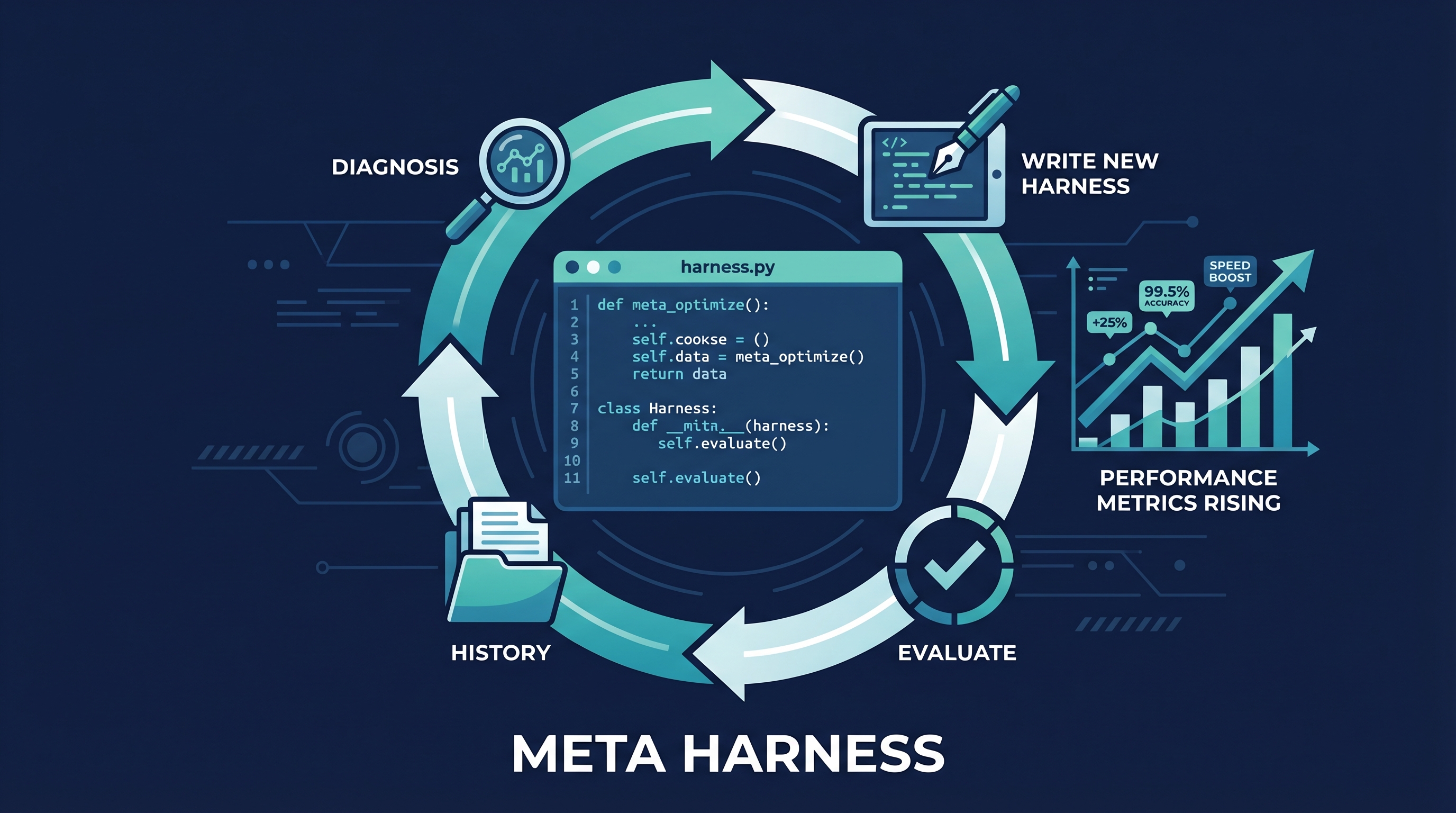
Changing the harness around a fixed LLM can produce a 6x performance gap on the same benchmark. That’s the finding from Stanford and MIT’s Meta Harness paper — and their solution: an agent that reads all prior harness code, scores, and execution traces through a filesystem, then writes a better harness. The result: it beat every human-written harness on TerminalBench-2, used 1/4 the tokens of the previous best, and made a small model (Haiku 4.5) rank #1 in its weight class.
| *Source: arXiv:2603.28052 (Mar 2026) | Project Page | GitHub* |
The Key Insight
Same model + bad harness  = 12% accuracy
Same model + good harness = 76% accuracy
                             ↑
                    6x gap from harness alone
A “harness” is everything wrapping the LLM: prompts, tool calls, context management, retrieval strategy, error handling. Harness engineering matters as much as model selection — yet the community hand-tunes harnesses while spending billions on model training.
How Meta Harness Works
┌─────────────────────────────────────────────┐
│              META HARNESS LOOP              │
│                                             │
│  ┌─────────────┐    ┌──────────────────┐   │
│  │  Filesystem  │    │  Proposer Agent  │   │
│  │              │    │  (Claude Code)   │   │
│  │  All prior:  │───>│                  │   │
│  │  - code      │    │  grep, cat the   │   │
│  │  - scores    │    │  full history    │   │
│  │  - traces    │    │  (10M tokens)    │   │
│  │  (uncompressed)│  │                  │   │
│  └─────────────┘    │  Counterfactual   │   │
│         ↑           │  diagnosis        │   │
│         │           └────────┬─────────┘   │
│         │                    │              │
│         │           ┌───────v────────┐     │
│         │           │ New Harness    │     │
│         │           │ (actual code)  │     │
│         │           └───────┬────────┘     │
│         │                    │              │
│         │           ┌───────v────────┐     │
│         └───────────│  Evaluate on   │     │
│                     │  held-out tasks│     │
│                     └────────────────┘     │
└─────────────────────────────────────────────┘
Critical design: the proposer gets full, uncompressed access to all prior code and traces via filesystem (10M tokens), not compressed summaries. It uses grep and cat like a human developer reviewing prior work.
Results
| Benchmark | Meta Harness | Previous Best | Improvement |
|---|---|---|---|
| Text Classification (avg) | 48.6% | ACE: 40.9% | +7.7 points |
| Token usage (vs ACE) | 1/4 of ACE | — | 4x cheaper |
| IMO-level math (pass@1) | +4.7 points | BM25 baseline | Transfers across 5 models |
| TerminalBench-2 (Opus 4.6) | 76.4% | All human harnesses | #1 overall |
| TerminalBench-2 (Haiku 4.5) | 37.6% | All Haiku agents | #1 in weight class |
The small model result is the most striking: an optimized harness made a cheap model beat expensive models with hand-written harnesses.
Why This Matters
| Implication | Detail |
|---|---|
| Harness > Model | 6x gap from harness alone. Community under-invests in scaffolding vs. model training. |
| Self-improving infrastructure | AI systems that optimize their own tooling, not just solve end tasks (Karpathy’s autoresearch vision). |
| Small models punch up | Haiku 4.5 + Meta Harness = #1 in weight class. Optimized harness substitutes for larger models. |
| Transferability | IMO math harness discovered with one model improved accuracy across 5 different models. |
| One-time cost | Search uses 10M tokens/iteration, but the resulting harness is cheaper to run than alternatives. |
Authors
| Author | Affiliation |
|---|---|
| Yoonho Lee | Stanford IRIS Lab |
| Roshen Nair | Stanford |
| Qizheng Zhang | Stanford |
| Kangwook Lee | KRAFTON |
| Omar Khattab | MIT |
| Chelsea Finn | Stanford |
How LearnAI Team Could Use This
- Research seminar paper — This is a must-read for anyone studying AI agents. The 6x harness gap finding alone is worth a full class discussion. Directly connects to Q’s harness engineering wiki entries.
- Student research projects — Students can replicate the text classification experiment: write multiple harnesses for the same model, measure the performance gap. Teaches that infrastructure matters.
- Cost optimization — The finding that optimized harnesses make small models competitive means the team can use cheaper models (Haiku) with better scaffolding instead of paying for Opus on every task.
- Program analysis connection — Meta Harness’s “counterfactual diagnosis across execution traces” is essentially program analysis applied to agent behavior. Directly relevant to Q’s research.
- Teaching meta-optimization — The concept of “an agent that improves the agent” is a powerful teaching example for AI systems courses. Where does the optimization loop end?
Real-World Use Cases
- Enterprise harness optimization — Companies running AI agents at scale can use Meta Harness to automatically discover better scaffolding, reducing costs while improving quality.
- Benchmark competitions — Teams competing on TerminalBench, SWE-bench, etc. can use Meta Harness to search the harness space instead of manually tuning prompts.
- Model evaluation — The 6x harness gap means benchmark results without controlling for harness quality are unreliable. Meta Harness provides a way to normalize this.
- AutoML for agents — Just as AutoML optimizes model hyperparameters, Meta Harness optimizes agent infrastructure. The next logical step in the “agents that build agents” trajectory.