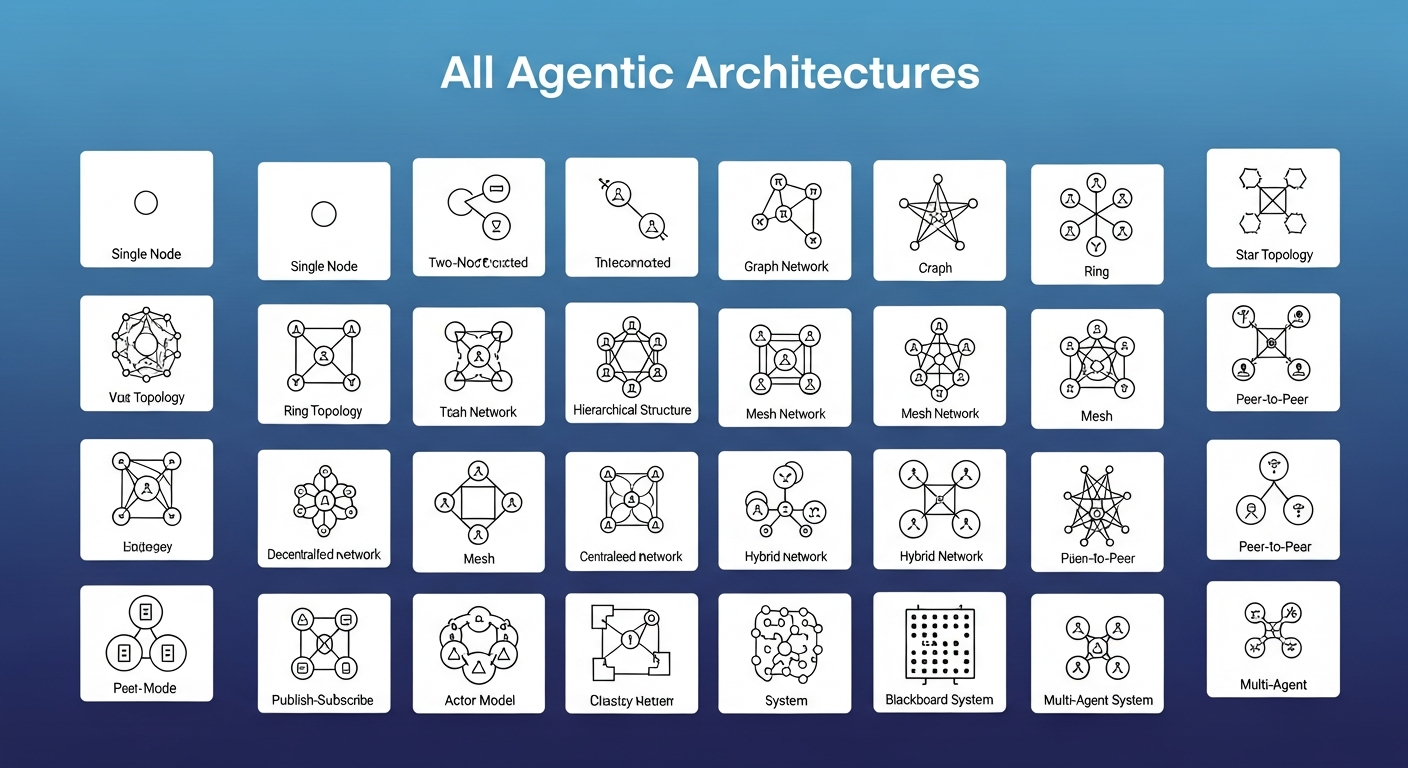
The hands-on lab companion to every conceptual overview of agent design. Where most guides tell you what the patterns are, this GitHub repo makes you run them — 17+ agentic architectures implemented as standalone Jupyter Notebooks using LangChain and LangGraph, progressing systematically from single-agent fundamentals to multi-agent collaboration to reliability and security.
Primary source: FareedKhan-dev/all-agentic-architectures (GitHub). Secondary source: Weibo post by 蚁工厂 (May 2026) — used for discovery only; all content details verified against the GitHub repo.
How this entry relates to “7 Agent Architectures”: The wiki already has a conceptual overview of 7 architecture patterns (see 7 Agent Architectures — From Single Agent to Enterprise Graph Workflows). That entry is the map. This entry is the lab kit — a runnable codebase covering 17+ patterns that the conceptual entry can only sketch in diagrams. Notably, the seven-architectures entry already cites this GitHub repo in its source line; readers arriving from there should continue here for the implementation depth.
What the Repo Contains
The project provides a structured, progressive learning path through the landscape of agentic AI design. Each architecture lives in its own Jupyter Notebook with three consistent sections:
- Core Concepts / TDLR — a plain-language explanation of what the architecture does and why
- Use Case Examples — concrete scenarios where this pattern fits
- Key Notebook Implementation — runnable LangChain/LangGraph code you can execute and modify
The entire stack is built on LangChain and LangGraph. Setup requirements vary by notebook — some require only an LLM API key, while others need accounts for external services such as Nebius (LLM provider), Tavily (web search), Neo4j (graph database), FAISS (vector store), and LangSmith (tracing). pygraphviz is optionally required for graph visualization. Check each notebook’s requirements section before running.
The Progression: From Single-Pass to Complex
The notebooks are deliberately sequenced to build intuition before complexity:
Phase 1: Single-Agent Fundamentals (early notebooks)
  ├── Reflection         — agent reviews and critiques its own output
  ├── Tool Calling       — agent selects and invokes external tools
  └── ReAct Planning     — reason-then-act loop with observation

Phase 2: Multi-Agent Collaboration (selected notebooks incl. 5, 7, 11, 13)
  ├── Orchestrator + Workers
  └── Shared state / blackboard patterns

Phase 3: Reliability & Advanced Patterns (later notebooks)
  ├── Error recovery and retry logic
  └── Human-in-the-loop gates
Note: Multi-agent notebooks are not a contiguous block — they appear at notebooks 5, 7, 11, and 13 among the 17 total. Consult the GitHub README for the current, authoritative notebook list.
The “moves from single-pass to complex” arc is intentional: you can stop at Phase 1 for a complete intro course, or run all notebooks as a full practitioner curriculum.
Architecture Patterns Covered
| Phase | Pattern | Core Idea |
|---|---|---|
| Fundamentals | Reflection | Agent self-critiques and iterates on output |
| Fundamentals | Tool Calling | Dynamic selection and invocation of external tools |
| Fundamentals | ReAct | Interleaved reason → act → observe cycles |
| Multi-Agent | Orchestrator + Workers | Supervisor dispatches to specialized agents |
| Multi-Agent | Shared State | Blackboard pattern — agents read/write a common store |
| Reliability | Error Recovery | Retry loops, fallbacks, graceful degradation |
| Reliability | Human-in-the-Loop | Gates where humans review before the agent continues |
The repo covers 17 notebooks total. The table above lists patterns confirmed in the repo; consult the GitHub README for the full, current notebook list.
Why LangChain + LangGraph
The choice of LangChain/LangGraph is pedagogically deliberate:
- LangChain provides a uniform abstraction for tool-calling, memory, and model interfaces — so each notebook teaches the pattern, not framework-specific boilerplate.
- LangGraph models agent control flow as a state graph — nodes are agent steps, edges are transitions — making the architecture’s structure visible in the code rather than implicit.
- Both are open-source and widely documented, making them practical choices for learning and experimentation in agentic AI work.
How LearnAI Team Could Use This
- Lab assignments — assign one notebook per week as the practical counterpart to a conceptual lecture. “Today we learned about ReAct — tonight you run notebook 3 and modify the observation loop.” The self-contained format means zero environment setup drama.
- Architecture comparison project — assign students to implement the same task (e.g., research a topic and write a summary) in three different architectures from the repo. Have them measure and compare token cost, latency, reliability, and output quality.
- Capstone scaffolding — students building agent systems for a course project can browse the repo as an architecture menu and select the pattern closest to their use case, then fork and adapt.
- Live demo material — a professor can run one notebook live in class to make an architecture tangible in a way no slide can. Runtime varies by notebook and API latency.
- Self-paced learner track — the repo’s own structure (Phase 1 → 2 → 3) is a ready-made syllabus for learners who want to go from zero to multi-agent in one weekend.
Real-World Use Cases
| Scenario | How to use |
|---|---|
| Engineering onboarding | New team members run Phase 1 notebooks to ground shared vocabulary before touching production agent code |
| Architecture selection | Before committing to a design, prototype the candidate patterns using the repo’s notebooks and compare behavior empirically |
| Research baseline | Academic papers on agent architectures can reference these notebooks as implementation examples; verify reproducibility independently before citing as experimental baselines |
| Workshop curriculum | A one-day “Agentic AI” workshop can assign notebooks 1, 3, 5, and one Phase 3 notebook — covering fundamentals to reliability in four hands-on blocks |
| Interview prep | Engineering candidates can work through the repo to demonstrate understanding of multi-agent design beyond theoretical knowledge |
| Corporate training | L&D teams can license or adapt the structured progression for internal AI upskilling programs |
Important Things to Know
- LangChain/LangGraph evolve fast — breaking API changes are common; pin dependency versions when running notebooks in a course setting to avoid student frustration mid-assignment.
- Each notebook is self-contained — but they share a common conceptual vocabulary. Running them out of order is possible but the Phase 1 → 2 → 3 sequence is the intended path.
- 17+ is a floor, not a ceiling — the repo is actively maintained; the pattern count may grow. Check the GitHub README for the current notebook list before syllabus planning.
- LangGraph’s graph model is a teaching tool — the visual state graph it produces helps students see the architecture in addition to reading it. Encourage students to render and inspect the graph for each notebook.
- “Moves from single-pass to complex” is the key insight — the repo’s sequencing teaches that complexity should be earned, not assumed. This maps directly to the selection guide in the seven-architectures entry.
Links
- GitHub Repo: FareedKhan-dev/all-agentic-architectures
- Conceptual overview of 7 patterns: 7 Agent Architectures — From Single Agent to Enterprise Graph Workflows
- LangGraph documentation: langchain-ai.github.io/langgraph
- LangChain documentation: python.langchain.com