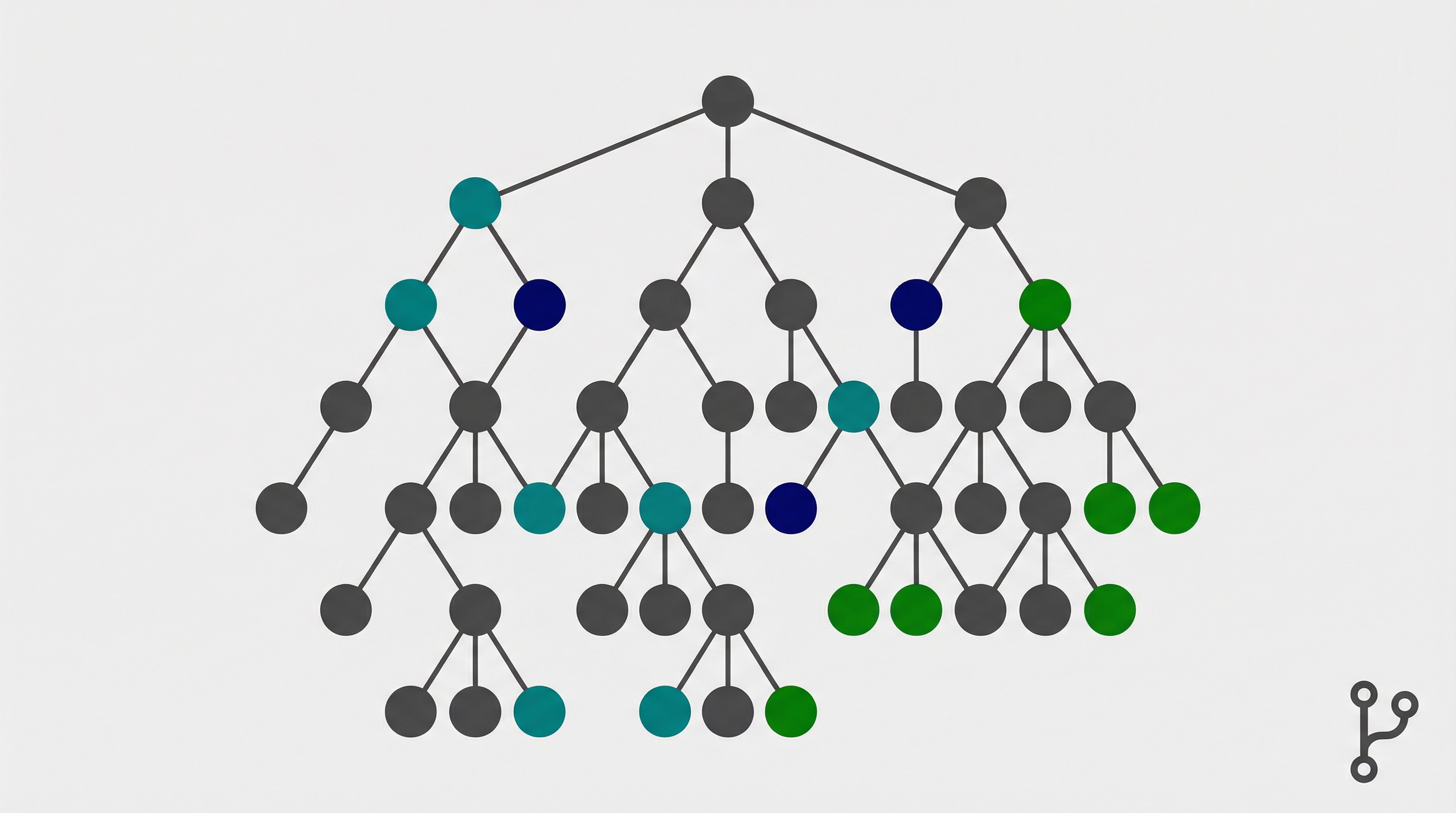
Today I learned about Beads — a distributed, git-backed graph issue tracker built specifically for AI coding agents. Instead of flat markdown files for memory, it gives agents a structured dependency graph so they can manage complex, long-running tasks without losing context.
Source: Beads GitHub Repository
The Problem with Markdown Memory
Tools like CLAUDE.md and todo lists store agent memory as flat text. This works for simple tasks, but breaks down when:
- Tasks have dependencies — what’s blocked? what’s ready?
- Multiple agents work in parallel — merge conflicts on the same markdown file
- Sessions run long — the context window fills up with stale completed tasks
- You need to understand relationships between tasks, not just a bullet list
How Beads Solves This
Beads replaces flat text with a dependency-aware graph stored as JSONL files in a .beads/ directory, versioned by git alongside your code.
| Markdown Memory | Beads (Graph) | |
|---|---|---|
| Structure | Flat text, unordered | Dependency graph with typed relationships |
| Task readiness | Figure it out manually | bd ready auto-detects unblocked tasks |
| Multi-agent | Conflicts when agents edit same file | Hash-based IDs (bd-a1b2) prevent collisions |
| History | Overwritten or appended | Full git-versioned audit trail |
| Context decay | Context window fills up | Compaction summarizes old closed tasks |
| Relationships | None | relates_to, duplicates, supersedes, replies_to |
Getting Started
Install
npm install -g @beads/bd    # npm
brew install beads          # Homebrew
go install github.com/steveyegge/beads/cmd/bd@latest  # Go
Initialize in Your Project
bd init          # Standard — commits to repo
bd init --stealth      # Local only, nothing committed
bd init --contributor  # Routes planning to separate repo
Core Commands
bd ready                       # Show tasks with no blockers (JSON output)
bd create "Refactor auth" -p 0 # Create a priority-0 task
bd update bd-a1b2 --claim      # Atomically claim a task
bd dep add bd-c3d4 bd-a1b2     # bd-c3d4 is blocked by bd-a1b2
bd show bd-a1b2                # View task details + change history
The key command is bd ready — it queries the graph and returns only tasks whose dependencies are all resolved. Agents can call this programmatically (JSON output) to decide what to work on next.
Hierarchical Task Structure
Beads supports epics, tasks, and subtasks:
bd-a3f8          (Epic: Redesign auth system)
├── bd-a3f8.1    (Task: Migrate to JWT)
│   ├── bd-a3f8.1.1  (Subtask: Update token generation)
│   └── bd-a3f8.1.2  (Subtask: Add refresh token flow)
└── bd-a3f8.2    (Task: Update middleware)
Dependencies between any level — a subtask can block an epic in a different branch of the tree.
Context Window Management: Compaction
Long-running projects accumulate hundreds of completed tasks. Beads addresses this with compaction — semantic summarization of closed tasks. The agent retains the key decisions and outcomes without carrying the full verbose history in its context window.
This is similar to how Claude Code’s /rewind summarize option works, but applied to the task graph rather than conversation history.
Why This Matters for Multi-Agent Workflows
When multiple agents (or agent teams) work on the same project:
- Atomic claiming (
--claim) prevents two agents from grabbing the same task - Hash-based IDs eliminate merge conflicts when agents commit simultaneously
- Dependency resolution means Agent B automatically sees its task become ready when Agent A finishes the blocker
- Git-backed means everything is branchable, mergeable, and auditable
Workflow Modes
| Mode | Command | Use Case |
|---|---|---|
| Standard | bd init |
Full tracking, committed to repo |
| Stealth | bd init --stealth |
Personal use, no commits to main repo |
| Contributor | bd init --contributor |
Routes plans to ~/.beads-planning, keeps PRs clean |
When to Use Beads vs Plain Markdown
Use Beads when:
- The project has many interdependent tasks
- Multiple agents or team members work in parallel
- Tasks span days or weeks (long-horizon work)
- You need to query “what’s ready to work on?” programmatically
Stick with markdown when:
- Tasks are simple and sequential
- You’re working solo on short sessions
- The overhead of a graph tracker isn’t justified
How LearnAI Team Could Use This
- Agent workflow curriculum — Use Beads to teach why long-running AI work needs structured memory, dependencies, and task readiness instead of flat todo lists.
- Multi-agent demos — Show students how dependency graphs and atomic claiming prevent duplicated work when several agents operate in parallel.
- Capstone project management — Have learners model project plans as graph-backed issues so AI agents can pick unblocked tasks programmatically.
- Tooling comparison exercises — Compare CLAUDE.md, markdown todos, GitHub Issues, and Beads to clarify when graph memory is worth the overhead.
Real-World Use Cases
- AI coding teams: Coordinate multiple agents across dependent implementation tasks without editing the same memory file.
- Long-horizon refactors: Track blockers, subtasks, and decisions across sessions that span days or weeks.
- Open-source maintenance: Keep issue state versioned with the repository while preserving a git-backed audit trail.
- Agent orchestration: Let agents call
bd readyto choose the next unblocked task automatically.