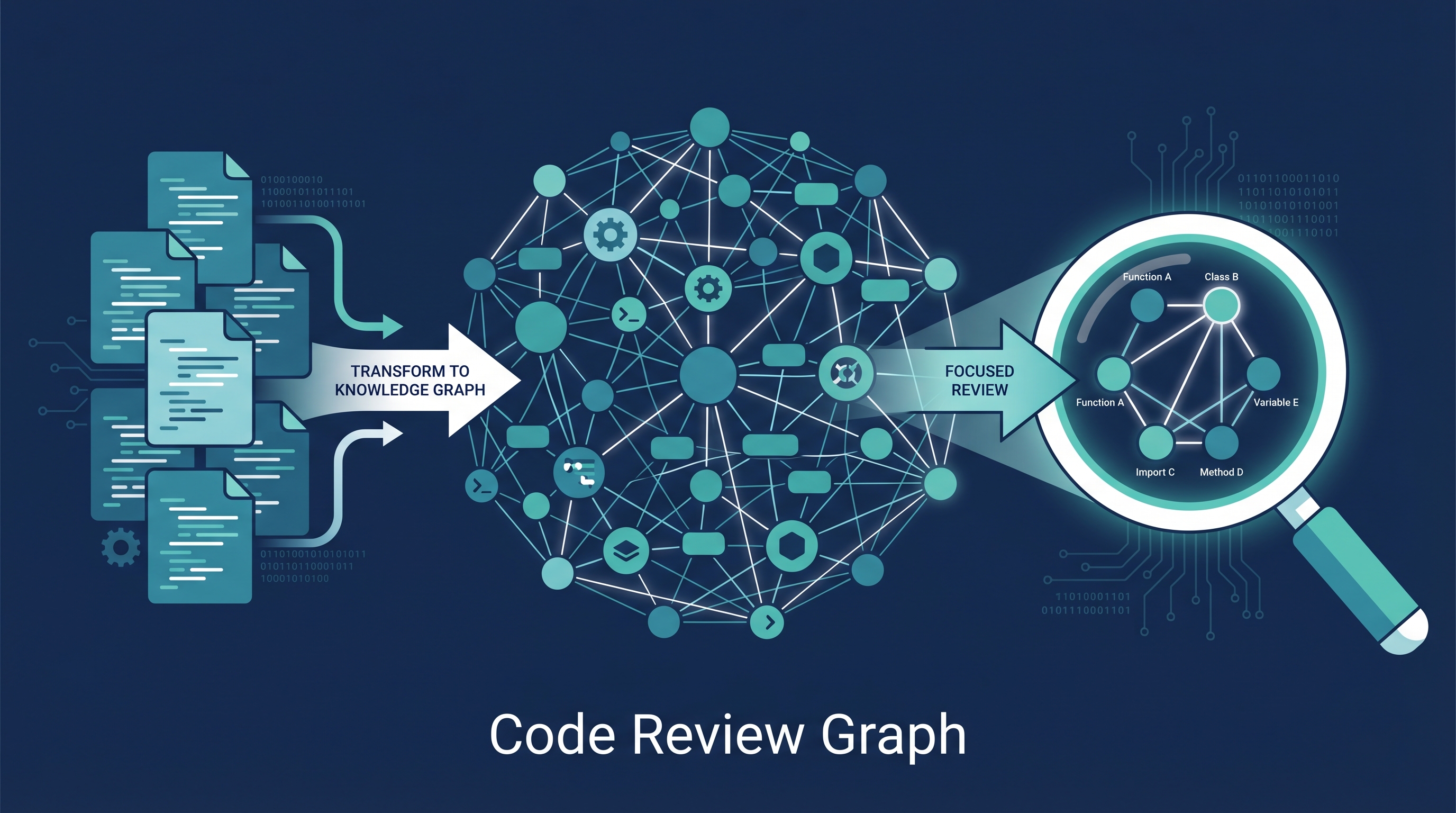
Every time you ask Claude Code to review changes, it re-reads your entire codebase — burning tokens, hitting context limits, and sometimes hallucinating about files it barely scanned. Code Review Graph solves this by parsing your codebase into a persistent knowledge graph with Tree-sitter, then exposing it via MCP. When files change, it traces the blast radius — callers, dependents, tests — and feeds only the relevant files to your AI. Average token reduction: 8.2x. On monorepos: up to 49x.
| *Source: GitHub — tirth8205/code-review-graph (15.6k stars) | code-review-graph.com* |
How It Works
Source Code → Tree-sitter AST → Nodes + Edges → SQLite Graph
                                                      ↓
File changes → Blast Radius Query → Only relevant files
                                                      ↓
                                        MCP Server → Claude Code
                                        (22 tools, 5 prompt templates)
Three core mechanisms:
- Blast-radius analysis — traces every caller, dependent, and test affected by a change. 100% recall (never misses), deliberately over-predicts for safety.
- Incremental updates <2s — SHA-256 hash checks, re-parses only changed files. 2,900-file project reindexes in under 2 seconds.
- Monorepo optimization — Next.js: 27,700 files → ~15 actually read (49x reduction).
Token Savings
| Repository | Files | Naive Tokens | Graph Tokens | Reduction |
|---|---|---|---|---|
| fastapi | 1,122 | 4,944 | 614 | 8.1x |
| flask | 83 | 44,751 | 4,252 | 9.1x |
| gin | 99 | 21,972 | 1,153 | 16.4x |
| httpx | 60 | 12,044 | 1,728 | 6.9x |
| nextjs | 27,700+ | — | — | up to 49x |
| Average | 8.2x |
Caveat: Small single-file edits in small packages (Express) can show 0.7x — graph overhead exceeds raw file size.
23 Supported Languages
Python, TypeScript/TSX, JavaScript, Vue, Svelte, Go, Rust, Java, Scala, C#, Ruby, Kotlin, PHP, C/C++, Swift, Dart, Solidity, Lua, R, Perl, Zig, PowerShell, Julia + Jupyter/Databricks notebooks.
28 MCP Tools
| Category | Tools |
|---|---|
| Graph ops | Build, update, impact radius, review context, query |
| Search | Semantic search, embeddings, cross-repo search |
| Architecture | Flows, communities (Leiden), architecture overview |
| Refactoring | Large functions, rename preview, dead code, apply refactor |
| Documentation | Wiki generation, wiki page retrieval |
Installation
pip install code-review-graph
code-review-graph install    # Auto-detects Claude Code/Cursor/etc
code-review-graph build      # Parse codebase into graph
Works with: Claude Code, Cursor, Windsurf, Zed, Continue, OpenCode, Codex, Antigravity.
How LearnAI Team Could Use This
- Large project code reviews — For research codebases with 500+ files, install code-review-graph to make Claude Code reviews actually useful instead of surface-level token-limited scans.
- Teaching code architecture — The graph visualization (D3.js force-directed) shows students how files are connected. Great for software architecture courses.
- Student project analysis — Run blast-radius analysis on student PRs to teach them about change impact and dependency awareness.
- Research on program analysis — The Tree-sitter AST → knowledge graph pipeline is directly relevant to Q’s research in program analysis and type systems. Compare with traditional call graph tools.
- Token cost management — If the team runs Claude Code on a budget, 8x token reduction means 8x more reviews for the same cost.
Real-World Use Cases
- Enterprise code review — Teams with large monorepos get AI reviews that actually understand cross-file dependencies instead of reviewing files in isolation.
- CI/CD integration — Run blast-radius analysis on every PR to auto-scope the review to affected code.
- Onboarding — The
onboard_developerprompt template generates a codebase walkthrough from the graph structure. - Refactoring safety — Before renaming a function, see every caller and test that would be affected.
- Architecture documentation — Auto-generate wiki from code communities (Leiden algorithm clustering).