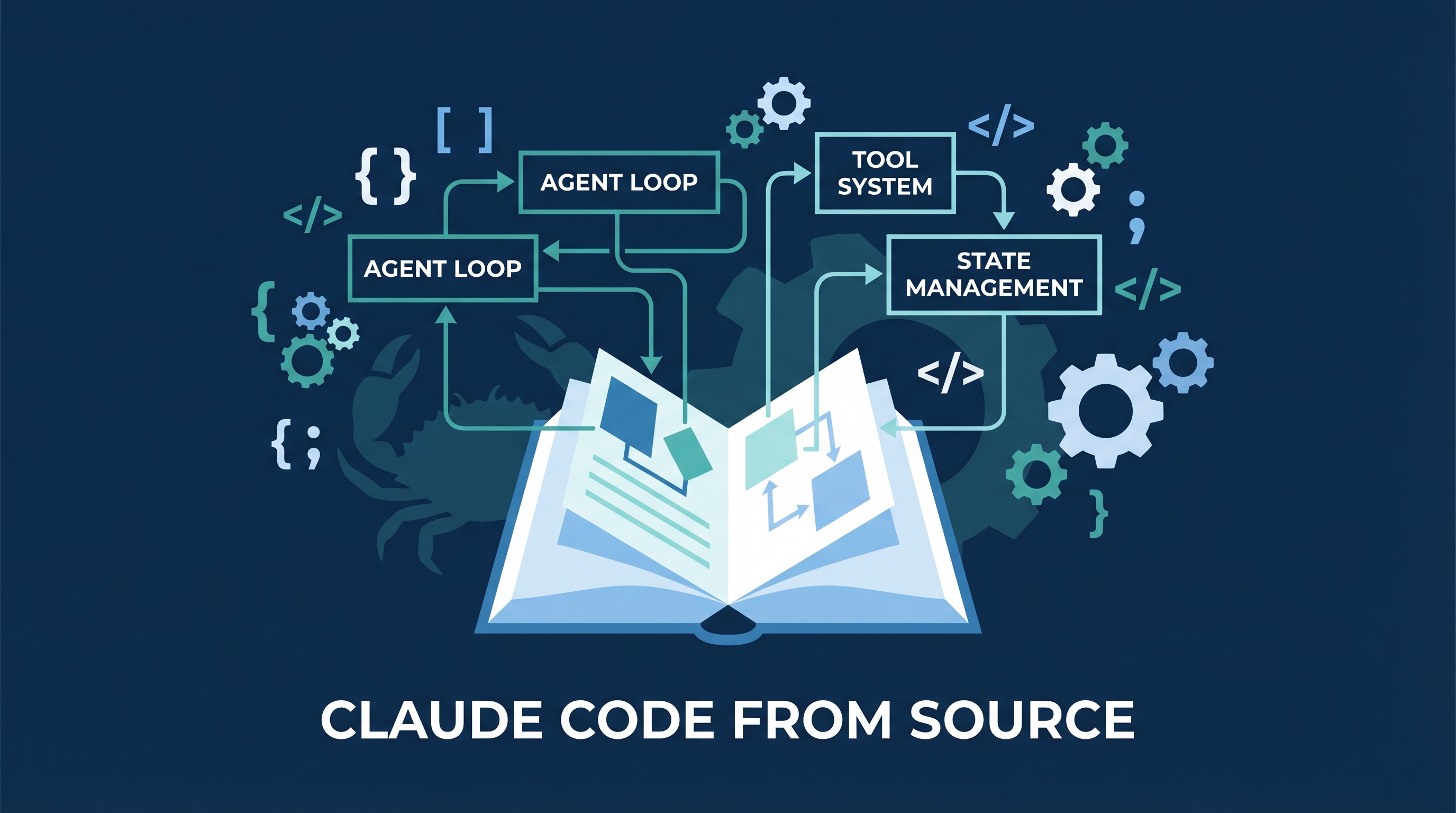
When Claude Code’s source leaked via an npm source map in March 2026, most people skimmed for secrets. Alejandro Balderas did something better — he deployed 36 AI agents across 6 hours to reverse-engineer the architecture into an 18-chapter book. No proprietary code, only original pseudocode illustrating patterns. The result is a free, structured guide to how the most widely used AI coding agent actually works — and how to apply those patterns to your own systems.
The 18 Chapters (7 Parts)
| Part |
Chapters |
What You Learn |
| I: Foundations |
1-4 |
Agent architecture, bootstrap pipeline, two-tier state, API layer |
| II: Core Loop |
5-7 |
The agent loop (~1,700 lines), tool system, concurrent execution |
| III: Multi-Agent |
8-10 |
Sub-agents, fork agents, prompt cache, task coordination, swarms |
| IV: Persistence |
11-12 |
Memory (3 levels), skills, hooks (27 events) |
| V: Interface |
13-14 |
Terminal UI (React-based), input handling |
| VI: Connectivity |
15-16 |
MCP protocol, remote/cloud execution |
| VII: Performance |
17-18 |
Token optimization, latency, epilogue |
6 Core Abstractions Discovered
┌─────────────────────────────────────────────────┐
│              CLAUDE CODE ARCHITECTURE            │
│                                                  │
│  ┌──────────┐  ┌──────────┐  ┌──────────┐      │
│  │  Query   │  │  Tool    │  │  Tasks   │      │
│  │  Loop    │→ │  System  │→ │ (agents) │      │
│  │ (1700 ln)│  │ (self-   │  │ state    │      │
│  │ async gen│  │ describing│  │ machine  │      │
│  └──────────┘  └──────────┘  └──────────┘      │
│  ┌──────────┐  ┌──────────┐  ┌──────────┐      │
│  │  State   │  │  Memory  │  │  Hooks   │      │
│  │ (2-tier) │  │ (3-level)│  │ (27 evts)│      │
│  │ infra +  │  │ project/ │  │ 4 exec   │      │
│  │ UI store │  │ user/team│  │ types    │      │
│  └──────────┘  └──────────┘  └──────────┘      │
└─────────────────────────────────────────────────┘
| Abstraction |
Key Insight |
| Query Loop |
Async generator with backpressure — streams responses, collects tool calls, executes, loops |
| Tool System |
Tools declare their own concurrency safety — no god-object orchestrator |
| Tasks |
Sub-agents as state machines: pending → running → completed/failed/killed |
| State |
Two-tier: mutable infra singleton (~80 fields) + reactive UI store (34 lines) |
| Memory |
Three levels: project, user, team — with 200-line cap and silent truncation |
| Hooks |
27 lifecycle events across 4 execution types |
Surprising Hidden Details
| Discovery |
Implication |
| 200-line memory cap with silent truncation |
Your CLAUDE.md can be ignored if too long |
| Auto-compaction destroys context after ~167K tokens |
Long sessions lose early context silently |
| 2,000-line file read ceiling |
Large files are only partially read |
| Silent model downgrade (Opus → Sonnet) after server errors |
Quality drops without notification |
| KAIROS: internal continuous operation system |
Claude Code behaves like a team, not a single assistant |
How It Was Made
36 AI agents, 4 phases, ~6 hours total:
- Exploration (6 agents) — examined ~2,000 TypeScript files
- Analysis (12 agents) — produced 494KB of documentation
- Writing (15 agents) — authored narrative chapters from scratch
- Review (3 reviewers + 3 revision agents) — editorial polish
Zero proprietary code in the final book — all pseudocode is original.
How LearnAI Team Could Use This
- Software architecture course material — Each chapter’s “Apply This” section extracts 5 transferable patterns (generator loops, self-describing tools, permission enums). Perfect for CS architecture courses.
- Agent development reference — Students building their own AI agents can follow the same patterns Claude Code uses: the agent loop, tool registration, sub-agent spawning.
- Research on AI tool design — The book reveals real engineering tradeoffs (state management, context limits, performance) that are relevant to program analysis and formal verification research.
- Understanding your own tools — If the team uses Claude Code daily, knowing its hidden limits (memory truncation, context compaction, model downgrades) prevents mysterious failures.
Real-World Use Cases
- Building custom agents — Engineers use the book’s patterns (async generator loop, self-describing tools) to build their own coding agents without starting from scratch.
- Debugging Claude Code — Understanding the 167K compaction threshold and 200-line memory cap helps developers debug unexpected behavior.
- Architecture interviews — The 6 core abstractions serve as a study guide for systems design interviews focused on AI infrastructure.
- Open-source agent projects — Projects like Hermes Agent and OpenClaw can benchmark their architecture against Claude Code’s patterns.
vs. Existing Wiki Entries
| Entry |
Focus |
| This (from Source book) |
Full 18-chapter structured book, transferable patterns, hidden limits |
| Claude Code Source Analysis |
Broader source leak analysis, learning approaches |
| CCUnpacked |
Internals explained, community deep-dives |