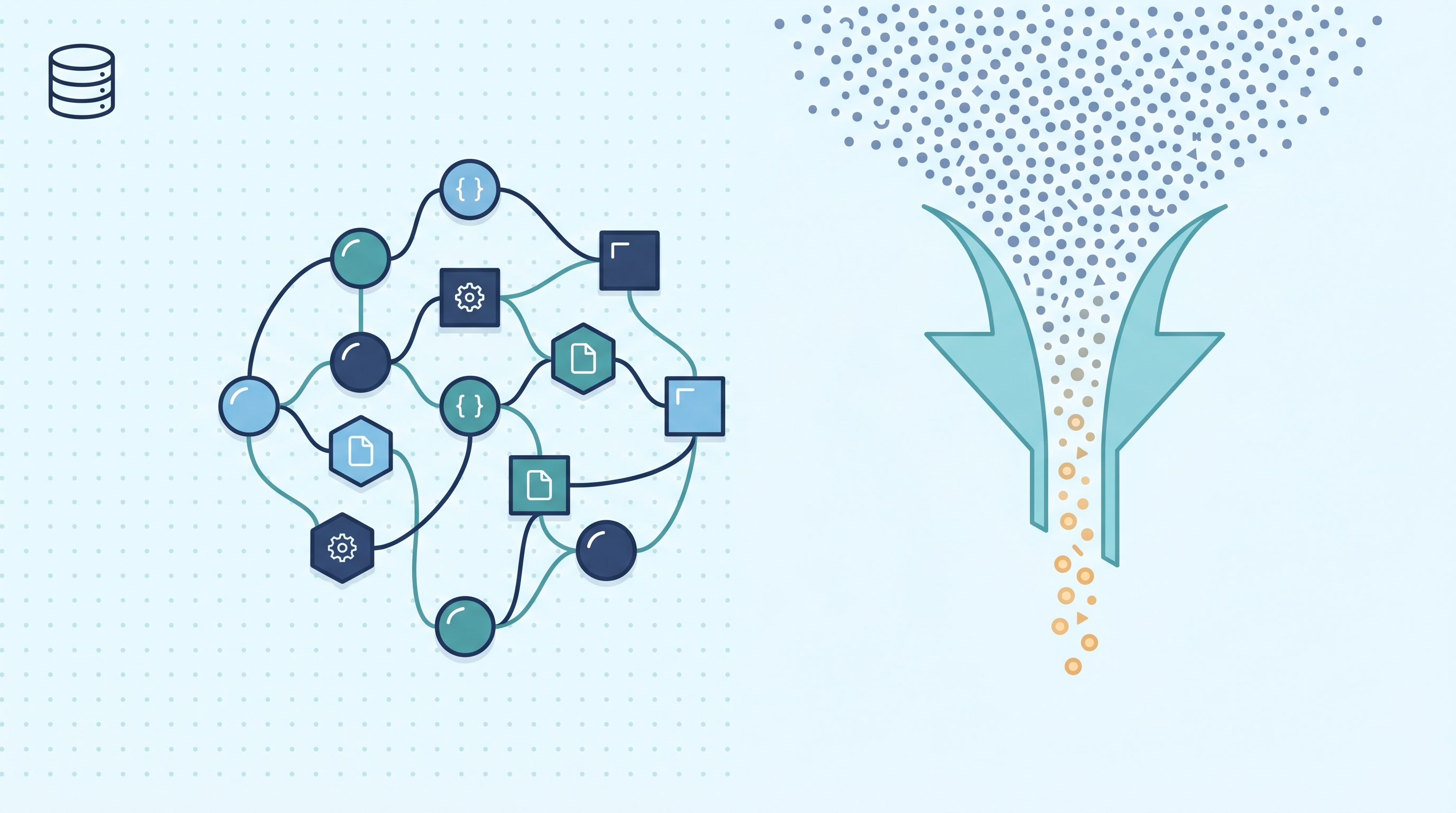
CodeGraph: Local Code Knowledge Graph that Cuts Token Usage
TL;DR: CodeGraph pre-indexes your codebase into a knowledge graph (symbols, call paths, file structure) and exposes it via an MCP server. Agents like Claude Code, Codex CLI, Cursor query the graph instead of fanning out with grep/glob/Read. Upstream’s benchmark claims ~35% cheaper, ~70% fewer tool calls, 100% local. My install + small-repo test on May 23, 2026 illustrated the mechanism (a single codegraph context query returned ~93% fewer tokens than naively reading all files in one small project) but I did not reproduce the full headless claude -p benchmark — see “Why I didn’t run the full benchmark” below.
What it is
- GitHub: colbymchenry/codegraph — ~19K⭐ (snapshot May 23, 2026), MIT, TypeScript. Repo owned by
colbymchenry. - npm:
@colbymchenry/codegraph@0.9.3 - Mechanism: builds a SQLite knowledge graph (nodes = symbols/files, edges = imports/calls/refs) at project init/index, then serves it via MCP (
codegraph serve --mcp) so agents can query it via tool calls instead of file reads. - Supported agents: Claude Code, Cursor, Codex CLI, opencode, Hermes Agent.
- Languages: README claims 19+ languages. Upstream benchmark winners include Rust (Tokio: 81% fewer tokens), TypeScript (VS Code/Excalidraw: 73%), Python (Django: 64%), Swift (Alamofire: 59%), Java (OkHttp: 41%), Go (Gin: 23%).
Why it might matter for you
If you use Claude Code or Codex on real codebases (multi-hundred files+), the “Explore” agents normally fan out:
Read package.json → grep for X → Read 5 candidate files → grep for Y → Read 3 more →...
Each Read/grep is a tool call and burns input tokens. CodeGraph replaces those with a structured query: “What calls saveScene?” returns a list of call sites + code snippets, often <2000 tokens, in one call.
The win compounds on large codebases. On VS Code (~10K files), upstream reported 73% fewer tokens. On Gin (~150 files), only 23% fewer. Bigger codebases = bigger wins.
What I actually tested
Install safety check (passed)
| Check | Result |
|---|---|
| npm package size | 10.5kB, 3 files only (it’s a shim) |
| Lifecycle scripts (preinstall/postinstall) | None |
| install.sh review | Clean: downloads tarball from GitHub Releases, symlinks to ~/.local/bin/ |
| License + owner | MIT, repo owned by colbymchenry |
| Latest release | v0.9.3 (May 22, 2026) — package.json on main shows 0.9.4 (avoid “latest” ambiguity) |
# Safe install path (avoided curl|sh):
npm i -g @colbymchenry/codegraph@0.9.3
Dry-run config inspection
Manual MCP setup is one stdio entry per agent. The full codegraph install command writes more: MCP config + agent steering files (CLAUDE.md / AGENTS.md additions instructing the agent to prefer graph queries) + Claude Code auto-allow permissions (unless --no-permissions is passed). Inspect via codegraph install --print-config <agent> before running.
Claude Code (writes to ~/.claude.json):
{ "mcpServers": { "codegraph": { "type": "stdio", "command": "codegraph", "args": ["serve", "--mcp"] }}}
Codex CLI (writes to ~/.codex/config.toml):
[mcp_servers.codegraph]
command = "codegraph"
args = ["serve", "--mcp"]
Use codegraph install --print-config <agent> to see the exact diff before writing.
Indexing performance (real numbers)
| Codebase | Files | Nodes | Edges | Index time | Disk |
|---|---|---|---|---|---|
| Excalidraw (shallow clone) | 603 TS files | 9,286 | 8,622 | 11.4s | 19MB |
| learnai-3d-studio | 14 TS files | 109 | 95 | 561ms | 0.32MB |
codegraph sync (incremental update) on no-change: 0.54s. Fast enough to run as a git post-commit hook.
Context-query value (one concrete example, illustrative only)
Query: “how does the scene render and what files are involved” against learnai-3d-studio.
codegraph contextoutput: 5,824 chars (~1,456 tokens) — structured summary with entry points, related symbols, code snippets, ready to drop into an LLM prompt.- Naive
Readof all 14 .ts/.tsx files insrc/: 89,025 chars (~22,256 tokens). - ~93% reduction for this one query.
This single observation illustrates the mechanism (one structured query vs N file reads) but does not reproduce upstream’s headless-agent benchmark. It’s directional only.
Why I didn’t run the full headless benchmark
Tried to reproduce upstream’s claude -p --strict-mcp-config benchmark on Excalidraw. Hit two real obstacles:
- Session contamination: without
--bare,claude -pinherits auto-memory, plugin sync, and recent-session prefetch from my parent Claude Code instance. First smoke-test response came back referencing “the earlier polling task” instead of answering about Excalidraw. $1.27 wasted on garbage output. --barerequiresANTHROPIC_API_KEY: CC’s--baremode explicitly skips OAuth/keychain, so subscription users can’t use it without a separate API key.
Conclusion: independent benchmarking of headless agent runs is non-trivial for OAuth-subscription Claude Code users. The upstream benchmark numbers should be treated as upper-bound vendor claims until reproduced by a third party with a clean test rig.
How to install (for your own use)
# 1. Inspect package contents before installing
npm pack --dry-run @colbymchenry/codegraph@0.9.3

# 2. Install globally (or use npx for a one-off)
npm i -g @colbymchenry/codegraph@0.9.3
# Alternative dry-run without global install:
#   npx -y @colbymchenry/codegraph@0.9.3 install --print-config claude

# 3. AFTER install, dry-run the agent config writes
codegraph install --print-config claude
codegraph install --print-config codex

# 4. Per-project init + index
cd your-project
codegraph init -i             # initialize + initial index

# 5. Enable MCP server + steering files (writes to ~/.claude.json / ~/.codex/config.toml AND CLAUDE.md/AGENTS.md)
codegraph install             # interactive; add --no-permissions to skip CC auto-allow

# 6. Use it via the agent — restart Claude Code / Codex so MCP picks up

# 7. Keep index fresh after code changes
codegraph sync                # incremental

# 8. Uninstall paths (three independent layers)
codegraph uninstall           # removes agent MCP entries + steering text
codegraph uninit              # removes .codegraph/ index in current project
npm rm -g @colbymchenry/codegraph   # finally remove the global binary
Concerns / things to watch
- Vendor benchmark is steel-manned: 4 runs/arm, median, Opus 4.7 headless. Per the README, all benchmark queries ARE published — verify your real questions look like theirs before extrapolating.
- Small-repo gains are smaller, not zero: Gin (~150 files Go) still showed 23% fewer tokens / 22% cheaper in upstream’s table. The break-even point where index overhead exceeds savings is unmeasured in my testing. Real-world: don’t assume sub-100-file repos won’t benefit — measure.
- MCP adds a fixed per-query overhead: stdio pipe + index lookup is non-zero (I did not measure mine; cite or test before quoting numbers). Worth it when it replaces 10+ Read calls; less so for 1-2 reads.
- Vendor steers the agent: codegraph’s
installwrites instructions to CLAUDE.md AND AGENTS.md telling the agent to prefer graph queries over grep/Read. This is part of the product, but it means “WITH codegraph” includes a behavioral nudge, not just the MCP server. Diff the files after install. - No
--print-instructionsflag: only--print-configshows the MCP entry. Steering-text additions to CLAUDE.md / AGENTS.md aren’t dry-runnable — install and diff. - Language mix matters: README claims 19+ languages. Upstream benchmark range was 23% (Go) → 81% (Rust) fewer tokens. Don’t extrapolate TS wins to your favorite language without testing.
- Privacy: the index and MCP server are 100% local, but any code snippet the MCP server returns to your agent is still sent to Claude/Codex’s cloud model as normal tool-result context. CodeGraph doesn’t change your data-exposure surface, just the volume.
When it’s worth installing
✅ Yes if:
- You work on codebases > 500 files (esp. TypeScript/React/Next.js)
- Most of your AI-coding sessions are exploration/architecture questions (not “fix this line”)
- You’re cost-sensitive on API usage (or hitting subscription rate limits)
❌ Skip if:
- Your projects are < 100 files (your Read calls are already cheap)
- You mostly do localized edits (Edit/Write workflows, not Explore)
- You don’t want any MCP server in your agent config
How LearnAI team could use this
- MARIE thesis codebase: if multi-hundred-file, codegraph would speed up “where is X called from” exploration during code review.
- Course assignments: students working in Claude Code on a moderate-size repo could install codegraph locally to keep their token usage down (especially if they’re on free API tier).
learnai-coursesite: currently mostly static HTML, so no big win — keep simple Read.learnai-3d-studio: only 14 files; the index doesn’t pay off yet. Revisit when the studio grows.
Real-world use cases
- Exploring an unfamiliar codebase (“how does feature X work?”) — graph traversal beats grep fan-out.
- Impact analysis before refactor (“what calls this function?”) — call-graph query is one tool call.
- Onboarding documentation prep —
codegraph contextoutputs structured summaries that can seed README architecture sections. - Multi-agent orchestration — shared
.codegraphindex queried by multiple agents/subagents instead of each fanning out its own grep storm (each agent runs its own stdio MCP process against the same on-disk index).
Related / alternatives
- safaiame/graphify — similar idea, “knowledge graph that auto-updates as code changes.” NetworkChuck promoted it as a Hermes Agent replacement for OpenClaw. Smaller community.
- CC’s built-in Explore agent — fine for one-off queries; codegraph helps when the same codebase is queried repeatedly.
- LSP-based tools (e.g.
lsp_goto_definitionMCP servers) — narrower scope (symbol lookups only), no full call-graph view.
My honest take
CodeGraph is a real product, not vaporware. The benchmark numbers are likely overstated for typical use (their questions were chosen to favor the graph), but the mechanism is correct: replacing N grep/Read calls with one structured query saves tokens. The 93% token reduction I observed on a single context query is consistent with the upstream claims at the per-query level.
The blocker is the MCP install touches your agent config in multiple places: Codex users get changes to ~/.codex/config.toml AND ~/.codex/AGENTS.md steering. Claude Code users get changes to ~/.claude.json (MCP + auto-allow permissions) AND CLAUDE.md steering. All reversible via codegraph uninstall, but worth diffing first.
I’d install it on real-codebase projects and keep it off the small ones. The token savings on a thesis-sized codebase over 6 months of AI-assisted refactoring would more than pay for the install ceremony.
Pinned versions used in this evaluation
- codegraph:
0.9.3(npm) / GitHubv0.9.3(released May 22, 2026) - Test target:
excalidraw@f6d85bc - Test target:
learnai-3d-studio(local) - Claude Code: 2.1.x (current)
- Date: 2026-05-23
Source
- colbymchenry/codegraph README
- Recommended in: Section D of the Codex + Claude Code Skill Repos: May 23 Batch wiki entry.
- Screenshot reference: 5.23/IMG_6473 (#3 on “AI 大模型 GitHub 本周十大热门” weekly chart, +10,749 stars/week).