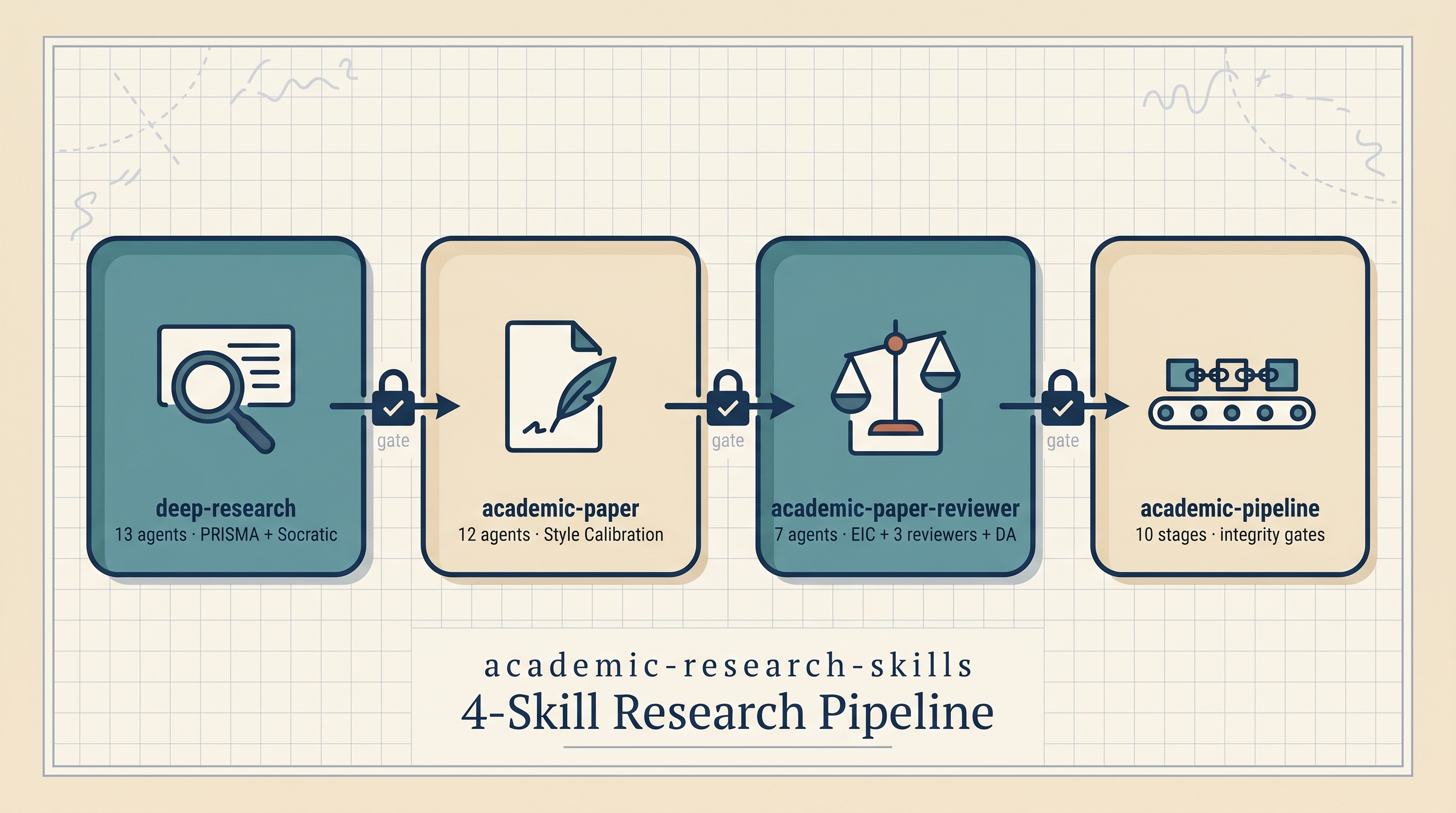
Imbad0202/academic-research-skills (6.3K stars as of May 2026) is a Claude Code skill bundle that turns the end-to-end PhD research workflow — search → write → review → revise → finalize — into a chain of four cooperating skills, each with multiple sub-agents and explicit quality gates. The headline mechanisms are unusually concrete: PRISMA systematic-review templates, a Socratic-mode dialogue health-check every 5 turns, Style Calibration that learns voice from 3+ of your past papers, a Devil’s Advocate concession-threshold protocol that scores rebuttals 1–5 before agreeing, and an EIC + three-reviewer rubric that maps 0–100 scores to Accept/Minor/Major/Reject decisions. Licensed CC BY-NC 4.0 (non-commercial). Verified against the upstream repo on 2026-05-12.
| *Source: GitHub — Imbad0202/academic-research-skills — 6.3K stars, CC BY-NC 4.0 | docs/ARCHITECTURE.md, docs/SETUP.md, docs/PERFORMANCE.md in repo |
Surfaced via Douyin post by 大大黑猩猩 (March 1, 2026)* |
Repo claims vs. independent verification: the per-skill agent counts (13/12/7/orchestrator), mode lists, and rubric thresholds below are taken directly from the upstream
README.mdandARCHITECTURE.md. The Douyin commentary that surfaced the repo is cited separately and not treated as primary source.
The 4 Skills
| Skill | Version (README / ARCHITECTURE.md) | Agents | What It Does |
|---|---|---|---|
| deep-research | v2.8 / v2.9.2 | 13 | Full research + quick briefs + PRISMA systematic reviews + Socratic guided questioning + fact-checking + literature reviews + paper-quality assessment |
| academic-paper | v3.0 / v3.1.1 | 12 | Full papers, step-by-step planning, outlines, revisions, abstracts, lit reviews, format conversion, citation checking. Outputs Markdown, DOCX (via Pandoc), and LaTeX/PDF |
| academic-paper-reviewer | v1.8 / v1.9.0 | 7 | Multi-perspective review: Editor-in-Chief + 3 dynamic reviewers + Devil’s Advocate challenger, quality scoring on 0–100 rubrics, re-review and calibration modes |
| academic-pipeline | v3.7 / v3.6.5 (matrix) or v3.7.0 (timeline) | 10-stage orchestrator | Manages the full workflow: research → integrity checks → peer review → revision → finalization, with Material Passport handoff schemas and collaboration evaluation |
Version drift note: the repo README and
docs/ARCHITECTURE.mdreport slightly different per-skill versions (the architecture doc tends to track ahead of the README between releases). Numbers above are as of the 2026-05-12 check; pin to whatever the upstream commit shows when you install.
Each skill is independent — you can use deep-research alone for a literature scan, or chain all four for a full paper-shipping workflow.
The Five Headline Mechanisms
These are the patterns that make the bundle distinctive vs. a generic “AI writing assistant”:
1. PRISMA Systematic Review (in deep-research)
A dedicated mode that follows the PRISMA reporting standard: search strategy → records identified → screening → eligibility → inclusion → synthesis. Ships with protocol/report templates and risk-of-bias assessment. Useful for actual systematic reviews; overkill for a quick lit scan (use a different mode there).
2. Socratic Mode (in deep-research)
Intent-based activation: detects whether the user is in exploratory mode (still figuring out the question) versus goal-oriented mode (knows what they want).
- In exploratory mode: disables premature convergence so the agent doesn’t close down options before the user is ready
- Every 5 turns the agent runs a “dialogue health check” — is the conversation actually moving forward, or going in circles?
This is rare; most assistants just answer whatever is asked, which is a poor fit for exploring an open research question.
3. Style Calibration (in academic-paper)
The user provides ≥3 of their own past papers. The skill learns the user’s voice (sentence rhythm, hedging style, paragraph length) and applies it as a soft guide during drafting. Discipline norms always take hard priority — the model won’t break IMRaD structure or citation style to match your prose.
The “soft guide / hard priority” split is the careful part: prevents the calibrator from producing prose that sounds like you but breaks venue requirements.
4. Devil’s Advocate Concession-Threshold Protocol (in paper-reviewer)
When the Devil’s Advocate (DA) reviewer is challenged, the Concession Threshold Protocol kicks in:
- DA must score rebuttals 1–5 before responding
- Concession only at score ≥4
- Prevents two well-known failure modes: sycophantic agreement (DA caves to author push-back) and frame-lock (DA stubbornly refuses to revise once committed)
The numeric threshold is what makes this enforceable — most “play devil’s advocate” prompts collapse the moment the author argues back.
5. EIC + Three Reviewers + Decision Mapping
The full review team simulates a real journal:
- Editor-in-Chief sets scope and arbitrates
- R1, R2, R3 — three dynamically-spawned reviewers covering different angles
- Devil’s Advocate — challenges the consensus
- Quality score → decision mapping:
| Score | Decision |
|---|---|
| ≥80 | Accept |
| 65–79 | Minor Revision |
| 50–64 | Major Revision |
| <50 | Reject |
The score-to-decision mapping is in the same shape that many journals publish (Accept / Minor / Major / Reject buckets), giving the reviewer output an obvious meaning rather than a generic 5-star rating.
The 10-Stage Pipeline + Integrity Gates
The academic-pipeline orchestrator runs the full workflow as 10 stages with explicit Material Passport handoff schemas between them (so each stage knows exactly what shape of artifact the previous stage hands it).
Integrity gates at Stages 2.5 and 4.5 cannot be skipped. Every “FULL” checkpoint requires explicit user confirmation. This is the safety mechanism — the agent won’t silently auto-advance past a stage that needs human verification.
License: CC BY-NC 4.0 (Non-Commercial)
The repo is released under Creative Commons Attribution-NonCommercial 4.0:
- ✅ Academic / research use: fine
- ✅ Forking for your own thesis / lab / department: fine
- ✅ Course adoption: fine
- ❌ Commercial use, paid services, SaaS wrapping: not permitted
- 📌 Attribution required in all uses
If your use case is for-profit research (industrial R&D, consulting), check with the author or use a differently-licensed alternative.
Human-in-the-Loop Philosophy
Quoting the repo’s framing directly:
“AI is your copilot, not the pilot… handles the grunt work — hunting down references, formatting citations, verifying data, checking logical consistency — so you can focus on the parts that actually require your brain.”
This is not “press one button, get a paper.” The pipeline is built so the human has to confirm at every gate, review every claim, and own the final voice. The agent does the labor; the researcher does the thinking.
Installation
Plugin method (v3.7.0+, recommended):
/plugin marketplace add Imbad0202/academic-research-skills
/plugin install academic-research-skills
Traditional method: clone the repo and symlink to ~/.claude/skills/.
Prerequisites:
- Claude Code CLI (latest)
ANTHROPIC_API_KEYset- Optional: Pandoc + tectonic for DOCX/PDF output
Verify install: run /ars-plan to start a Socratic dialogue that maps your paper’s structure.
Cost Sketch
The repo’s docs/PERFORMANCE.md reports rough token budgets per workflow. As a baseline: ~$4–6 per 15K-word paper through the full pipeline (rough order of magnitude — actual cost varies with mode, paper length, and how many revision rounds you run).
For a PhD student writing one journal paper a quarter, this is order-of-magnitude cheaper than the time spent on grunt-work without it.
How It Compares to Related Wiki Entries
| Related entry | What’s different |
|---|---|
| AI Agents for Academic Research & Writing (KatmerCode, Nature Playbook) | Covers different repos and the Nature editorial playbook; complementary, not overlapping |
| Claude PRISM — Adversarial-Iterative Academic Writing | PRISM focuses on iterative revision with adversarial review; this repo is the broader end-to-end pipeline that PRISM-style review is one component of |
| Claude Code Research Infrastructure | Sets up the environment (folders, repos, templates) for research; this repo is the operational skill bundle you run inside that environment |
| AI Research Workflow Pipeline | The general principles; this repo is one concrete implementation |
| Research KB — Zotero + Obsidian + Quartz | The KB / literature side; this repo is the writing / review side |
How LearnAI Team Could Use This
- PhD-track curriculum module — assign students to ship one paper using the full pipeline (Stage 1 → Stage 10). Graded artifacts are the per-stage checkpoint outputs, not the final paper. Teaches both research methodology and skill orchestration.
- Peer-review training — use the
paper-reviewerskill on student work, then have students respond to the DA challenges. Builds review skills + resilience to adversarial feedback. - Style Calibration exercise — students upload 3 papers in their field, generate calibrated drafts, then diff against the originals to identify what the calibrator captured (and missed). Teaches the meta-skill of voice in academic writing.
- PRISMA module — for systematic-review training, use the dedicated mode and compare students’ AI-assisted PRISMA flowcharts to manually-built ones. Catches gaps in both approaches.
- Socratic mode for thesis planning — first-year PhDs use the Socratic mode to interrogate their proposed thesis question. The dialogue health check exposes circular reasoning early.
- Integrity-gates as pedagogy — every required user-confirmation gate is a teaching moment about what needs human judgment in research.
Real-World Use Cases
- PhD students — full-pipeline use during a paper-writing semester. Offloads citation cleanup, formatting, and consistency checks so the student can spend more time on the argument.
- Junior faculty — first journal submissions: run
paper-revieweras a pre-submission check; surfaces likely reviewer objections before you hit submit. - Lab onboarding — new postdocs can use
deep-researchin Socratic mode to map the lab’s existing literature. - Grant writing — Style Calibration on past funded proposals as a soft guide for tone.
- Open-source research teams — fork the repo, customize the skills for a subfield (medical imaging, ML theory, materials science), and standardize the team’s research workflow.
- Replication projects —
paper-reviewerplus Devil’s Advocate as a structured first pass on a paper you’re replicating: where might it not hold up?
Caveats
- CC BY-NC 4.0 — see license section above. Commercial use needs a different arrangement.
- Not a paper-writing autopilot — the gates require human confirmation. Skipping them defeats the design.
- PRISMA is heavy — overkill for quick lit scans. Use the appropriate mode for your task.
- 6.3K stars is real traction but not maturity — expect rough edges; the repo is still evolving (
academic-pipelineis at v3.7, indicating active iteration). - API costs scale with mode — the 10-stage pipeline with all reviewer modes is materially more expensive than a single skill in isolation. The repo’s
PERFORMANCE.mddocuments token budgets per mode.
Links
- Repo: github.com/Imbad0202/academic-research-skills (6.3K stars, CC BY-NC 4.0)
- Architecture doc:
docs/ARCHITECTURE.mdin the repo — flow diagrams, stage-by-stage matrix, mode registry - Performance doc:
docs/PERFORMANCE.md— token budgets, cost per paper - Setup doc:
docs/SETUP.md— prerequisites and install - Surfaced via: Douyin post by 大大黑猩猩 (March 1, 2026)