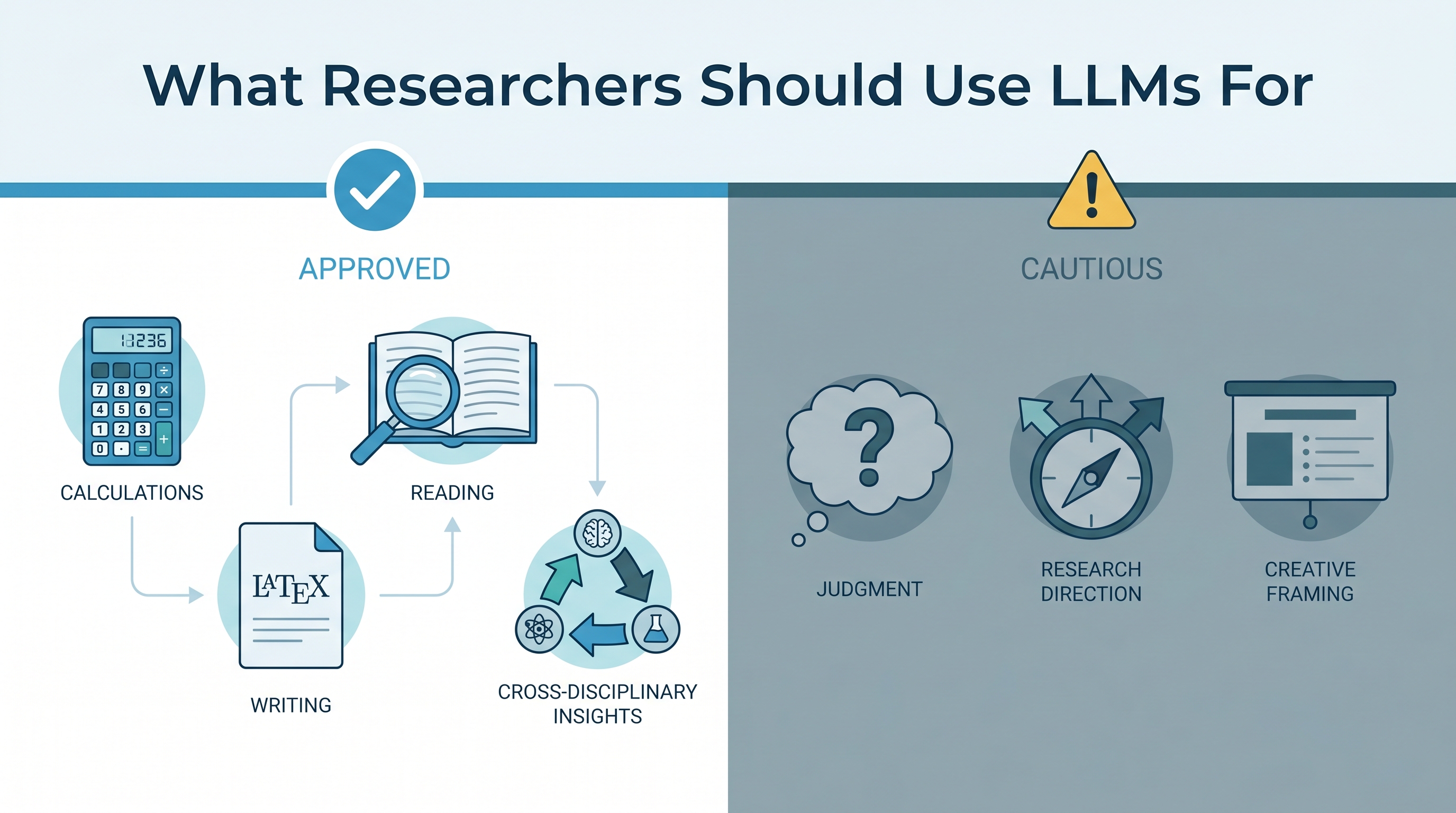
Most AI-in-research advice falls into two unhelpful camps: “use it for everything” or “don’t trust it at all.” A more useful framework comes from working researchers who’ve internalized one principle: LLMs excel where output is easy to verify, and fail where judgment is required. A physics researcher’s lecture slide crystallizes this — six things they use LLMs for, three things they don’t — and the dividing line is sharp enough to generalize across disciplines.
| *Source: Lecture slide from a physics/math researcher (shared publicly) | Gruda, D. “Three ways ChatGPT helps me in my academic writing” — Nature (2024) | ACM CHIIR 2026: Investigating Academic Researchers’ Verification Challenges with LLMs | Carlson et al. “The use of LLMs to annotate data in management research” — Strategic Management Journal (2026) | LLMs in Science* |
The Core Insight: Verifiability as the Dividing Line
                    EASY TO VERIFY                    HARD TO VERIFY
                    ─────────────                     ──────────────
                    ✓ Use LLMs here                   ✗ Don't use LLMs here

  Calculations      "Solve this integral"             "Is this proof conceptually sound?"
                    → check the answer                → requires deep understanding

  Literature        "Summarize arXiv:2932.10245"      "Is this research direction interesting?"
                    → read the paper yourself          → requires taste and judgment

  Writing           "Write LaTeX for this section"    "Write my paper's introduction"
                    → edit the output                  → sets the framing you're judged on

  Teaching          "What are solvable 2D QM systems?" "Write my homework problems"
                    → verify against known results     → you need to own the pedagogy
The pattern: if you can check the output faster than you can produce it, the LLM is a net positive. If checking requires the same expertise as producing, you’ve gained nothing and risked importing errors you can’t see.
What To Use LLMs For (YES List)
| Use Case | Why It Works | Example |
|---|---|---|
| Difficult calculations | Problems hard to solve but easy to check. LLMs can reproduce anything known — derivatives, series expansions, matrix operations. You verify the answer, not the process. | “Compute the partition function for the Mathieu potential” |
| Cross-disciplinary insights | LLMs have read papers across every field. They surface connections you’d never find by searching your own discipline’s literature. | “Has anyone in fluid dynamics solved a problem structurally similar to this condensed matter system?” |
| Learning known material | Asking about established facts and frameworks. The answers are checkable against textbooks and review articles. | “What are the axioms of quantum field theory?” / “What are some exactly solvable 2D quantum mechanical systems?” |
| Reading and summarizing | First-pass triage of papers. The LLM highlights claims and methods; you read critically. Explicitly request critical evaluation. | “What do you think of arXiv:2932.10245? Be very critical.” |
| Making figures | First drafts of plots, diagrams, and schematics. The LLM knows matplotlib/TikZ/pgfplots tricks you’d spend hours finding. Output is visual — you immediately see if it’s wrong. | “Plot the band structure with spin-orbit coupling highlighted” |
| Writing LaTeX | Drafting sections where the content is already decided. Formatting, notation consistency, boilerplate. You edit the prose; the LLM handles the markup. | “Write a section for my paper generalizing to the Mathieu potential” |
What NOT To Use LLMs For (NO List)
| Use Case | Why It Fails | The Risk |
|---|---|---|
| Subtle conceptual points | These are questions where reasonable experts disagree. The LLM will give you a confident, averaged answer that papers over the disagreement. | You adopt a position without understanding why it’s contested. You can’t defend it in peer review. |
| Judging research direction | “Is this interesting?” requires taste — awareness of what the field needs, what reviewers value, what’s been tried and failed. LLMs optimize for plausibility, not insight. | You pursue a direction that looks good on paper but is either trivial or already dead. |
| Homework problems, talk slides, paper introductions | These artifacts define your voice and pedagogical choices. Outsourcing them means your students/audience get generic framing. | Your introduction frames the paper in a way that doesn’t match your actual contribution. Your homework tests what the LLM thinks is important, not what you think is important. |
The Verification Principle in Practice
A 2026 ACM study on researcher verification behavior found that the key factor determining whether researchers verify LLM output is perceived accuracy relative to their own domain knowledge. When researchers are experts, they catch errors easily. When they’re outside their domain, they over-trust the LLM — exactly the moment when verification matters most.
This creates a dangerous inversion:
Domain expertise HIGH  → Verification easy  → LLM output useful (but you needed it less)
Domain expertise LOW   → Verification hard   → LLM output risky (and you needed it more)
The practical rule: use LLMs most aggressively in your area of expertise (where you can verify ruthlessly) and most cautiously outside it (where confident-sounding nonsense is hardest to detect).
A Decision Checklist for Researchers
Before using an LLM for a research task, ask:
- Can I verify the output in under 5 minutes? If yes, use the LLM freely.
- Is the answer a fact or a judgment? Facts are checkable. Judgments about importance, novelty, or framing are not.
- Would two experts give different answers? If yes, the LLM’s averaged response is actively misleading.
- Does the output carry my name? If it goes in your paper’s introduction, your grant proposal’s framing, or your lecture slides, you need to own every sentence. Drafting assistance is fine; delegation is not.
- Am I in-domain or out-of-domain? In-domain: verify aggressively, use freely. Out-of-domain: treat every claim as suspect until confirmed by a primary source.
How LearnAI Team Could Use This
- CS courses (all levels): Use this framework as a Day 1 handout. Students need to internalize the verifiability principle before they start using Copilot and Claude for assignments. The YES/NO table translates directly: “use AI to debug your code (easy to verify — run it), don’t use AI to design your architecture (requires judgment you’re here to develop).”
- AI education research: The verification-inversion problem (LLMs most dangerous where you’re least expert) is a publishable finding waiting to be replicated in CS education contexts. Run a study: do students catch more LLM errors in topics they’ve mastered vs. topics they’re learning?
- Faculty workshops: Most faculty AI-use policies are binary (allowed/banned). This framework gives them a nuanced middle: “here’s exactly where AI helps your students and where it stunts their growth.” The physics researcher’s slide is a perfect conversation starter.
- Thesis advising: When students bring LLM-assisted drafts, ask: “which parts did you verify, and how?” This shifts the conversation from policing to metacognition.
Real-World Use Cases
| Scenario | Verifiable? | LLM Role | Human Role |
|---|---|---|---|
| Deriving a closed-form solution for a differential equation | Yes — plug it back in | Do the algebra | Check the solution, interpret the physics |
| Surveying 50 papers for a literature review section | Partially — claims are checkable | Summarize, extract key claims, flag contradictions | Read the important papers yourself, verify claims against source |
| Deciding whether to pivot your research agenda | No — pure judgment | None. Don’t ask. | Talk to your advisor, collaborators, and your own intuition |
| Writing a conference talk | No — voice and emphasis are judgment | At most: suggest structure, check notation | Own every slide. Your talk is your reputation. |
| Finding analogous problems in another discipline | Yes — the analogy either holds or doesn’t | Surface candidates from other fields | Evaluate whether the structural similarity is deep or superficial |
| Generating matplotlib/TikZ figures | Yes — you see the output | Draft code, suggest styling tricks | Iterate until the figure communicates what you intend |
The Broader Principle
This isn’t about fear of AI or rigid rules. It’s about comparative advantage. LLMs are fast, broad, and tireless. Humans have judgment, taste, and accountability. The researchers who thrive will be the ones who assign each task to the right agent — not the ones who use AI for everything or nothing.
The physics researcher’s slide is quietly radical: it says “I use AI constantly” and “I never use AI for the parts that matter most” in the same breath. That’s not a contradiction. That’s expertise.
Links
- Nature: Three ways ChatGPT helps me in my academic writing
- ACM CHIIR 2026: Investigating Academic Researchers’ Verification Challenges with LLMs
- Strategic Management Journal: The use of LLMs to annotate data in management research
- Thoughtworks: Managing LLM risks: A framework for academic publishing
- LLMs in Science: llminscience.com
- Harvard OAISC: Academic Integrity and Teaching With(out) AI
- Nature Scientific Reports: Cross-disciplinary thinking in LLMs