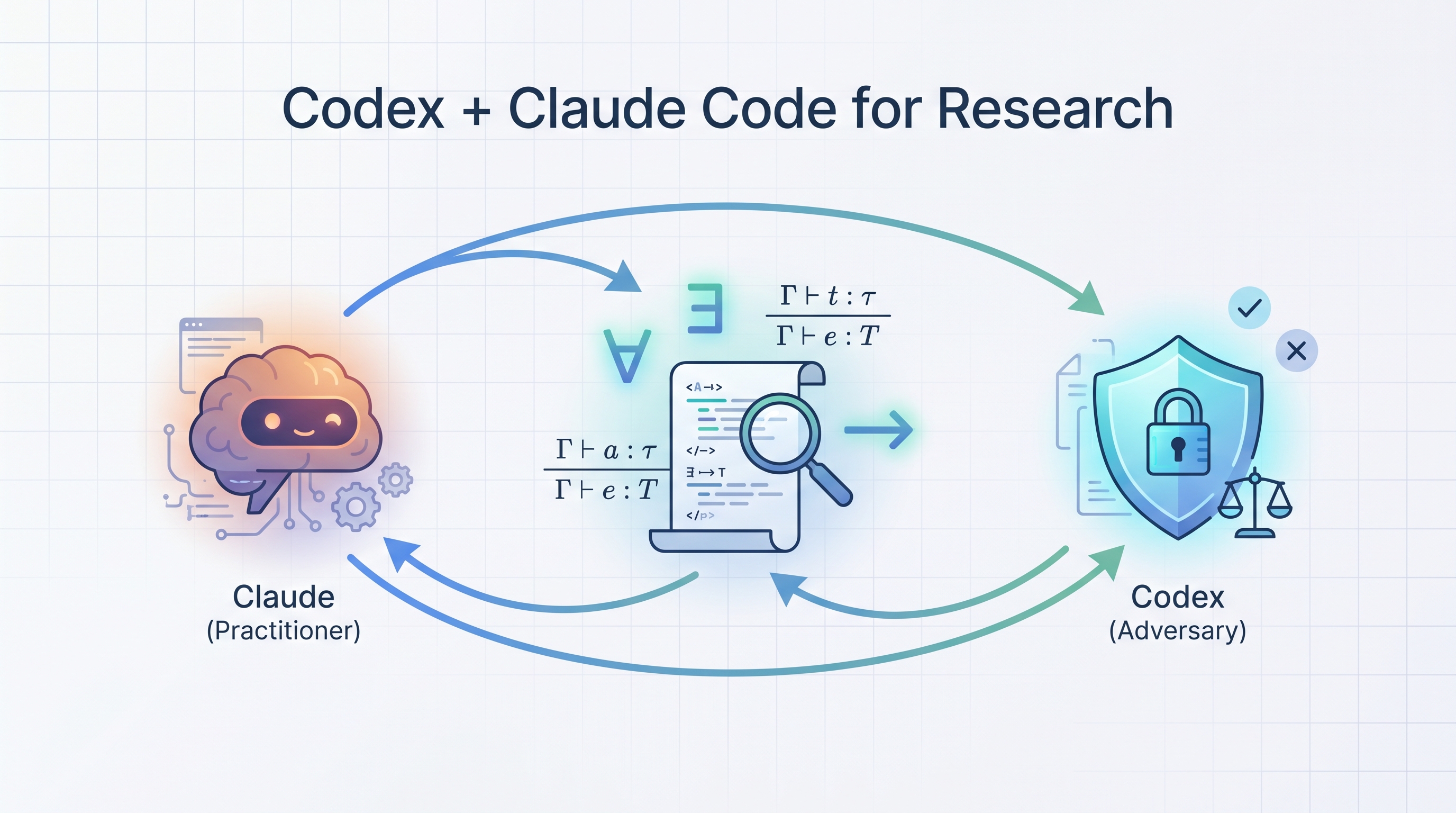
The companion entry (Cross-Model Code Review) explains why cross-model review works and walks through a REST-API example. This entry is the research-work tutorial — how to use codex-plugin-cc as a daily driver for formal verification, type-systems research, program analysis, and paper writing, where “looks right” is not good enough and adversarial rigor pays for itself.
| *Source: openai/codex-plugin-cc | Cross-Model Code Review setup entry | Codex CLI 0.121.0 docs* |
The Core Mental Model
Claude (Opus 4.6) and Codex (GPT-5.4) have different training data, different reasoning patterns, and different blind spots. For research work — where correctness is non-negotiable and novelty has to be defensible — that asymmetry is the whole point:
Claude (the practitioner)          Codex (the adversary)
  - Broad synthesis                  - Rigorous, skeptical
  - Drafts, explains, refactors      - Hunts counterexamples
  - Fast iteration                   - Challenges framings
  - Wants to help you ship           - Wants to prove you wrong
You drive Claude. You summon Codex when “this has to actually be true.”
Command Cheat-Sheet
| Command | When to use |
|---|---|
/codex:review |
Standard second-pair-of-eyes on uncommitted work — proofs, encodings, analyzers |
/codex:adversarial-review |
Devil’s-advocate pass — challenges problem framing, hunts counterexamples |
/codex:rescue |
Hand the whole task to Codex (run a tool, investigate a bug, fix the proof) |
/codex:review --base main |
Review a feature branch’s diff against main |
/codex:review --background |
Async review; check with /codex:status, fetch with /codex:result |
/codex:cancel |
Kill a runaway background job |
Keep the review gate off. Manual invocation beats the auto-gate because the gate triggers on every Claude response and quickly burns usage in a Claude↔Codex loop.
The Research Loop
            ┌────────────────────────────────────────────────┐
            │                                                │
            ▼                                                │
  ┌─────────────────┐                                        │
  │  Claude drafts  │   proof / encoding / type rule /       │
  │  (practitioner) │   problem statement / paper section    │
  └────────┬────────┘                                        │
           │ uncommitted changes                             │
           ▼                                                 │
  ┌─────────────────┐     /codex:review                      │
  │  Codex reviews  │ or  /codex:adversarial-review          │
  │   (adversary)   │     /codex:rescue (executes tools)     │
  └────────┬────────┘                                        │
           │ findings: gaps, counter-examples, open admits   │
           ▼                                                 │
  ┌─────────────────┐                                        │
  │  Disagreement?  │ ── No ──► commit                       │
  └────────┬────────┘                                        │
           │ Yes                                             │
           ▼                                                 │
   slow down, resolve, repeat ──────────────────────────────┘
Rule of thumb: Cross-model disagreement is the signal. Whenever Claude says “done” and Codex says “no”, that’s exactly where your research contribution lives — either your proof has a real gap, or your framing is unclear enough that two strong models read it differently.
Pattern 1 — Sharpening a Research Problem Statement
You have a vague intuition for a new result. Claude helps you articulate it; Codex tries to demolish it.
Step 1 — Claude drafts
Open the repo containing your draft (e.g., ~/research/relcost-hol/problem.md) and ask Claude:
Draft a one-page problem statement for proving non-interference for
a higher-order relational cost language, targeting POPL 2027. Include:
motivation, informal statement, why existing techniques don't suffice.
Step 2 — Codex attacks
With the draft uncommitted, run:
/codex:adversarial-review Focus on novelty and related-work overlap.
Assume you are Reviewer 2. Challenge every contribution claim.
Typical Codex output:
🔴 Contribution overlap — RelCost (Çiçek et al., POPL 2017) already
   handles non-interference for a fragment of this language. Your
   delta (higher-order + effects) needs an explicit worked example
   showing where their system fails.

🟡 Motivation is abstract — the "security-critical" framing is
   generic. Name one concrete program where cost-preserving
   non-interference matters and existing tools cannot prove it.

🟡 "Novel type-and-effect system" — Barthe, Grégoire, Zanella-Béguelin
   (CSF 2013) and Rajani & Garg (POPL 2020) both have relational
   refinement systems with cost. Cite and differentiate.
Step 3 — Iterate
Feed Codex’s findings back to Claude:
Revise the problem statement to: (a) include a concrete failing
example vs. RelCost, (b) cite Barthe/Rajani and draw the delta
explicitly, (c) replace "security-critical" with the concrete scenario.
Re-run /codex:adversarial-review. Two to three rounds typically converge on a framing that survives a hostile read.
Budget: 3–5 Codex calls per session. If you hit 10, you’re rewriting the paper with Codex’s voice — stop and think.
Pattern 2 — Reviewing a Proof Script (Coq / Rocq / Lean)
Proof assistants accept incomplete proofs silently if you use admit, Admitted, shelve, or sorry. Self-review frequently misses these. Codex does not.
Step 1 — Claude writes the proof
Prove `preservation` for the STLC fragment in Stlc.v. Use induction
on the typing derivation; handle E_App and E_Abs explicitly.
Claude produces Lemma preservation : ... with a tactic script.
Step 2 — Codex reviews
/codex:review Focus on completeness of the proof: any admit,
Admitted, sorry, shelve, or uses of `eauto` / `firstorder`
that may silently discharge the wrong goal. Also verify the
induction principle matches the typing judgment structure.
Typical findings:
🔴 Stlc.v:87 — `admit.` in case E_App with applied function.
   The induction hypothesis is there; try `eapply IHHt1; eauto`
   after strengthening the context.

🟡 Stlc.v:104 — uses `eauto 7` as closer. This succeeds, but a
   weaker lemma (wrong quantifier) would also satisfy it. Replace
   with explicit `apply substitution_lemma; eauto.`

ℹ️  The induction is on the term, but the typing judgment is
   mutual with values. Consider `dependent induction Ht` for
   the well-typed case.
Step 3 — Claude patches, Codex re-verifies
Address all three findings. Remove admit, tighten the eauto, switch
to dependent induction in the second branch.
Re-run /codex:review. When it returns ✅ No issues found, commit.
Pattern 3 — Probing a New Type Rule for Soundness
You’ve proposed a new typing rule in a draft. Before formalizing, you want to know if a well-typed-but-stuck term exists.
Step 1 — Claude drafts
In rules.tex (or a markdown inference-rule file):
Add a typing rule T-Select for non-blocking channel select, with
premises for each branch's guard type and result type. State it
in the same style as the existing T-Send / T-Recv rules.
Step 2 — Codex hunts counterexamples
/codex:adversarial-review Construct a program that type-checks under
T-Select but gets stuck during evaluation. If you find one, show the
derivation and the stuck configuration. If you can't, explain
which premise of T-Select rules out each candidate attack.
Codex might reply:
🔴 Counterexample:
   select { true => !c1; true => !c2 } where c1, c2 : !unit
   Both guards are `true`, type-checks via T-Select with unit result.
   Evaluation: nondeterministic commit to one branch; if the scheduler
   is adversarial both sends are published to different receivers,
   violating linearity.

   Root cause: T-Select doesn't require branch guards to be disjoint,
   but your operational semantics picks one branch and consumes the
   prefix of both. Fix options:
   (a) Require mutually exclusive guards in T-Select.
   (b) Change the operational semantics to commit atomically.
Step 3 — Claude revises the rule or semantics
Feed the counterexample back. Either tighten the rule or change the operational semantics. This is the core research loop — Codex plays the role an anonymous reviewer would, months earlier.
Pattern 4 — PCSAT Encoding Sanity Check (Relational Verification)
This one is straight from Q’s pipeline. You’ve encoded a relational property as CHC constraints in a .clp file for PCSAT. Did you faithfully capture the source program’s semantics?
Step 1 — Claude writes the encoding
Encode the `merged_scheduler` function from scheduler.ml as CHC
constraints in scheduler.clp. Preserve the relational cost invariant
from Section 3 of the paper. Use the predicate naming scheme in
existing .clp files.
Step 2 — Codex executes and verifies
Unlike /codex:review (read-only), /codex:rescue can actually run tools. This is how you close the loop:
/codex:rescue Run pcsat on scheduler.clp and report the verdict.
Then, independently, check whether the encoding faithfully represents
scheduler.ml: for each predicate in the .clp, show which ML construct
it abstracts, and flag any case where the abstraction drops
information (e.g., overapproximating loops, non-linear assertions
reduced to linear ones).
Codex will run pcsat scheduler.clp, collect the result, read scheduler.ml, and produce a report:
Verdict: pcsat returned SAT (property violated)

Encoding audit:
  ✅ merge_step → sched_step predicate: faithful
  ✅ relational cost pair (c₁, c₂) → sched_cost predicate: faithful
  🔴 loop_invariant: your encoding drops the tuple-length constraint
     from line 47 of scheduler.ml. As encoded, PCSAT considers traces
     of any length — which is why it finds a "counterexample" at
     length 0 that doesn't exist in the real program.
  🟡 non-linear cost aggregation encoded as linear sum. This is a
     known PCSAT limitation, but the paper's Theorem 4.2 requires the
     quadratic bound — you need to justify the linearization.
Step 3 — Claude tightens the encoding
Add the tuple-length invariant to the relevant predicate in
scheduler.clp. Document the linearization assumption and cite
Theorem 4.2 explicitly as a side condition.
Re-run /codex:rescue. When the verdict matches the paper claim and the audit is clean, commit.
Pattern 5 — Literature-Gap Hunt for “Related Work”
Reviewer 2’s favorite rejection reason is “you missed X”. Catch it before submission.
Step 1 — Claude drafts Related Work
Draft the Related Work section for our paper on ownership types for
async Rust. Cover: linear types, session types, existing Rust borrow
checker work, and async-specific verification tools.
Step 2 — Codex hunts gaps
/codex:adversarial-review Read related-work.tex and contribution.tex.
For each contribution claim, find at least one recent (2022+)
published paper that overlaps. If the overlap is partial, say exactly
what's different. If no overlap, say so and why you're confident.
Typical output:
🔴 Contribution C2 ("first relational proof of cancel-safety") —
   Jung et al. (OOPSLA 2023, "RustBelt goes async") prove a related
   safety property for tokio primitives. Your delta is the
   *relational* formulation; state that explicitly in Related Work.

🟡 You cite Pony's reference capabilities but miss Verona (Parkinson
   et al.). Verona is more recent (2024) and has a formal ownership
   calculus that overlaps with your § 4.

✅ Session types coverage is complete (Honda, Gay, Hu et al. all
   cited with correct differentiation).
Step 3 — Claude folds in the fixes
Now you cite Jung et al. and Verona, and reframe C2 with the relational delta explicit. You can also chain into /lit-scout for a fuller literature pass:
Run /lit-scout on "relational ownership types async" to confirm
I'm not missing anything else.
Working Async on Long Tasks
Proofs and big encodings can take minutes. Don’t block:
/codex:review --background
# keep writing in Claude Code
/codex:status          # check if done
/codex:result          # pull findings when ready
/codex:status shows all active/recent jobs. /codex:result shows the latest (or pass a session ID).
This pattern pairs well with background theorem provers — kick off Codex to audit one proof while you write the next.
When NOT to Use It
| Situation | Why skip Codex |
|---|---|
| Exploratory prototyping | Review tax > value; you’re going to rewrite it anyway |
| Fixing a typo / rename | No semantic content to review |
| Claude just wrote tests that are failing | Fix the code first; Codex can’t help until the thing runs |
| You’re stuck on understanding a library | Use /codex:rescue as reader, not reviewer — different use case |
| Mid-refactor, half-finished state | Commit the intermediate step or --base against a checkpoint; otherwise Codex’s feedback is noise |
Cost & Usage Discipline
- Budget 3–5 Codex calls per research session. More than that usually means you’re letting Codex write the paper.
- Prefer
/codex:reviewover/codex:adversarial-reviewfor routine checks; save adversarial for design decisions, problem statements, and pre-submission reads. - Keep the review gate off. It auto-invokes Codex after every Claude response and is a known loop hazard.
- Use
--backgroundfor anything over a few files or a big proof — don’t waste wall-clock time blocking.
Model Complementarity — The Disagreement Rule
Claude says "LGTM" + Codex says "LGTM" → ship
Claude says "LGTM" + Codex raises issues → slow down, investigate
Claude raises issues + Codex says "LGTM" → usually Claude's caution is real; re-ask Codex with specifics
Both raise issues → trivially: fix
The most valuable case is Claude-LGTM / Codex-flags — that’s where research bugs hide. Self-review missed it; a different reasoning style caught it. Treat these as signal, not noise.
How LearnAI Team Could Use This
- CS305 / formal methods courses: Students pair Claude (to draft proofs, explain tactics) with Codex (to hunt
admits, verify induction principles). Makes adversarial review a habit — the same cognitive move PhD students need in their own work. - PCSAT pipeline: The relational-verification research workflow (merged scheduler, cell morphing, relational cost) is exactly Pattern 4. Replace “manually audit the encoding” with a
/codex:rescuecall that runs PCSAT and diffs the abstraction against the source program. - Paper drafts: Every contribution claim gets an adversarial pass before internal review. Cuts the “Reviewer 2 missed X” rejection path by a meaningful fraction.
- Thesis chapters / grant proposals: Pattern 1 (problem-statement sharpening) catches weak framings before advisor/PM time is spent on them.
- AI-ed research artifacts: When LAI ships tutorials or autograders that students will rely on, cross-model review catches the silent-failure bugs Claude’s self-tests miss.
Real-World Use Cases (Recap)
| # | Pattern | Codex command | Research payoff |
|---|---|---|---|
| 1 | Problem-statement sharpening | /codex:adversarial-review |
Defensible novelty claim; fewer weak-framing rejections |
| 2 | Proof-script review (Coq/Rocq) | /codex:review |
No hidden admits, correct induction |
| 3 | Type-rule soundness probe | /codex:adversarial-review |
Counterexamples before formalization |
| 4 | PCSAT encoding sanity check | /codex:rescue |
Faithful CHC abstractions, verdicts that match paper claims |
| 5 | Literature-gap hunt | /codex:adversarial-review + /lit-scout |
Fewer missed citations, sharper deltas |
One-Screen Summary
Before Codex:
  Claude writes → Claude reviews → "LGTM" → hidden bug ships
After Codex:
  Claude writes → /codex:review → gaps surface → Claude patches
                → /codex:review → clean → commit
                → /codex:adversarial-review (before submission)

For research: correctness matters more than throughput.
The review tax is the work.
The setup entry (linked above) covers installation. This entry covers the muscle memory. Run it on a real proof this week and see which pattern fits your workflow.