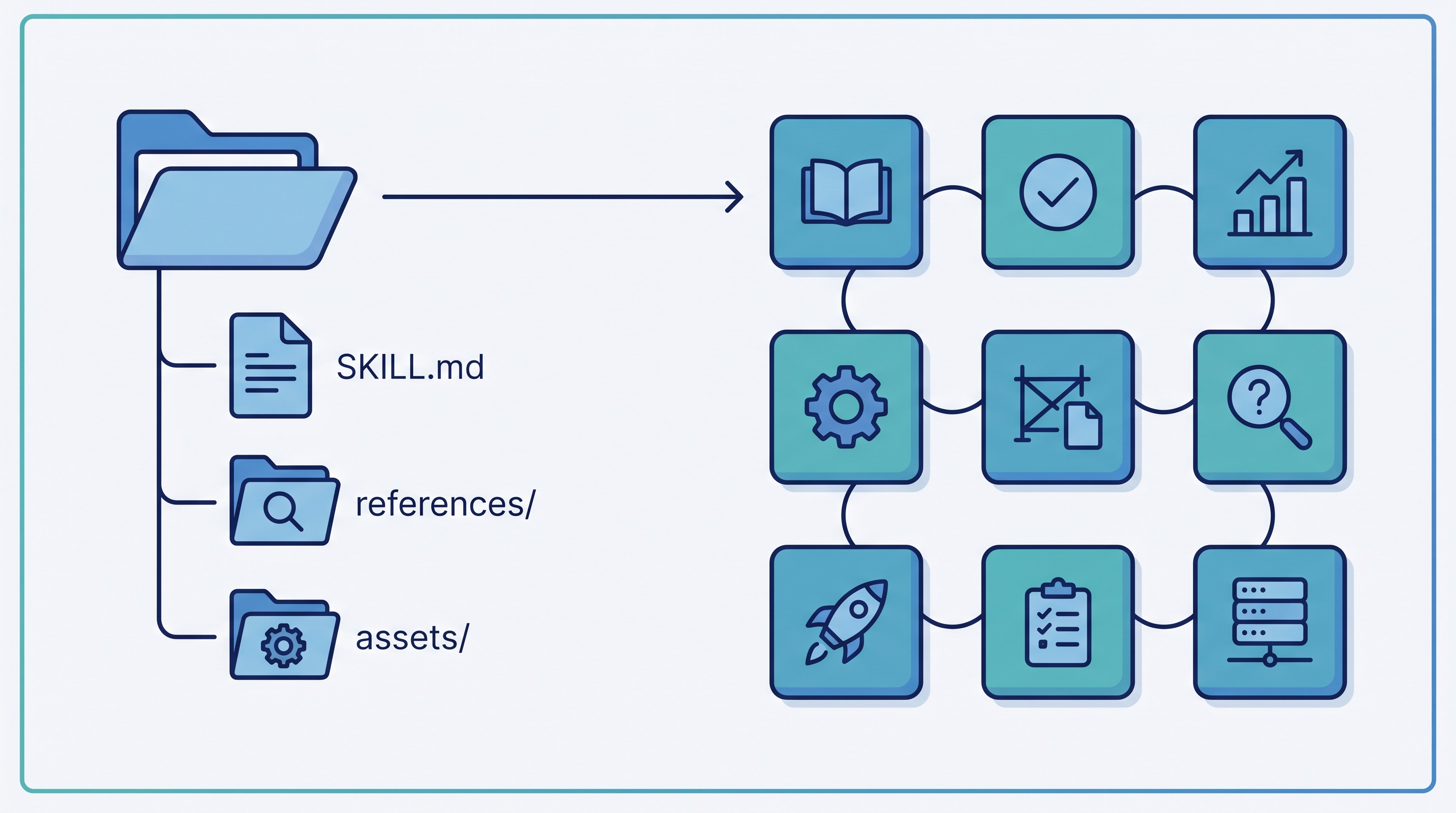
Thariq Shihipar (Claude Code team, Anthropic) published a concrete primary-source account of how Anthropic uses Skills internally — many of them, in production, across teams. The article proposes a nine-category taxonomy that the skills he’s seen tend to fall into, names the Gotchas section as the highest-signal block in any SKILL.md, and reframes skills as folders, not files — turning the filesystem into a progressive-disclosure mechanism for context engineering. It reads as a practitioner manual for the Skills abstraction Anthropic introduced last year.
| *Source: Thariq on X — original thread | LinkedIn: Lessons from Building Claude Code — How We Use Skills | DEV.to summary — 9-Category Framework | Threads mirror* |
The Headline Reframe
“A skill is a folder, not just a markdown file.”
Most teams write skills as a single SKILL.md and stop. Thariq’s argument: the filesystem is the skill. References live in references/, templates live in assets/, helper scripts live alongside the markdown. The agent discovers and reads them at the right time. This turns a skill from a static prompt into a structured workspace the agent can navigate.
The 9-Category Framework
After cataloging the skills in active use on Thariq’s team, he observed they cluster into nine recurring categories. The best skills fit cleanly into one; confused ones straddle several. Treat the list as a useful working taxonomy, not a fixed standard.
| # | Category | Purpose | Example Skill Names |
|---|---|---|---|
| 1 | Library & API Reference | Teach Claude how to use a library or CLI — with gotchas | billing-lib, frontend-design, auth-sdk |
| 2 | Product Verification | End-to-end check that a feature still works | signup-flow-driver, checkout-verifier |
| 3 | Data Fetching & Analysis | Hook into the data/monitoring stack | funnel-query, cohort-compare |
| 4 | Business Process & Team Automation | Recurring workflow with shared output | standup-post, ticket-create |
| 5 | Code Scaffolding & Templates | Generate framework-conformant boilerplate | new-migration, create-app |
| 6 | Code Quality & Review | Enforce house style and review standards | adversarial-review, code-style |
| 7 | CI/CD & Deployment | Babysit PRs, push, deploy, roll back | babysit-pr, deploy-service |
| 8 | Runbooks | Multi-tool investigation: symptom → structured report | Incident triage, customer-issue dispatch |
| 9 | Infrastructure Operations | Routine ops with safety guardrails | Orphan-resource cleanup, dependency bumps |
Why this matters: Most external teams only use 2–3 of these categories — usually 1, 5, and 6 (libraries, scaffolding, code quality). The other six are where the long-tail productivity gains live. Read the list as a checklist for what your team is not yet automating.
The Gotchas Pattern — The Highest-Signal Block
The single most quoted line in the article:
“The highest-signal content in any skill is the Gotchas section.”
Example structure (from a billing-lib skill):
---
name: billing-lib
description: Use when working with invoicing, proration, or Stripe webhooks.
---

# Billing Library

## Gotchas

- Proration rounds DOWN, not nearest cent.
- test-mode skips invoice.finalized hook.
- refunds need charge ID, not invoice ID.
- idempotency keys expire after 24h.
Gotchas capture what the docs don’t say — undocumented edge cases, rate-limit surprises, environment-specific quirks, lessons learned from real failures. They’re built iteratively: every time Claude trips on a new edge case, you append it. This is the loop that makes skills compound over time.
Practical rule: if your skill has no Gotchas section, you haven’t used it long enough.
Progressive Disclosure as Context Engineering
Context is finite. Don’t burn it on content Claude doesn’t need right now.
billing-lib/
├── SKILL.md              # entry point — high-signal only
├── references/
│   ├── api.md            # full method reference (loaded on demand)
│   ├── webhooks.md       # webhook event catalog
│   └── error-codes.md    # error → meaning mapping
├── assets/
│   ├── invoice.tmpl.json # copy-and-fill templates
│   └── retry.tmpl.ts
└── scripts/
    └── reconcile.ts      # run when reconciliation needed
The SKILL.md tells Claude what’s in the folder and when to read each file. Claude pulls deeper context only when the task demands it. The pattern: keep the entry point small and high-signal; push detail into references/ files that load on demand. The savings show up as fewer tokens spent on context the agent doesn’t need for the current task.
The Description Field Is a Trigger, Not a Summary
“The description field is not a summary — it’s a description of when to trigger this skill.”
Anthropic uses descriptions as routing signals. At session startup, Claude reads every skill’s description and decides which are relevant. A bad description sinks even a great skill.
| Bad Description | Good Description |
|---|---|
| “Library for working with payments” | “Use when modifying anything in src/billing/, when reasoning about Stripe webhook payloads, or when invoices/refunds/proration logic is being touched.” |
| “Helps with deployment” | “Use when shipping a PR — runs preflight, monitors deploy, alerts on regressions.” |
Write descriptions like trigger conditions, not catalog blurbs.
Three Anti-Patterns to Avoid
1. Railroading
Don’t write step-by-step procedures. Give Claude the information and let it adapt to the situation. Overly prescriptive skills break the moment context shifts.
2. Stating the Obvious
Don’t tell Claude what it already knows about coding. Skills are valuable when they push Claude out of its default behavior — into your team’s specific patterns, your stack’s specific gotchas, your domain’s specific terminology.
3. Vague Descriptions
Already covered above — but worth repeating. If two skills have overlapping descriptions, Claude won’t know which to use, and both will quietly underperform.
Patterns Worth Stealing
| Pattern | What It Does |
|---|---|
| Config.json + AskUserQuestion | Skills define structured config; use AskUserQuestion to fill it interactively the first time |
| Append-only memory logs | standups.log, decisions.log — skills both read and write these, building team memory over time |
| PreToolUse hooks for adoption tracking | Wrap skill invocations to measure which skills actually get used, then prune the dead ones |
| Composable helper scripts | Don’t ask Claude to write reconciliation logic every time — give it a scripts/reconcile.ts to call |
| On-demand safety hooks | /careful (blocks destructive commands), /freeze (restricts edits to safe directories) — load only when needed |
Distribution Strategy
- Small teams: Check skills into the repo at
./.claude/skills/. Version control = audit trail. - Large orgs: Internal plugin marketplace (Anthropic’s own pattern). Skills get curated, deprecated, and rated.
- Open source: GitHub repos like
addyosmani/agent-skills,mattpocock/skills,kepano/obsidian-skills— install vianpx skills add.
Curation matters more than creation. Skills almost always start simple and improve as gotchas accumulate.
Where This Fits in the Skills Landscape
| Source | Angle |
|---|---|
| Karpathy | Four rules in a CLAUDE.md to fix LLM coding’s worst habits |
| Addy Osmani | 20 senior-engineering practices as SKILL.md files (lifecycle-focused) |
| Matt Pocock | Discipline skills for real engineers (TDD, debugging, requirements grilling) |
| Kepano | Skills as knowledge-work tools (Obsidian-style) |
| Thariq (this entry) | Anthropic’s own internal taxonomy + the Gotchas/progressive-disclosure patterns |
Thariq’s piece is an unusually concrete primary-source view from the team that designed the abstraction. The other resources show patterns; this one shows the working taxonomy behind them.
How LearnAI Team Could Use This
- Skill-design curriculum — teach the 9 categories as a working taxonomy. Students audit any skill repo and classify each skill into one of the 9; misclassifications expose poor scoping.
- Gotchas-driven iteration — make Gotchas-writing a required step in every student skill submission. “What broke when you used it?” becomes a graded artifact.
- Progressive disclosure as a teaching tool — students rewrite a single 50KB doc into a SKILL.md + references/ structure; compare context usage before/after.
- Description-writing drills — give students 5 skill names and have them write trigger descriptions; peer-rate for routing clarity.
- Mapping LearnAI’s own workflows — which of the 9 categories does the LearnAI team already automate? Where are the gaps? Often the answer is categories 3, 4, and 8 (data fetching, business process, runbooks).
Real-World Use Cases
- Internal libraries with non-obvious behavior — every team has one. Wrap it in a skill, document the gotchas, and stop re-explaining proration semantics in every PR review.
- Onboarding playbooks — new hires use skills 2 and 4 (product verification + business process) to learn the system by running it.
- Incident response — category 8 (runbooks) turns symptom-to-resolution from tribal knowledge into a callable skill.
- Customer-facing product teams — combine categories 1, 3, and 6 to give support engineers a Claude that knows the product, the data warehouse, and the review standards.
- Solo developers — even one person benefits: a Gotchas section in your personal
notes/skill compounds across projects.
Links
- Thariq’s X thread: @trq212
- LinkedIn article: Lessons from Building Claude Code: How We Use Skills
- Thariq’s earlier piece on tool design: Seeing Like an Agent
- Companion entries in this wiki: Addy Osmani, Matt Pocock, Karpathy, Kepano on skills