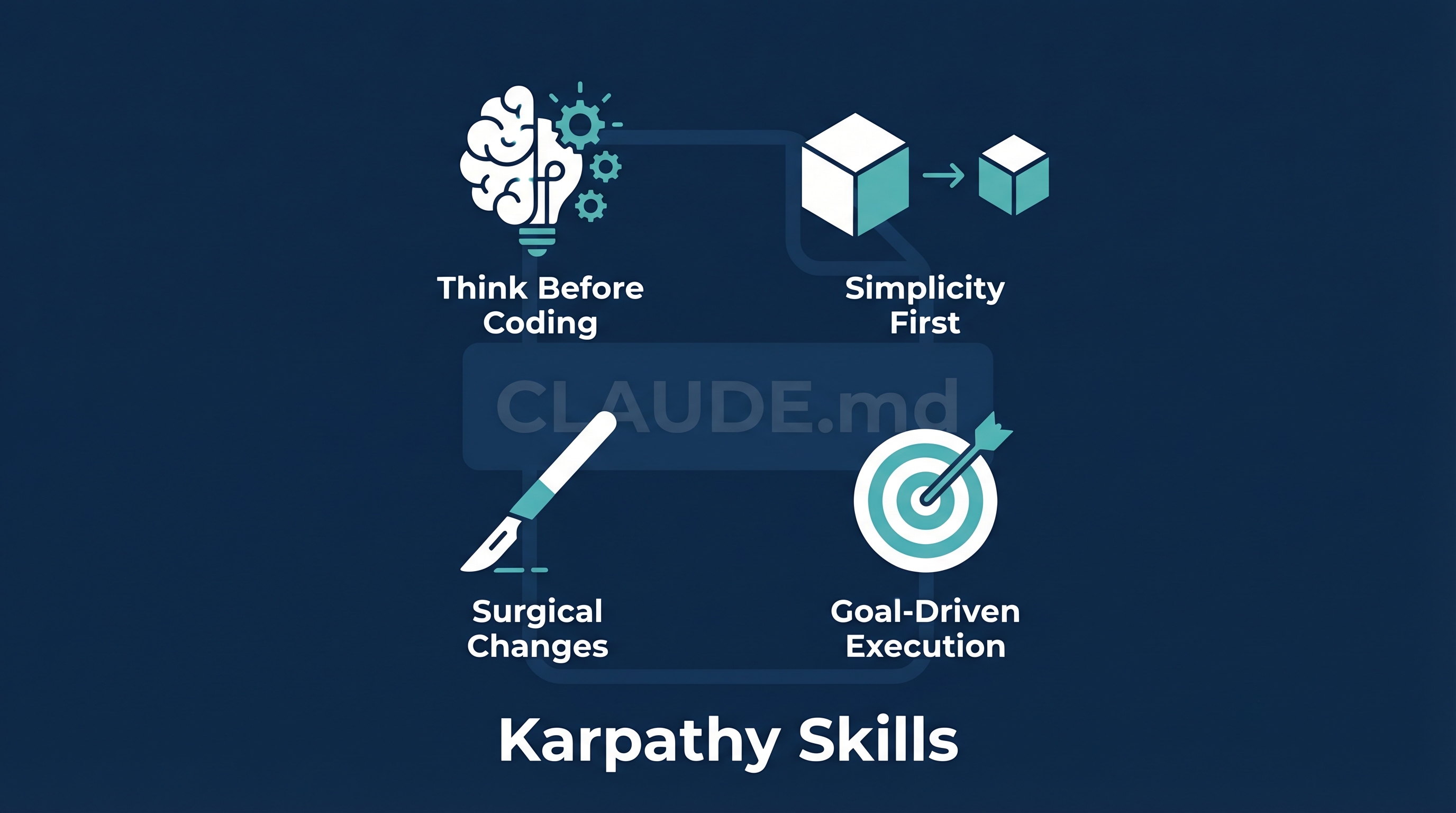
Andrej Karpathy identified three ways LLMs fail at coding: they assume silently (guess what you mean and barrel forward), overcomplicate (1000 lines when 100 would do), and cause collateral damage (touch code you didn’t ask them to). andrej-karpathy-skills distills these observations into four CLAUDE.md rules that fix the behavior directly. 40k+ stars (as of April 2026), one file, instant improvement.
| *Source: GitHub — forrestchang/andrej-karpathy-skills (40k+ stars) | Karpathy’s original observations* |
The Four Rules
1. Think Before Coding
Don’t assume. Don’t hide confusion. Surface tradeoffs.
- State assumptions explicitly. If uncertain, ask.
- If multiple interpretations exist, present them — don’t pick silently.
- If a simpler approach exists, say so. Push back when warranted.
2. Simplicity First
Minimum code that solves the problem. Nothing speculative.
- No features beyond what was asked
- No abstractions for single-use code
- No error handling for impossible scenarios
- If 200 lines could be 50, rewrite it
Test: “Would a senior engineer say this is overcomplicated?” If yes, simplify.
3. Surgical Changes
Touch only what you must. Clean up only your own mess.
- Don’t “improve” adjacent code, comments, or formatting
- Don’t refactor things that aren’t broken
- Match existing style, even if you’d do it differently
- Only remove imports/variables that your changes made unused
Test: Every changed line should trace directly to the user’s request.
4. Goal-Driven Execution
Define success criteria. Loop until verified.
Transform vague tasks into testable goals:
- “Add validation” → Write tests for invalid inputs, then make them pass
- “Fix the bug” → Write a test that reproduces it, then make it pass
- “Refactor X” → Ensure tests pass before and after
What Problem Each Rule Solves
| Karpathy Observation | Rule | Fix |
|---|---|---|
| Models assume silently, don’t seek clarification | Think Before Coding | Force explicit assumptions, ask before guessing |
| Models don’t push back when they should | Think Before Coding | “Push back when warranted” |
| Overcomplicated code, bloated abstractions | Simplicity First | Hard cap: no speculative features |
| Models “improve” code they weren’t asked to touch | Surgical Changes | Every changed line traces to the request |
| Vague goals lead to wrong implementations | Goal-Driven Execution | Convert to verifiable tests first |
Installation
# As a Claude Code plugin (recommended)
/plugin marketplace add forrestchang/andrej-karpathy-skills
/plugin install andrej-karpathy-skills@karpathy-skills

# Or manual — new project
curl -o CLAUDE.md https://raw.githubusercontent.com/forrestchang/andrej-karpathy-skills/main/CLAUDE.md

# Append to existing CLAUDE.md
echo "" >> CLAUDE.md
curl https://raw.githubusercontent.com/forrestchang/andrej-karpathy-skills/main/CLAUDE.md >> CLAUDE.md
Real Results
- Users report fewer unnecessary diff changes and simpler initial implementations
- Clarifying questions come before implementation rather than after mistakes
- Shopify CEO Tobi Lutke reportedly used the Karpathy approach on Shopify’s templating engine → 53% faster rendering from 93 automated commits
How LearnAI Team Could Use This
- Student coding with AI — Install as default CLAUDE.md for student projects. Prevents the #1 student complaint: “Claude wrote 500 lines of code I didn’t ask for and broke my existing code.”
- Teaching code review — The four rules are a checklist for code review: Did the AI assume? Did it overcomplicate? Did it touch unrelated code? Did it verify?
- Research tool development — When using Claude Code for research prototypes, Surgical Changes prevents unintended modifications to working code.
- CLAUDE.md curriculum — Use as a teaching example of how to write effective AI instructions. Compare with Q’s own CLAUDE.md to show different approaches to the same problems.
Real-World Use Cases
- Enterprise Claude Code deployments — Teams install this as the base CLAUDE.md for all projects, ensuring consistent AI behavior across the organization.
- Code review automation — The four rules become the review checklist for AI-generated PRs.
- Junior developer guardrails — New developers using AI get protection against the most common failure modes without needing to learn them the hard way.
- Open-source contributions — Maintainers add this to
.claude/CLAUDE.mdso AI-generated PRs follow project conventions and don’t include drive-by refactors.
Tradeoff
The README is honest: these guidelines bias toward caution over speed. For trivial tasks (typo fixes, obvious one-liners), the full rigor is overkill. The value is preventing costly errors in substantial work.