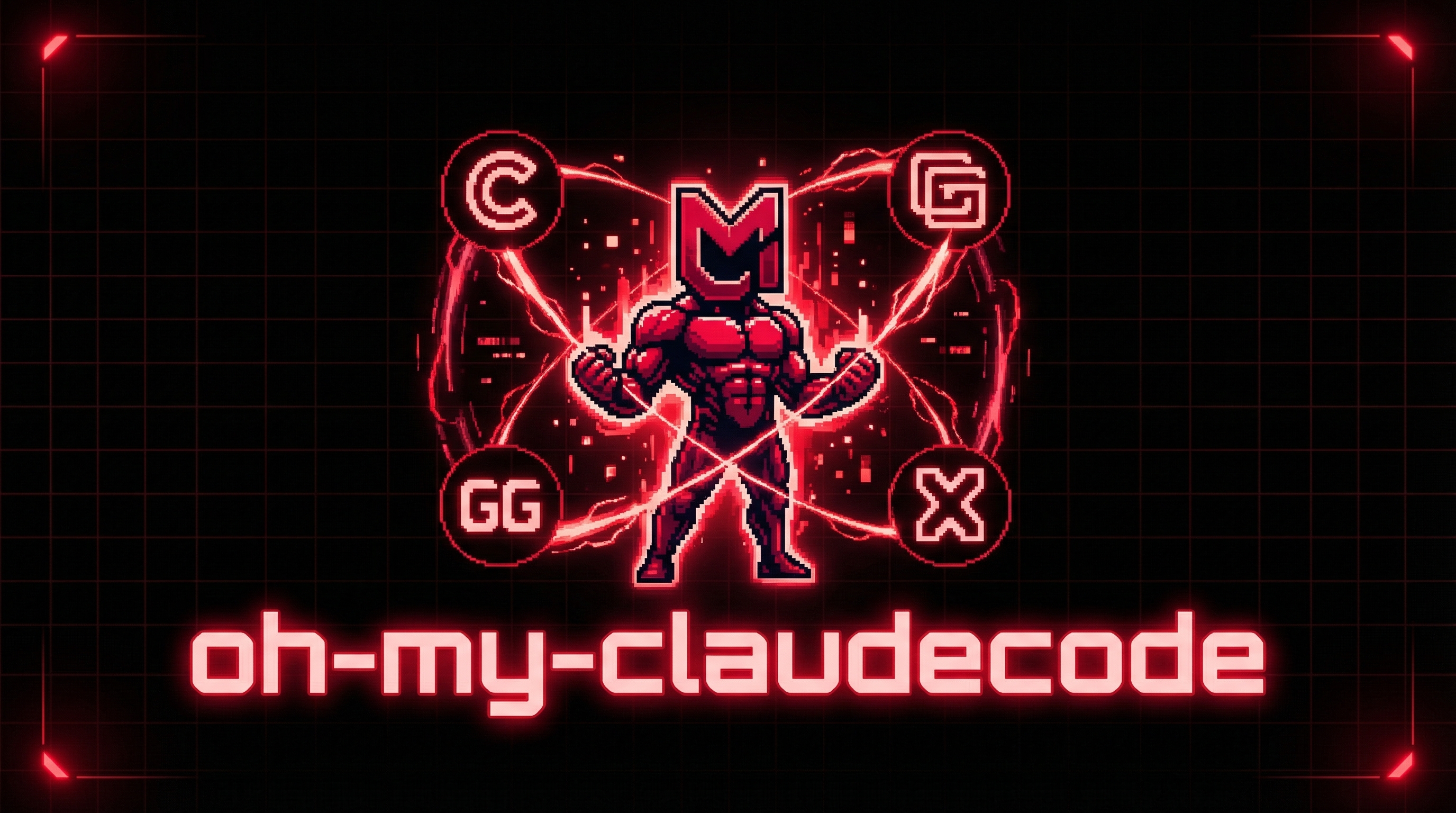
“A weapon, not a tool.” oh-my-claudecode (OMC) is a multi-AI orchestration plugin for Claude Code that coordinates Claude, Gemini, and Codex with 19+ specialized agents, 28 skills, and MCP-powered tools. 14.5K stars, 26.5K installs, zero learning curve — just describe what you want.
| *Source: GitHub — Yeachan-Heo/oh-my-claudecode | Documentation | 爱可可-爱生活 on Weibo* |
Quick Start
# In Claude Code:
/plugin marketplace add https://github.com/Yeachan-Heo/oh-my-claudecode
/plugin install oh-my-claudecode

# Or via npm:
npm i -g oh-my-claude-sisyphus@latest

# Setup:
/setup

# Build something:
autopilot: build a REST API for managing tasks
That’s it. Everything else is automatic.
Orchestration Modes
OMC’s core strength: multiple execution strategies for different task types.
| Mode | What It Does | Best For |
|---|---|---|
| Team (recommended) | Staged pipeline: plan → prd → exec → verify → fix |
Coordinated multi-agent work with shared task list |
| omc team (CLI) | tmux workers — real claude/codex/gemini processes in split panes |
Multi-model tasks; workers spawn on-demand, die when done |
| ccg | /ask codex + /ask gemini, Claude synthesizes |
Mixed backend + UI work needing both Codex and Gemini perspectives |
| Autopilot | Single lead agent, autonomous execution | End-to-end feature work with minimal ceremony |
| Ultrawork | Maximum parallelism (non-team) | Burst parallel fixes/refactors |
| Ralph | Persistent mode with verify/fix loops | Tasks that must complete fully (no silent partials) |
| Pipeline | Sequential staged processing | Multi-step transformations with strict ordering |
Team Mode Pipeline
team-plan → team-prd → team-exec → team-verify → team-fix (loop)
# Spawn 3 executor agents for parallel work
/team 3:executor "fix all TypeScript errors"

# Multi-model teams via CLI
omc team 2:codex "review auth module for security issues"
omc team 2:gemini "redesign UI components for accessibility"
omc team 1:claude "implement the payment flow"
Magic Keywords
Natural language works fine, but power users get shortcuts:
| Keyword | Effect |
|---|---|
autopilot: <task> |
Full autonomous execution |
ralph: <task> |
Persistent mode (includes ultrawork) |
ulw <task> |
Maximum parallelism |
ralplan <task> |
Iterative planning consensus |
deep-interview "<idea>" |
Socratic requirements clarification |
deepsearch <query> |
Codebase-focused search routing |
ultrathink <topic> |
Deep reasoning mode |
Key Features
32 Specialized Agents
Architecture, research, design, testing, data science — each agent has domain expertise. OMC routes to the right agent automatically.
Smart Model Routing
Haiku for simple tasks, Opus for complex reasoning. Saves 30-50% on tokens compared to always-Opus.
Deep Interview
Not sure what to build? The Socratic interview mode exposes hidden assumptions before any code is written:
/deep-interview "I want to build a task management app"
Measures clarity across weighted dimensions, ensuring you know exactly what to build before execution begins.
Custom Skills — Learn Once, Reuse Forever
OMC extracts debugging knowledge into portable skill files that auto-inject when relevant:
# .omc/skills/fix-proxy-crash.md
---
name: Fix Proxy Crash
triggers: ["proxy", "aiohttp", "disconnected"]
---
Wrap handler at server.py:42 in try/except ClientDisconnectedError...
| Scope | Path | Shared With |
|---|---|---|
| Project | .omc/skills/ |
Team (version-controlled) |
| User | ~/.omc/skills/ |
All your projects |
HUD Statusline
Real-time orchestration metrics in your terminal status bar — see what agents are doing, token usage, and execution state at a glance.
Rate Limit Auto-Resume
omc wait --start # Enable auto-resume daemon
Detects rate limits, waits for reset, auto-resumes your Claude Code session.
Provider Advisor
Query any AI provider directly and save artifacts:
omc ask claude "review this migration plan"
omc ask codex --prompt "identify architecture risks"
omc ask gemini --prompt "propose UI polish ideas"
Results saved as markdown in .omc/artifacts/ask/.
Notifications
Stop callbacks for Telegram, Discord, Slack — get tagged when sessions complete:
omc config-stop-callback telegram --enable --token <bot_token> --chat <chat_id>
omc config-stop-callback discord --enable --webhook <url>
The Creator
Yeachan Heo (@bellman_ych) — also created oh-my-codex (OmX) for OpenAI Codex. Both OMC and OmX were used to build the Claw Code clean-room rewrite of Claude Code’s harness.
Why This Matters
OMC represents the orchestration layer thesis: the value isn’t in any single model, but in how you coordinate multiple models with specialized agents, persistent execution, and automatic quality verification. It’s harness engineering packaged as a plugin.
| Without OMC | With OMC |
|---|---|
| Single model, single task | Multiple models, parallel agents |
| Manual delegation | Automatic routing by task type |
| One-shot execution | Verify/fix loops until complete |
| Generic Claude | 32 specialized domain agents |
| Manual cost tracking | Smart model routing saves 30-50% |
How LearnAI Team Could Use This
- Parallel documentation work — Split research, drafting, review, and polish across specialized agents while keeping a shared execution pipeline.
- Course tooling experiments — Prototype LearnAI teaching utilities with staged plan, implementation, verification, and fix loops.
- Research/code review — Ask Codex, Gemini, and Claude for separate reviews of the same codebase or paper, then synthesize findings.
- Reusable team skills — Capture recurring LearnAI workflows as
.omc/skills/files for future agent reuse. - Long-running automation — Use rate-limit resume and notifications for jobs that need to finish without constant terminal monitoring.
Real-World Use Cases
- Engineering teams coordinating multi-agent implementation and verification work inside Claude Code.
- Researchers comparing model perspectives on code, experiments, or paper drafts.
- Educators building teaching demos, course infrastructure, and review materials with staged agent workflows.
- Solo developers using autopilot or Ralph mode for end-to-end feature work with verify/fix loops.
- AI operations teams standardizing reusable skills, provider routing, and completion notifications across projects.