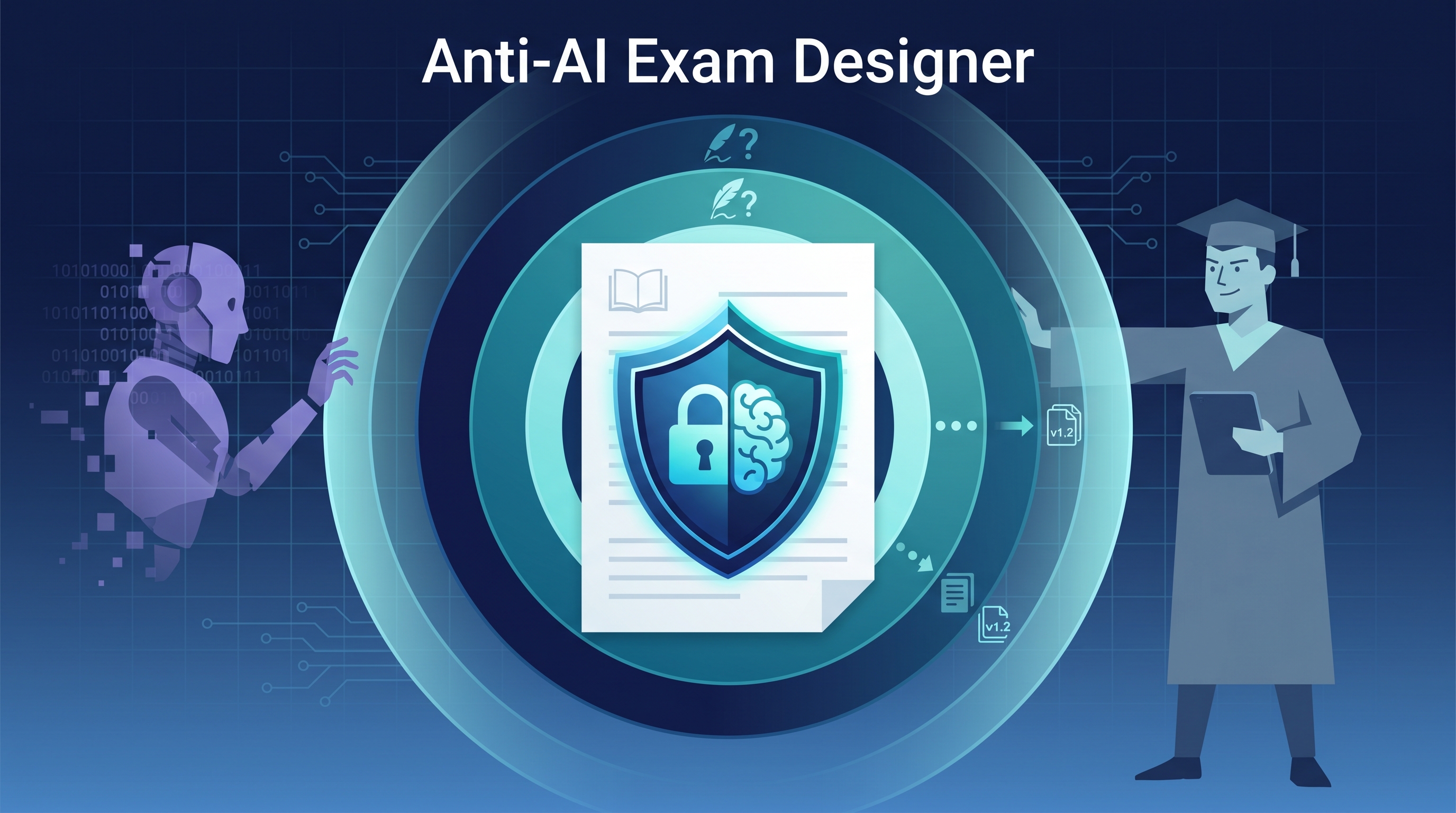
A Claude Code skill that helps CS professors design exams where AI-generated answers are detectably wrong. Instead of trying to detect AI usage after the fact, this skill flips the problem: make AI answers carry telltale signatures that only show up when a student bypasses the learning process. Built from adversarial testing against Claude, ChatGPT, and Codex during Spring 2026.
| *Source: GitHub: anti-ai-exam-skill | Cengage: 8 Ways to Prevent Cheating With AI | Inside Higher Ed: Best Defense Against AI Cheating | Claude Code Skills Docs* |
The Core Insight
Most anti-AI strategies try to detect AI usage. This skill takes a different approach: design the exam so AI gets it wrong in predictable, detectable ways. The key exploit is that AI models rely on public knowledge — textbook definitions, standard notation, common conventions. Anything taught exclusively in your classroom is invisible to AI.
Traditional approach:                This skill's approach:
  Student → AI → Answer              Student → AI → Wrong Answer (detectable)
  Professor → Detection tool (?)     Professor → Grading rubric catches it
  Result: Arms race                  Result: AI usage = lower grade
How It Works — Three Phases
The skill runs as an interactive workflow inside Claude Code:
┌─────────────────────────────────────────────────┐
│  /anti-ai-exam                                  │
│                                                 │
│  Phase 1: CONSULT ──→ Phase 2: AUDIT            │
│  Adaptive interview     Test questions           │
│  about your course      against AI               │
│       │                      │                   │
│       ▼                      ▼                   │
│  strategies.md          audit-report.md          │
│                              │                   │
│              ┌───────────────┘                   │
│              ▼                                   │
│  Phase 3: GENERATE                               │
│  Exam .docx + Solution + Rubric + AI Baseline   │
└─────────────────────────────────────────────────┘
Phase 1 — Consulting: An adaptive interview asks about your course (subject, level, exam format, class size), then branches into subject-specific questions. Output: a ranked list of anti-AI strategies tailored to your course.
Phase 2 — Adversarial Audit: Paste your exam questions or upload a file. The skill runs a simulated vulnerability scan (always) and optionally a live adversarial test (it actually tries to answer your questions as a student would submit them to AI). Output: per-question vulnerability scores and hardening recommendations.
Phase 3 — Output Generation: Generates a complete exam package — the exam document (.docx) with traps baked in, solution key, AI baseline (what AI would answer), grading rubric with AI-detection flag scoring, and a detection checklist for graders.
The Strategy Arsenal — 28+ Tested Traps
The skill ships with 7 CS subject modules plus 4 universal strategies. Here are the highest-impact ones:
Universal Strategies (work in any CS course)
| Strategy | Catch Rate | How It Works |
|---|---|---|
| Version Watermarking | ~100% | Print 2-3 versions with different constants. Mismatch = copied. |
| Verbal Correction Trap | ~100% | Print a deliberate typo, correct it verbally in class. AI uses the typo. |
| Step-by-Step Format | ~90% | Require labeled intermediate steps. AI produces single nested expressions. |
| Cross-Student Detection | — | Framework for spotting identical structures, version mismatches, unknown symbols. |
Subject-Specific Examples
Databases — Undefined Semantics Trap (~75%): Design your schema so painting.aid looks like “the artist who created it” but you teach in class that it means “the buyer.” AI joins tables directly using the obvious meaning — wrong answer. In testing, AI scored 10/30 points on an 8-question exam.
Architecture — Custom Opcode Mnemonics (~100%): Define abbreviated mnemonics in class (LD instead of LOAD, SKP instead of SKIPCOND). AI always uses full standard mnemonics. Any student using standard instead of class notation is instantly flagged.
Algorithms — “Explain Your Approach” (~90%): Require 2-3 sentences referencing class discussion before the formal solution. AI cannot reference Lecture 15’s proof technique.
Data Structures — Method Name Misdirection (~75%): Define BST.successor(node) to return the in-order predecessor in your implementation. AI assumes the textbook definition.
The Layering Principle
Any single trap might fail. The skill recommends combining 3-4 independent traps — the probability of AI navigating all of them drops to near zero:
Single trap:      ~75% catch rate
Two traps:        ~94% catch rate  (1 - 0.25 × 0.25)
Three traps:      ~98% catch rate  (1 - 0.25³)
Four traps:       ~99.6% catch rate
Supported CS Subjects
| Module | Key Traps | # Strategies |
|---|---|---|
| Databases | Undefined semantics, custom RA notation, division/universal quantifier, step-by-step format | 4 |
| Data Structures | Method name misdirection, trace format, custom pseudocode, implementation details | 4 |
| Algorithms | Proof format, recurrence notation, algorithm variants, explain-your-approach | 4 |
| Architecture | Assembly dialect, hand-assembly steps, custom opcodes, execution trace format | 4 |
| Networking | Protocol field meaning, diagram notation, packet trace format, layer model | 4 |
| Operating Systems | Scheduling variables, state diagram notation, trace tables, synchronization | 4 |
| Programming | Custom style, explain-before-code, API naming, output format | 4 |
The skill is designed for extensibility — adding a new discipline means adding a strategy module following the template. The orchestrator picks up new modules automatically.
Course Profiles — Semester-Over-Semester Evolution
The skill saves everything to anti-ai-profiles/<course>/:
anti-ai-profiles/cs432/
├── profile.json           ← Course metadata from interview
├── strategies.md          ← Active trap strategies
├── trap-history.json      ← Which traps used per exam
├── notation.md            ← Custom notation definitions
└── exams/
    └── midterm-2026/
        ├── audit-report.md      ← AI vulnerability analysis
        ├── detection-checklist.md
        ├── exam.docx            ← Generated exam (optional)
        ├── solution.docx        ← Solution key (optional)
        ├── ai-baseline.md       ← What AI would answer
        └── rubric.md            ← Grading rubric with AI-flag scoring
When you come back for the next exam, the skill:
- Warns against reusing the same traps (students share strategies)
- Suggests rotation (“You used undefined semantics on the midterm — try the notation trap for the final”)
- Tracks effectiveness over time
Installation
git clone https://github.com/weihaoqu/anti-ai-exam-skill ~/.claude/skills/anti-ai-exam
The skill is immediately available. Invoke with /anti-ai-exam or describe what you need (“audit my exam against AI”, “make my database exam AI-proof”).
Case Study: Building This Skill
This skill was built in a single Claude Code session, demonstrating the full workflow from idea to published tool:
Starting point: A Word document (anti-ai-exam-guide.docx) containing adversarial testing results from a CS database course — catch rates, tested strategies, detection flags.
Design phase (brainstorming skill): Five questions shaped the skill’s architecture:
- What should it do? → Consulting + audit (both needed)
- Which subjects? → CS-focused now, extensible later
- How to test questions? → Simulated fast pass + optional live adversarial test
- How deep an interview? → Adaptive (start light, go deeper when there’s a payoff)
- What output? → Structured files + optional exam .docx, solution, rubric
Architecture decision: Orchestrator + phases (single /anti-ai-exam entry point, but internally modular). Rejected: monolithic skill (hard to extend) and skill suite (fragmented UX).
Build: The complete SKILL.md was written in one pass since all sections are interdependent, then verified by a review subagent against the design document. The review confirmed 100% design coverage with expansions in several areas.
Publishing: Created a public GitHub repo with README and MIT license. Collaborators install with a single git clone command.
Total session time: Design (brainstorming + plan) → implementation → review → publish, all in one conversation.
How LearnAI Team Could Use This
- Create an internal assessment-design checklist for AI-resistant quizzes, coding exams, and project rubrics.
- Use the skill to audit LearnAI course assessments before release, especially where students could paste questions directly into chatbots.
- Teach instructors to design assessments around local context, class-specific notation, oral corrections, and required intermediate reasoning.
Real-World Use Cases
- Auditing a CS database midterm for questions that AI can answer using standard textbook assumptions.
- Generating alternate exam versions with watermark constants and grading flags for copied or AI-generated answers.
- Building rubrics that reward class-specific reasoning rather than generic final answers.
Philosophy
These strategies are not “gotcha” traps. They reward students who attend class, read carefully, and understand the material. Every trap has a straightforward correct answer for the prepared student. The goal is to make AI answers detectably wrong — shifting the cost-benefit away from cheating.
As Inside Higher Ed notes, the best defense against AI cheating isn’t detection technology — it’s assessment design that makes genuine understanding the path of least resistance.