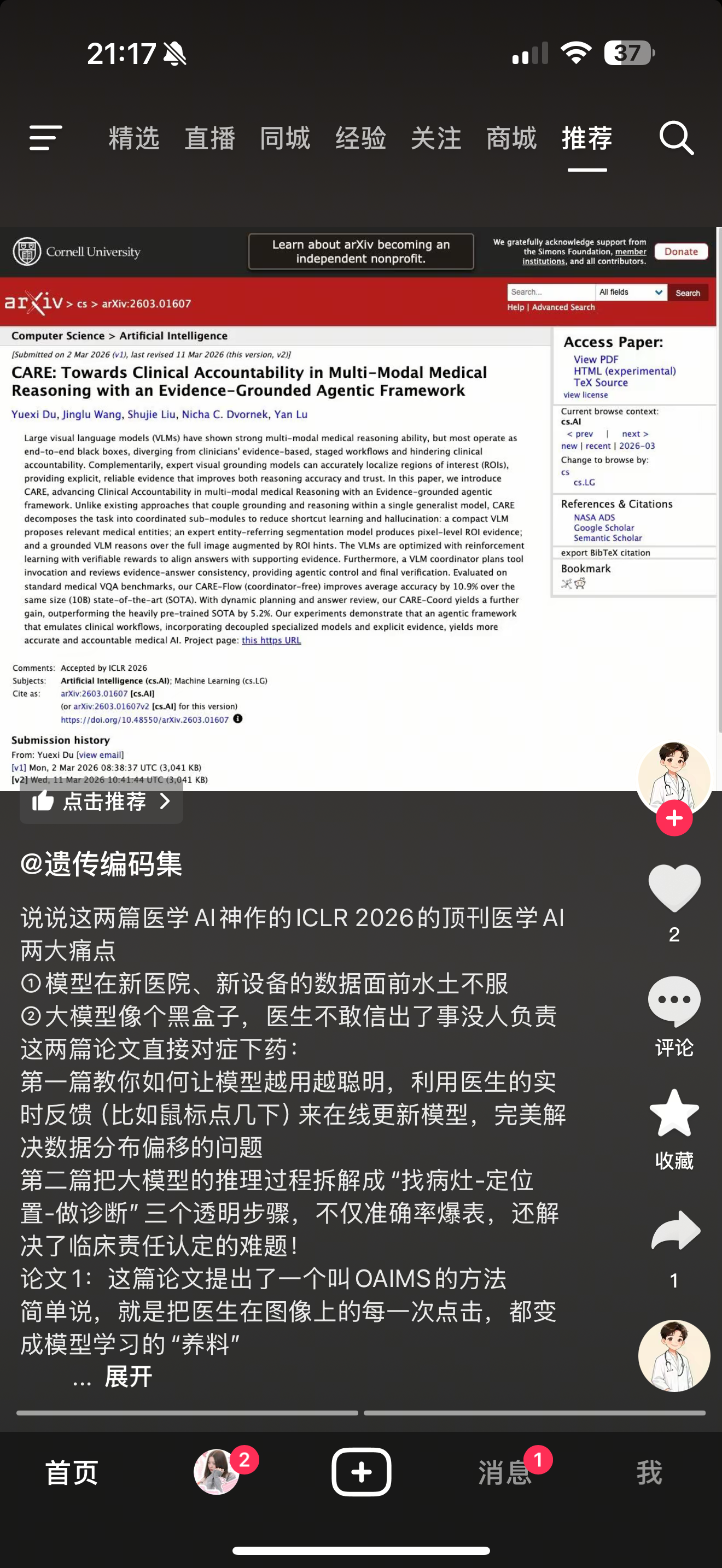
CARE is a medical-AI paper about making multimodal reasoning more accountable. The core design choice is to avoid asking one general model to do everything. Instead, CARE decomposes reasoning into coordinated modules: identify relevant medical entities, ground them visually, reason over the image with evidence, and verify consistency.
The Architecture Lesson
medical image/question
        |
        v
compact VLM proposes entities
        |
        v
segmentation model grounds regions of interest
        |
        v
grounded VLM reasons with evidence hints
        |
        v
coordinator reviews evidence-answer consistency
That decomposition is the reason this belongs in an agent-engineering wiki. It is not just “AI for medicine”; it is a case study in splitting a high-risk reasoning task into smaller verifiable steps.
Why Students Should Care
Medical AI is a good domain for learning accountability because wrong answers matter. CARE gives students a concrete pattern:
| Risk | CARE-style response |
|---|---|
| Black-box answer | Add explicit evidence regions |
| Shortcut reasoning | Split grounding from final reasoning |
| Hallucinated finding | Require evidence-answer consistency review |
| One-model brittleness | Coordinate specialized modules |
Teaching Use
This can be a reading note in an AI agents or medical AI module:
- Ask students to identify each model/tool role.
- Draw the data flow.
- Mark where hallucination could enter.
- Propose one additional audit check.
- Discuss whether the design improves accountability or only moves the trust problem.
Caveats
- This is a research paper, not clinical deployment guidance.
- Reported benchmark gains do not prove real-world safety.
- Medical images, patient data, and clinical decisions require governance far beyond an agent architecture.
Best LearnAI Use
Use CARE as a concrete example of “agentic workflow = model + tools + verifier.” It pairs well with Towards a Medical AI Scientist because one page covers end-to-end clinical research automation, while this page focuses on evidence-grounded reasoning inside a clinical task.