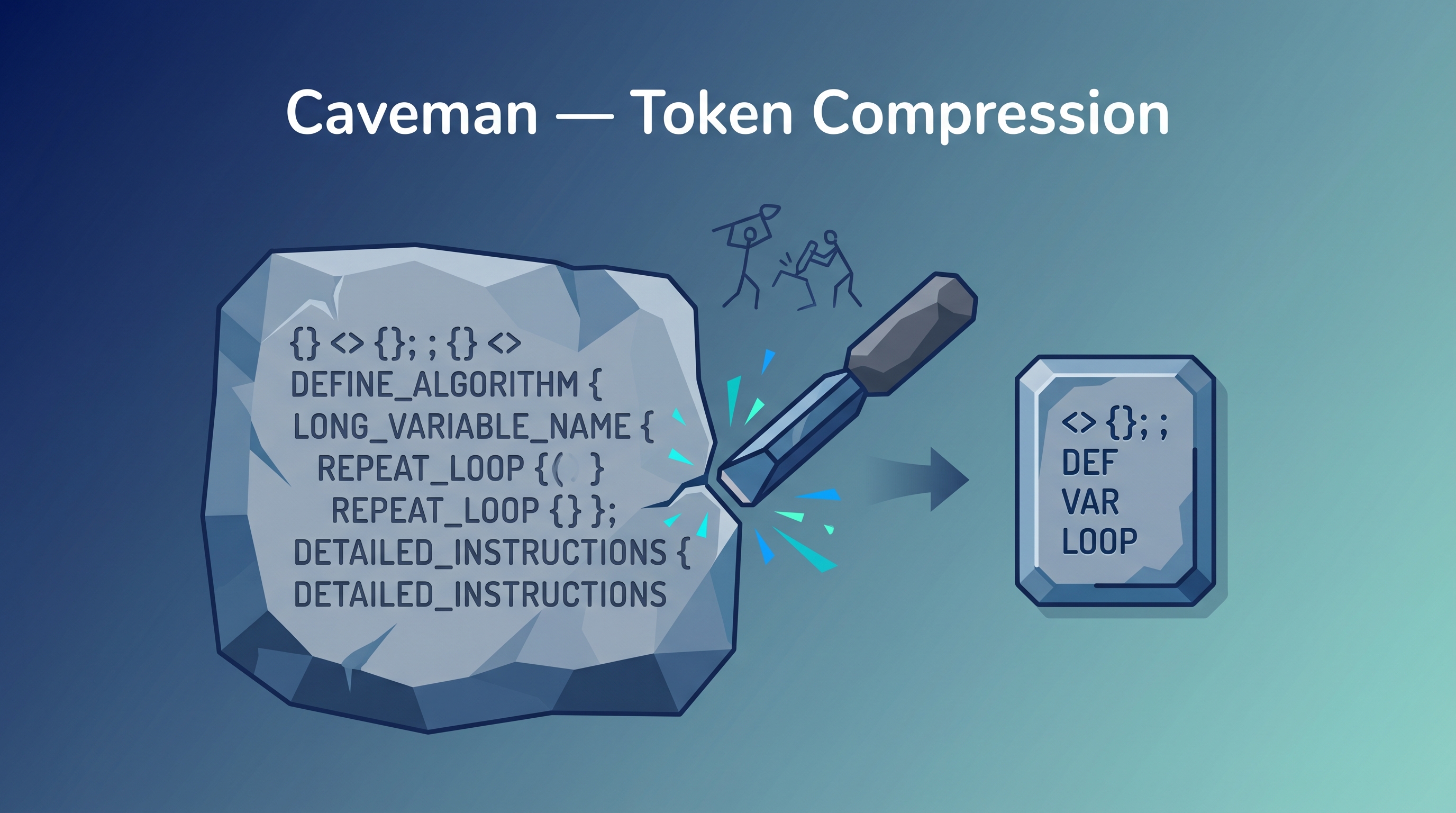
Caveman is a skill/plugin that makes AI coding agents talk like a caveman — cutting 65% of output tokens on average (range: 22-87% by task) while maintaining technical accuracy. It strips articles, filler words, and pleasantries from agent responses without touching code generation, tool calls, or internal reasoning. With ~46.8k GitHub stars, it’s become one of the most popular Claude Code skills in the ecosystem.
| *Source: GitHub - JuliusBrussee/caveman | Brevity Constraints Reverse Performance Hierarchies in Language Models | Caveman Tutorial* |
What It Does
Caveman targets the “conversational fluff” that AI agents produce — the phrases that burn tokens but add zero value:
Before: "The reason your component re-renders is because
         you're creating a new object reference each render cycle..."

After:  "Inline obj prop → new ref → re-render. useMemo."
Three things it strips first:
- Articles — a, an, the
- Filler words — just, basically, really, simply
- Pleasantries — “Sure!”, “I’d be happy to”, “Let me explain”
Six Compression Modes
Caveman offers three base levels, each with a Wenyan (文言文) variant that applies classical Chinese information density as a compression template:
| Mode | Style | Use Case |
|---|---|---|
| Lite | Remove fluff, keep grammar | Professional but concise |
| Full (default) | Fragments, caveman mode | Daily coding — max efficiency |
| Ultra | Telegram style, extreme compression | When every token counts |
| Wenyan-Lite | Classical Chinese density + grammar | Concise with literary compression |
| Wenyan | Classical Chinese density + fragments | Balanced density mode |
| Wenyan-Ultra | Maximum classical Chinese compression | Extreme density — “此非戏言,确实有效” |
Real Benchmark Data
Tested across 10 diverse coding tasks with actual API token counts:
| Task | Normal Tokens | Caveman Tokens | Savings |
|---|---|---|---|
| React re-render bug explanation | 1,180 | 159 | 87% |
| Auth middleware token expiry fix | 704 | 121 | 83% |
| PostgreSQL connection pool setup | 2,347 | 380 | 84% |
| Average across 10 tasks | 1,214 | 294 | 65% |
Range: 22%–87% depending on task verbosity. Explanatory tasks save more; code-heavy tasks save less.
Input compression via the caveman-compress companion skill reduces CLAUDE.md and context files by ~46%, meaning every session starts with fewer tokens loaded.
The Science: Brevity Actually Improves Accuracy
A March 2026 arxiv paper, “Brevity Constraints Reverse Performance Hierarchies in Language Models,” provides surprising evidence that Caveman’s approach isn’t just cheaper — it’s better:
Study: 31 models × 1,485 benchmark problems

Key findings:
├── Larger models underperform smaller ones by up to 28.4pp on ~7.7% of problems
├── Root cause: "spontaneous scale-dependent verbosity"
│   └── Bigger models over-elaborate, hedge, and introduce reasoning errors
└── Applying brevity constraints: large model accuracy jumped +26pp
The mechanism: large models “think out loud” too much, adding unnecessary qualifications and tangential reasoning that introduces errors. Forcing conciseness cuts off this failure mode.
Installation
Supports Claude Code, Codex, Gemini CLI, Cursor, Windsurf, Cline, Copilot, and more:
# Claude Code (two-step install)
claude plugin marketplace add JuliusBrussee/caveman
claude plugin install caveman@caveman

# Codex / Cursor / Windsurf / Cline / Copilot
npx skills add JuliusBrussee/caveman

# Gemini CLI (auto-activates via context files)
# See repo README for platform-specific setup
Claude Code users get auto-activation via hooks — install once, active permanently.
The Caveman Ecosystem
Caveman is part of a three-project toolkit:
| Project | Purpose | What It Compresses |
|---|---|---|
| caveman | Output compression | What the agent says |
| cavemem | Cross-agent persistent memory | What the agent remembers (local SQLite + MCP) |
| cavekit | Spec-driven autonomous build loops | How the agent works |
Companion skills included:
- caveman-commit — Terse Conventional Commits (≤50 chars)
- caveman-review — One-line PR review comments with location + issue
- caveman-compress — Rewrites CLAUDE.md/context files to caveman-speak (~46% input savings)
- caveman-help — Quick reference for all modes and commands
Who Should Use This
Caveman is for experienced developers who don’t need explanations — they already know what useMemo does and just want the agent to get to the point. If you’re learning a new codebase or framework, the verbose explanations are valuable and you should keep them.
The sweet spot: developers hitting Claude Code usage limits or paying for API tokens directly.
How LearnAI Team Could Use This
- Reduce costs on long coding sessions — especially relevant for skill development and plugin building
- Speed up agent responses by ~3x — less text to generate means faster turnaround
- Experiment with compression levels — the eval harness in the repo lets you measure your own savings
- Study the brevity-accuracy tradeoff — the linked arxiv paper is highly relevant to prompt engineering research
Real-World Use Cases
- High-volume API users — Teams running Claude Code across multiple developers can cut token bills significantly
- CI/CD pipelines — Automated coding agents in pipelines benefit from speed and cost reduction
- Token-limited plans — Users on Claude Pro/Max hitting daily limits stretch their quota further
- Research — The eval framework provides a template for measuring prompt engineering interventions