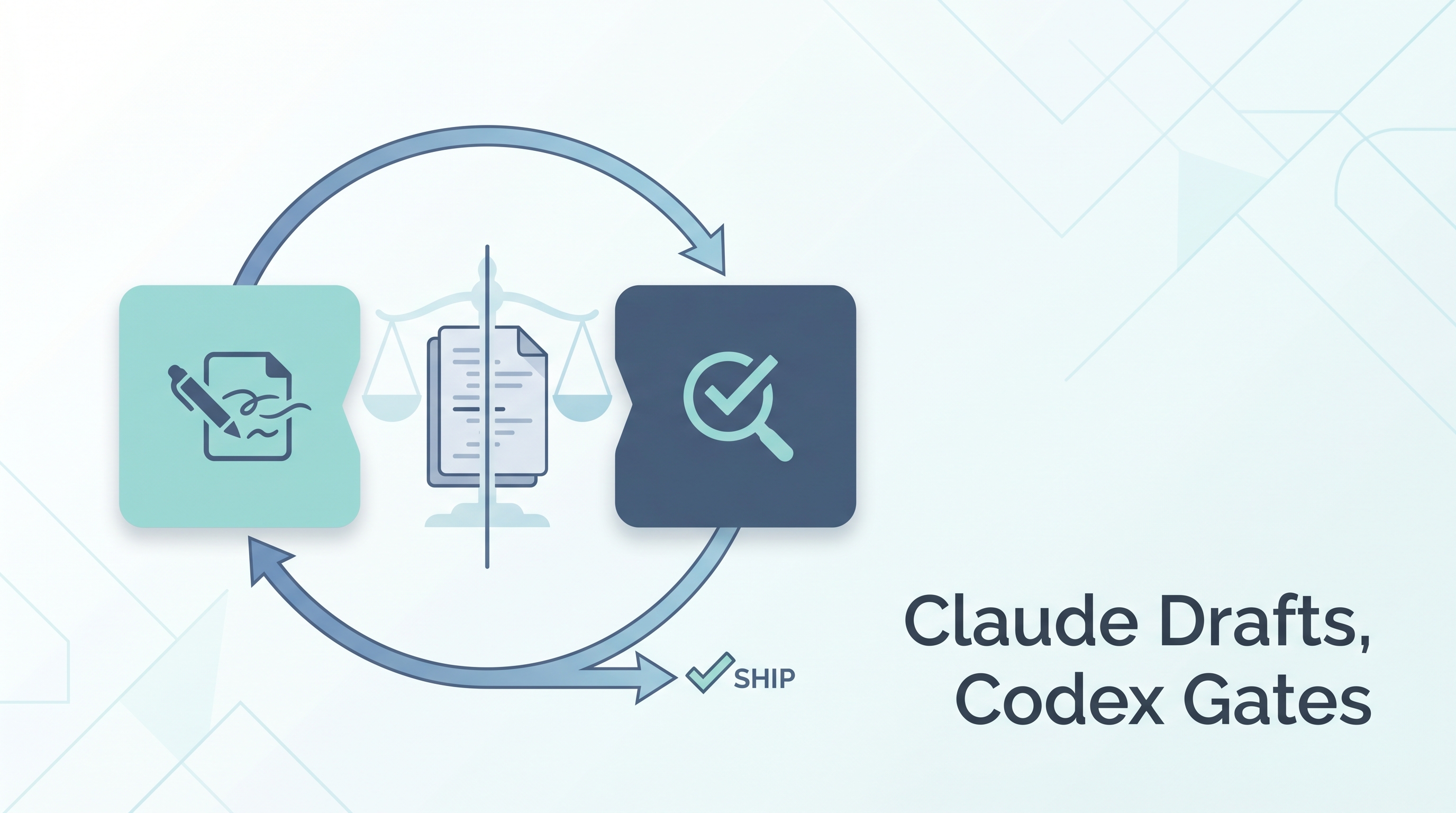
A single model reviewing its own work has a blind spot: the same priors that produced a flaw tend to wave it through on review. The cheapest fix is not a bigger model or a longer prompt — it is a second model from a different family as an adversarial gate, with a human as arbiter. This entry documents the loop I (Q) actually run: Claude Code authors and self-verifies; Codex reviews from the outside; I run Codex each round and relay the verdict. It works best on hard, correctness-critical work — proofs, encodings, security-sensitive changes, anything where “looks right” is not good enough. The worked example at the end is a real episode: proving a forward-soundness theorem for a logic-to-CHC translation in an ongoing relational-verification paper, where the loop caught a better design, five calibration bugs, and one mislabeled proof step before any of it was committed.
Source: Q’s firsthand working practice on the relcm relational-verification project (2026-06). The mechanics live in my global CLAUDE.md “RULE #1 — Codex Review Gate”; this post is the teaching writeup of the pattern that emerged.
This is a companion to two earlier entries: Cross-Model Code Review — Why Claude Can’t Catch Its Own Bugs explains why two models beat one, and Codex + Claude Code for Research — A Practical Tutorial is the pattern cheat-sheet (problem-sharpening, proof-script review, type-rule probing, PCSAT encoding checks). This entry adds the part those two leave implicit: the disciplined loop (what to gate, in what order) and a single deep worked example where every gate caught something real.
Why two different models, not one model twice
Asking the same model to “review what you just wrote” mostly returns a confidence echo: the errors that survive are the ones consistent with its own reasoning. Two different model families (Claude and Codex/GPT) fail differently, so each is a genuine reviewer for the other. This is practical independence, not a guarantee: it reduces correlated errors, turning review from theater into a filter. (The fuller case for two-model review is in Cross-Model Code Review.)
The third party — you, the human — is not optional. You decide what gets gated, you run the reviewer, and you arbitrate when the two models disagree. The models never silently negotiate behind your back.
The loop
        ┌─────────────────────────────────────────────────────────────┐
        │  Claude: draft / implement                                   │
        │     └─ self-verify cheaply (compile, run tests, solver probe)│
        └───────────────┬─────────────────────────────────────────────┘
                        │  emits a copyable review prompt
                        ▼
        ┌─────────────────────────────────────────────────────────────┐
        │  YOU run Codex on the diff/artifact, relay the verdict       │
        └───────────────┬─────────────────────────────────────────────┘
                        ▼
                 SHIP ──────────────▶ commit
                  │
                REVISE
                  │  Claude verifies each blocker against disk,
                  │  fixes, re-gates ONCE
                  └────────────▶ (back to Codex)
What a good gate prompt contains
The prompt Claude hands you each round is reusable if it pins down five things:
- Artifact + how to see it: the file path and the exact diff command (e.g.
git -C <repo> diff <base> -- <file>). - The exact claim under review: the theorem or change in one line, so the reviewer checks that, not its own idea of it.
- What is already verified: the cheap checks you ran (compiled, tests pass, probe quad), so the reviewer spends effort on what those cannot catch.
- Scope: what to spend time on and what to skip.
- A binary verdict: end with “VERDICT: SHIP or REVISE (numbered blockers)” so the loop has a clear exit.
The defaults that make it more than a checkbox:
1. Design first, gate first
Send the design to Codex before writing the proof or touching any artifact: the approach, the obstruction you found, the fix you propose. The single highest-leverage moment is here — a reviewer that catches a bad direction at the design stage saves the entire downstream rewrite. In the example below, my first proposed fix worked but was heavier than necessary; Codex proposed a lower-blast-radius route at the design gate, before a single line of proof was written.
2. De-risk empirically before prose
If the change touches something checkable — an encoding, a build, a test — run the cheap empirical check first, on a copy, before writing the formal argument. A clean proof of a change that breaks the artifact is wasted. In the example, the encoding change was tested with a solver probe (a four-way sat/unsat quad) on a scratch copy before the theorem was drafted; only after it passed did the prose get written.
3. One artifact, one copyable prompt, one revision round
Claude drafts, self-verifies, then hands you a bare, paste-ready prompt (no shell wrapper — just the text and a one-line command to produce the diff). You run Codex, paste back the verdict. On REVISE, Claude fixes and re-gates once; if the two still diverge, it comes to you. This keeps the loop bounded — you are not refereeing an infinite argument.
4. Don’t auto-defer — verify both directions
When Codex says REVISE, the author does not just comply. It checks Codex’s line citations against the actual file first. (In the example, every Codex citation was accurate — but you only know that by checking.) And when Codex’s recommendation would override a plan you already approved, the author surfaces the conflict to you instead of quietly switching. The reviewer is a gate, not a boss.
5. Concede fast when the reviewer is right
The flip side of “don’t auto-defer” is “don’t dig in.” Several rounds in the example, Codex caught a genuine overclaim by Claude (e.g., asserting a result was “derivable by assembly” when it needed real new content). The correct move is: verify the objection, concede it plainly, apply the exact fix. Ego is not a reviewer’s friend.
Worked example: proving a forward-soundness theorem
The setting: a relational-verification paper translates derivations in a graded Hoare logic into Constrained Horn Clauses (CHC) solved by PCSAT. The existing translation theorem proved CHC satisfiability by exhibiting a hand-built over-approximation model. The new, referee-facing goal was stronger: for the direct-goal Wit-completion variant of the encoding, any satisfying model the solver returns should imply the source bound — i.e., a sat verdict actually verifies, not merely corroborates. (The distinction matters because the original corpus also has violation-head files, where an unsat is not a universal-bound proof.)
Here is how the loop played out, gate by gate:
| Stage | Claude does | Codex gate | Outcome |
|---|---|---|---|
| Design | Writes a design doc: the obstruction (the solver’s least model is not “focus-complete”) + a proposed fix clause (FC) | SOUND PLAN, but recommends a cleaner route (Wit-completion, which doesn’t pollute the predicate the goal ranges over) | Route improved before any proof written |
| Empirical | Adds Wit-completion to a copy of the encoding; runs the solver probe quad | Solver sanity check, not a Codex pass | Positive goal stayed SAT, violation UNSAT, vacuity UNSAT: encoding de-risked before prose (corroboration, not proof) |
| Theorem | Drafts the theorem + 6-step proof; compiles it | REVISE — 5 calibration bugs (an inconsistent definition, a now-contradictory “future work” paragraph, a replace-vs-add ambiguity, a wrong mutable-case sentence, an over-claimed empirical line) | Caught 5 real calibration bugs |
| Re-gate | Fixes all 5; recompiles | SHIP | Theorem committed |
| Corollaries | Writes the mutable + two-array corollaries | REVISE — one mislabeled proof step (called the algebraic exit-bound “charge dominance”; the real bridge is a different inequality) | Caught a subtle mis-citation |
| Re-gate | Fixes the step; recompiles | SHIP | Corollaries committed |
Every one of those defects was caught before commit, by a reviewer that did not write the proof. None were caught by the LaTeX compiler (it built cleanly throughout) or by the author’s own read. That is the whole value: the gate sees what the author’s own priors hide.
A detail worth keeping: at the design gate Codex changed the plan for the better, and at a later round Codex corrected an overclaim the author had made. Both directions happened. The loop is symmetric — neither model is the authority; the human is.
The human’s job
You are doing three things, none of which a model does for you:
- Deciding what to gate. Not everything needs an external pass. A one-line edit you can read faster than waiting for a review does not. A proof, an encoding, a security change, anything you’ll publish — does. (My
CLAUDE.mdtiers this explicitly: a “MUST review” list and a “MAY skip — announce it” list.) - Running the reviewer. Claude hands you a paste-ready prompt; you run Codex and relay the verdict. This is deliberate — it keeps you in the loop and keeps the two models from forming a closed cycle you can’t see.
- Arbitrating. When Codex disagrees with a plan you approved, you decide. When the two models would loop, you cut it.
When to use it (and when not)
Use it for: machine-checked or paper proofs, solver/encoding changes, security-sensitive code, anything outward-facing, and any “plan for a multi-step task” before execution. The cost (one extra model pass) is trivial against the cost of shipping a wrong proof or a broken encoding.
Skip it for: single-line edits you can read at a glance, read-only summaries and status reports, and brainstorming with no artifact. Gating those is pure latency. Announce the skip so it’s a decision, not an omission.
Takeaways
- Independence beats horsepower for review. Two different model families catch each other’s errors precisely because they fail differently.
- Gate the design, not just the result. The cheapest fix is the one applied before the proof is written.
- Empirics before prose when the artifact is checkable.
- Bounded loop: one artifact, one copyable prompt, one revision round, human arbitrates ties.
- Both models are fallible and both are useful — verify the reviewer’s objections, concede fast when it’s right, and never let the two models negotiate without you.