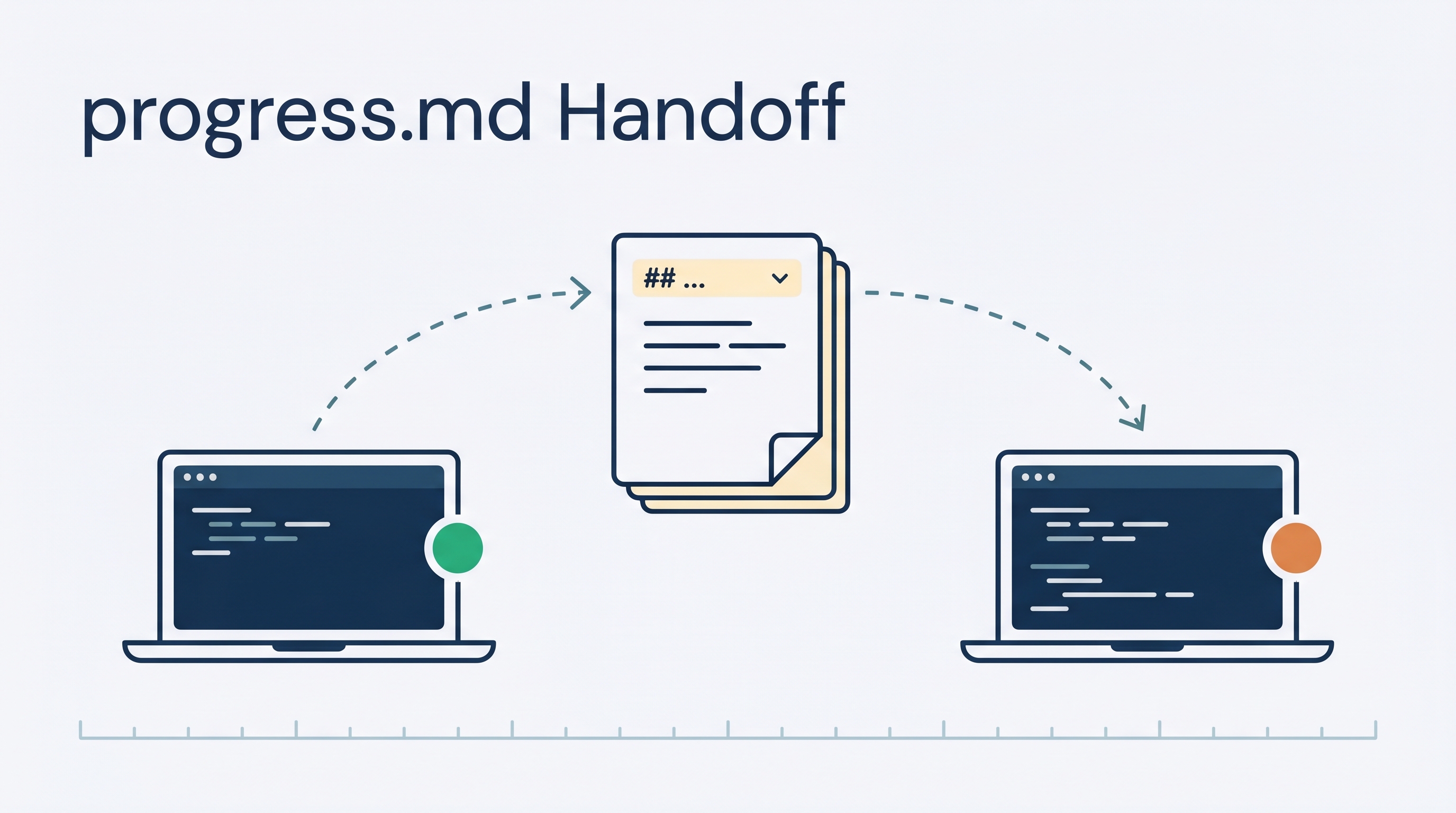
You finish work in Claude Code, stop, come back hours later in Codex (or vice versa), and you want the next agent to know exactly where you left off — branch, HEAD, what changed, what’s next, what NOT to touch. The v1 of this workflow used a hand-edited # Current Handoff block inside CLAUDE.md. It worked, but the block went stale the moment you made another commit. v2 replaces that block with a tracked progress.md log at repo root, two slash commands (/checkpoint, /resume), and a small bash script that handles git-state capture, locking, and atomic writes. You alternate sessions; the file is the shared memory.
*Source: This workflow was built on Q’s learnai-course project — committed as 3ad104a Switch agent handoff to progress.md log + harden script. v1 reference: Claude Code + Codex Handoff Workflow |
AGENTS.md spec (OpenAI Developers) | AGENTS.md complete guide 2026 (codersera) | Top AI Agent Standards 2026 (Agentailor)* |
Why v1 wasn’t enough
The v1 workflow was: write a # Current Handoff block at the top of CLAUDE.md before switching sessions, listing branch, latest commit, what changed, what to do next. It worked once. Then it failed in three predictable ways:
| v1 failure mode | Concrete symptom |
|---|---|
| The block goes stale on the very next commit | “Current commit: 3d2803a” stays written there after Codex commits ac11df9. The next session reads 3d2803a and acts on a snapshot of the past. |
| Nothing enforces “did you actually update it” | You commit code, you forget the block, you stop. The next session opens the project blind. |
| Per-target handoff files multiply | If you patch v1 with /tmp/learnai_resume_in_codex_latest.md and ..._claude_latest.md, you have two snapshots that drift apart and one project name hardcoded into a /tmp path. |
v2 inverts the problem: instead of a hand-edited block that may or may not match git state, the script generates a fresh append-only entry in progress.md every time you stop — and the entry captures the git state automatically.
The shape — one log, two slash commands, one script
Time →

Claude Code session                       Codex session
─────────────────                         ──────────────
edit files, test
git commit -m "..."
/checkpoint
  └─ scripts/agent-handoff.sh
     checkpoint claude --stdin
     └─ prepends entry to progress.md
git push  (with Q's approval)
── STOP ─────────────────────────  ⏸ ──→  │
                                          cd repo && codex \
                                            "Run /resume and continue."
                                          /resume
                                            └─ scripts/agent-handoff.sh resume
                                               prints latest entry + git status
                                          edit, review, fix
                                          /checkpoint
                                            └─ ... checkpoint codex --stdin
                                          git commit
                                          ── STOP ──────────────  ⏸ ──→
... repeat ...
Three moving parts:
progress.mdat repo root, tracked in git, newest entry on top.scripts/agent-handoff.shwith three subcommands:status,checkpoint <agent>,resume.AGENTS.md(for Codex) and Claude Code slash commands/checkpoint+/resume— both invoke the script.
progress.md anatomy
Each entry is one checkpoint. Structure:
# Project Progress

Live cross-agent handoff log. Newest entry on top. Each entry is one
checkpoint written by one agent. Both Codex and Claude Code append
entries; nobody edits prior entries.

<!-- newest entry below -->

## 2026-05-25 12:51:48 EDT — Claude Code

- **Branch:** `slide-redesign-2026-05`
- **HEAD:** `ac11df9` — Add agent handoff workflow
- **Upstream:** origin/slide-redesign-2026-05 — ahead 1, behind 0

### Summary

<what changed this session, what's next, off-limits files,
 server status, push status — markdown allowed>

### Working tree (`git status --short`)
...

### Unstaged diff (`git diff --stat`)
...

### Staged diff (`git diff --cached --stat`)
...

### Latest commit (`git show --stat --oneline HEAD`)
...

---

## 2026-05-24 23:27:14 EDT — Codex
...
Three properties make this work:
| Property | Why |
|---|---|
| Tracked in git | The log survives git clone, lands in PRs, and is reviewable. You can resume on a different machine after git pull. |
| Newest on top | resume reads only the top entry — O(1) regardless of how long the log grows. |
| Append-only | Nobody edits prior entries. If you got something wrong, write a new entry that corrects it. The file is durable history, not scratch. |
The HTML marker <!-- newest entry below --> is the insertion point the script writes against. It’s invisible when rendered.
scripts/agent-handoff.sh — three subcommands
scripts/agent-handoff.sh status
scripts/agent-handoff.sh checkpoint <agent> -m "<summary>"
scripts/agent-handoff.sh checkpoint <agent> --stdin       # heredoc-friendly
scripts/agent-handoff.sh resume
<agent> is codex or claude — who is writing, not the audience. Codex writes checkpoint codex; Claude Code writes checkpoint claude.
What each subcommand does:
status— prints branch, HEAD, ahead/behind, working-tree summary, and whereprogress.mdlives. Pure read.checkpoint— capturesgit status --short,git diff --stat,git diff --cached --stat,git show --stat --oneline HEAD, plus your summary, and inserts a new entry directly after the marker. Atomic viamktemp+mv -f. Serialized via amkdir-based lock at.progress.lockso two agents writing at the same time can’t lose entries.resume— printsstatusfollowed by just the top entry ofprogress.md. The parser boundaries on the second## YYYY-MM-DDheading (counted), not on---, so summaries containing Markdown horizontal rules or code-block---lines don’t truncate the output.
A typical checkpoint from inside Claude Code:
scripts/agent-handoff.sh checkpoint claude --stdin <<'EOF'
**Summary in one sentence.**

What changed this session:
- ...

What's next:
- ...

Off-limits files: <list>
Server status: stopped
Push status: unpushed
EOF
The single-quoted 'EOF' is non-negotiable — it disables shell interpolation so backticks, $, and quotes in the summary land verbatim in the file.
The slash commands
In Claude Code, create two files at .claude/commands/ in your project root. Each is a small markdown file describing what the slash command should do — Claude Code reads these on session start.
.claude/commands/checkpoint.md:
# /checkpoint

Write a checkpoint entry to `progress.md` so the next session can resume.

## Steps
1. Decide what to cover: what changed (1–3 bullets), what's next,
   off-limits files, server status, push status.
2. Run:
   ```bash
   scripts/agent-handoff.sh checkpoint claude --stdin <<'EOF'
   <your summary, markdown allowed>
   EOF
- Report the new entry path to Q. Stop unless Q asks for more.
Notes
- The
<agent>argument is who YOU are, not the audience. From Codex, usecheckpoint codex. - This does NOT commit or push. Q decides whether
progress.mdships in the next commit. ```
.claude/commands/resume.md:
# /resume

Pick up where the last session left off.

## Steps
1. Run `scripts/agent-handoff.sh resume`.
2. Read `CLAUDE.md` and `AGENTS.md` if present.
3. Summarize the current state in ≤6 bullets: branch, HEAD,
   working-tree cleanliness, last entry's "next", off-limits files.
4. Flag any conflict (top entry's HEAD ≠ current HEAD).
5. Ask Q for the next objective unless the entry specifies one.
6. Do NOT commit, push, reset, clean, or switch branches unless
   Q explicitly asks.
In Codex, the equivalent is text triggers documented in AGENTS.md at repo root:
- When Q says “resume” / “pick up where we left off” / “continue” → Codex runs
scripts/agent-handoff.sh resume. - When Q says “save context” / “next session” / “checkpoint” → Codex runs
scripts/agent-handoff.sh checkpoint codex --stdin <<...>>.
Both sides obey one rule: the agent label identifies the writer, not the audience. When Claude Code prepares a handoff for the next Codex run, Claude writes checkpoint claude, NOT checkpoint codex.
A worked switch
Start in Claude Code, finish a feature, hand off to Codex. The rule is commit first, then checkpoint so the entry captures the final committed state — not a “about to commit” snapshot that goes stale the moment you commit:
You:  (edit, test, verify)
You:  "Commit."
Claude: git commit -m "..."
You:  "Push." (explicit approval per Q's standing rule)
Claude: git push
You:  /checkpoint
Claude: (writes entry to progress.md — HEAD now reflects the new commit)
        "Wrote checkpoint for Claude Code -> progress.md"
You:  (close Claude Code, open Codex later that day)
You:  cd repo && codex "Run /resume and continue."
Codex:  (reads top entry, summarizes in ≤6 bullets, asks for next objective)
You:  "Fix the bug in line 42."
Codex:  (edits, tests, asks before committing)
You:  "Commit."
Codex:  git commit -m "..."
Codex:  /checkpoint
        "Wrote checkpoint for Codex -> progress.md"
You:  (back to Claude Code tomorrow)
You:  /resume
Either side can pick up. The log shows you the whole evolution. If you DO checkpoint before committing, that’s fine too — but the next session will see HEAD ≠ entry.HEAD and AGENTS.md tells the agent to flag that conflict to you before editing.
Quick Reference — what to type today
The whole workflow is two slash commands in Claude Code (or two trigger words in Codex — see caveat below). Everything else is plumbing.
Codex caveat: Codex’s TUI doesn’t honor user-defined slash commands — only its built-in slashes (
/model,/init, etc.). In Codex, type the trigger word without the leading slash:checkpoint,resume,save context,wrap up,pick up where we left off. The skill description andAGENTS.mdboth list these phrases, and Codex activates the samescripts/agent-handoff.shworkflow off them. Every example below shows the slash form (Claude Code); strip the slash when running in Codex.
To install the workflow in a NEW project (one command)
From the project’s root directory:
bash ~/.claude/skills/checkpoint/install.sh
That copies the 4 handoff files into the project (scripts/agent-handoff.sh, .claude/commands/checkpoint.md, .claude/commands/resume.md, and AGENTS.md if absent), adds two .gitignore entries, and prints what to do next. Idempotent — safe to re-run. The installer refuses to overwrite an existing AGENTS.md; if you have one, it tells you what to append manually. The ~/.codex/skills/checkpoint/install.sh mirror does the same thing from Codex.
Source path defaults to ~/Desktop/learnai-course; override with PROGRESS_HANDOFF_SRC=/path/to/source if the canonical repo lives elsewhere on your machine.
After install, the next two slash commands work in that project.
To checkpoint and stop (from EITHER agent)
Just type:
/checkpoint
The agent will compose the summary from current conversation context, run the script with the correct writer label (checkpoint claude from Claude Code, checkpoint codex from Codex), and stop.
If you want to write the summary yourself:
/checkpoint summary: <one-paragraph summary of what changed, what's next, off-limits>
To resume (from EITHER agent)
Just type:
/resume
The agent runs the script, reads the top entry of progress.md, reads CLAUDE.md and AGENTS.md, summarizes the state in ≤6 bullets, and asks for the next objective.
To switch between agents
End of Claude Code session:
1. (in chat) "Commit."          Claude commits.
2. (in chat) "Push."            Claude pushes (with your explicit OK).
3. (in chat) "/checkpoint"      Claude writes a checkpoint entry. Close the terminal.
Start of Codex session (in a new terminal):
cd /path/to/repo
codex "Run /resume and continue."
Codex picks up from the top entry. Same shape in reverse to come back to Claude Code.
The minimum viable session
/resume                # at start
... do work ...
"Commit." → "Push."    # if applicable
/checkpoint            # at end
Three keystrokes (effectively two slash commands) bracket every session. Skip neither.
Three guardrails that prevent the common failures
| Failure | Guardrail |
|---|---|
| Next session edits files the previous session intentionally left dirty | List “off-limits files” in your checkpoint summary |
| Next session pushes work that wasn’t ready | Say “Push status: unpushed” or “Push: only with Q’s explicit approval” in the entry |
| Two sessions conflict because both think they’re authoritative | The agent label (checkpoint claude vs checkpoint codex) makes the writer visible — you can see in progress.md and git log who wrote what |
One mental model to keep in your head
The repo is the shared memory. Both agents read git state plus one file (progress.md). Whatever isn’t in those two places doesn’t exist between sessions. Treat your conversation history as ephemeral — anything you want to survive the switch goes into the checkpoint.
Three bugs the audit caught
The first cut of the script had three real bugs that any cross-agent handoff script will hit. Worth knowing before you reinvent this:
---collision in the entry parser. If you used---as both the visual entry separator AND the parser stop-line, any summary containing a Markdown horizontal rule (or a code block with a---line) would truncate the output ofresume. Fix: parser counts entry headers (## YYYY-MM-DD) and stops at the second one, ignoring---entirely.- Race when two checkpoints land at the same time.
read → split → write → mvwithout a lock lets two agents both read the same baseline; the lastmvwins and silently drops the other entry. Fix:mkdir-based lock at.progress.lockwith a 30s wait.mkdiris atomic on POSIX, so it works without GNUflock. - Combined trap
EXIT INT TERMdoesn’t exit on signals. Bash will run the trap onINT/TERMand then resume the script body with stale state. Fix: split the traps —trap cleanup EXITfor the normal path, plustrap 'cleanup; exit 130' INTandtrap 'cleanup; exit 143' TERMso signals actually terminate.
Bonus gotcha: if you write a timeout 180 codex exec ... example in any doc, remember that timeout is GNU coreutils and is NOT installed on macOS by default. Use perl -e 'alarm shift @ARGV; exec { $ARGV[0] } @ARGV' 180 codex exec ... instead — perl is always present.
AGENTS.md is the universal half
The Codex-side rules live in AGENTS.md at repo root. This isn’t a Codex-only file. Per Agentailor’s 2026 AI agent standards survey, AGENTS.md was donated to the Agentic AI Foundation (a directed fund under the Linux Foundation) in December 2025, and the same survey plus the codersera 2026 guide report native support across a growing list of tools — OpenAI Codex, Cursor, GitHub Copilot coding agent, Gemini CLI, Windsurf, Aider, and several others. Writing your handoff triggers into AGENTS.md (rather than a Codex-only config file) means more agents can pick up the workflow without per-tool customization. Verify the current tool list against those sources before betting on a specific assistant.
CLAUDE.md stays as Claude Code’s project guidance — but with v2, it no longer holds live state. The “Current Handoff” block is gone; live state lives only in progress.md. CLAUDE.md just points at it.
When this is overkill
| Don’t bother if | Use this if |
|---|---|
| You work alone in one tool, one session | You alternate between Codex and Claude Code on the same project across days |
| The project is a throwaway script | The project has a multi-week life and stakeholders care about state |
| You commit every change immediately | You sometimes leave uncommitted work in flight between sessions |
| Only one machine ever touches the repo | You want to resume on a laptop after working on a desktop |
For solo-session work, git log is your handoff. For multi-session multi-agent work, progress.md is the answer to “what was I doing again?”
The hand-rolled flavor
This is workflow code, not a framework. It’s ~350 lines of bash, six files, no dependencies beyond git, bash, awk, and mktemp. The whole thing fits in a single commit. You can fork it for your own project, swap codex and claude for whatever agents you alternate between, and the same shape applies. The lesson is the shape, not the bash.
Important things to know
- The agent label is the WRITER, not the audience. Easiest mistake to make. Claude Code preparing a handoff writes
checkpoint claude. - Every
git commitshould be followed by a/checkpointif you’re stopping. Otherwise the top entry shows a stale HEAD and the next session has to flag a conflict. progress.mdis tracked — it goes into PRs andgit log. That’s a feature (review-ability, cross-machine resume), but it does add log noise. If you want it local-only, addprogress.mdto.gitignoreand lose the cross-machine resume.- Two slash commands per side, not four. v1 had
/resume-in-codexand/resume-in-claude-codewith inverted verbs (/resume-in-codexactually saved a Codex handoff, didn’t load one). v2 collapses to symmetric/checkpoint(write a checkpoint and stop) and/resume(read the top entry and continue). The old asymmetric commands stay as deprecated wrappers for muscle memory. - Tiered Codex review pairs naturally with this. When you checkpoint, the entry IS the canonical record of what you did. A future tiered review policy (“review canonical files always, skip single-line edits”) can refer back to checkpoints as the audit trail.
Sources:
- AGENTS.md custom instructions — Codex (OpenAI Developers)
- AGENTS.md Complete Guide 2026 — codersera
- How to Build Your AGENTS.md (2026) — Augment Code
- Top AI Agent Standards to Know in 2026 — Agentailor
- openai/codex AGENTS.md (GitHub)
- Claude Code + Codex Handoff Workflow (v1 — wiki)
- Claude Code /handover — generic save-context skill