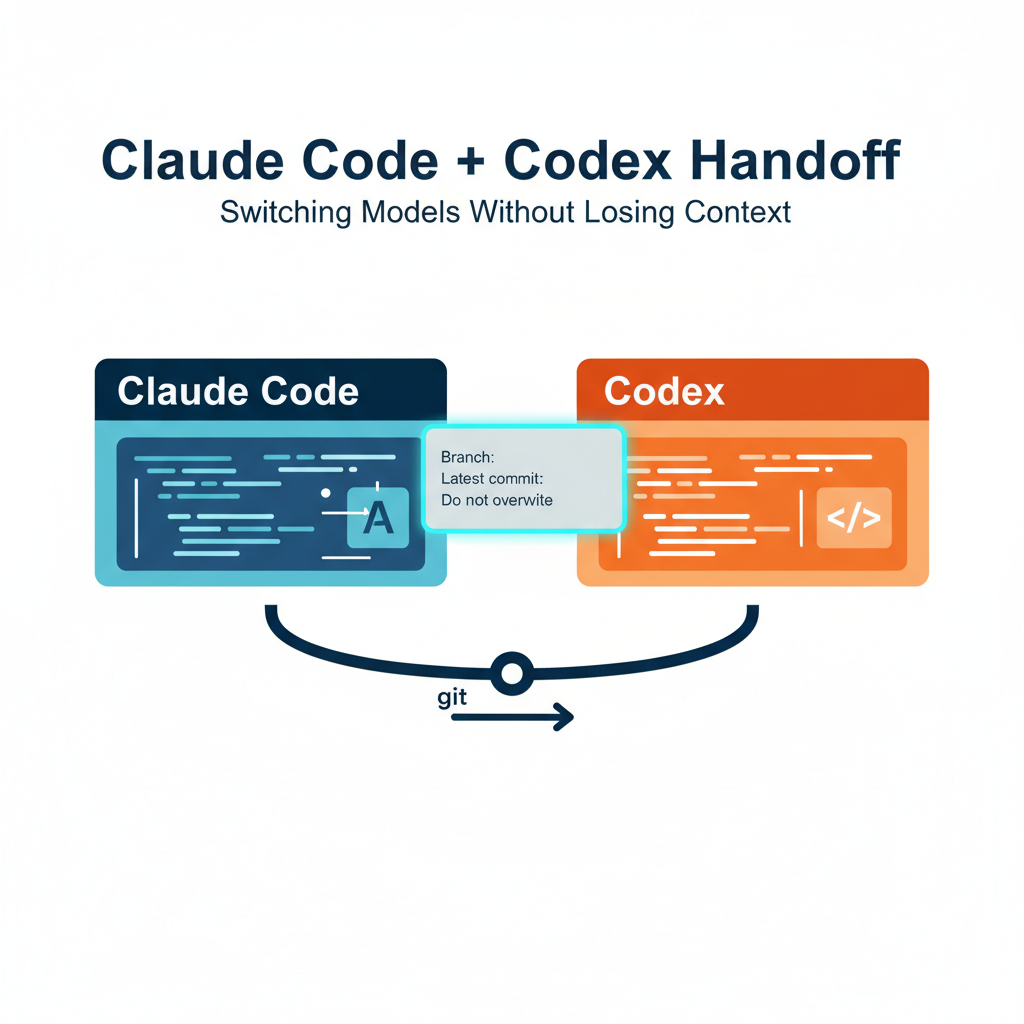
Claude Code and Codex can share one project — but only if the handoff is explicit. The risk is not the model switch itself; the risk is stale context: one session continues from an old mental model and overwrites newer files. A structured handoff block written into CLAUDE.md before switching turns model-switching into a research workflow: one agent builds, the other reviews, and both preserve project memory.
Source: Q’s personal workflow, derived from the LearnAI session slides project — Codex committed be82d21, wrote the handoff block, Claude Code pushed without reverting the slide work.
Why This Matters
Most multi-model workflows fail not because the models are bad, but because the second agent starts from stale context. It reads an old version of a file, generates changes based on that, and overwrites work the first agent just finished.
The fix is not technical — it’s procedural: write a handoff block before you switch. The block tells the next agent exactly where things stand: branch, latest commit, what changed, what not to touch, and what to do next.
The 8-Step Pattern
- Start with one clear goal.
- Use a dedicated branch or worktree when the change has real scope.
- Commit finished scoped work before switching (if Q approved the commit).
- Write a current handoff block in
CLAUDE.mdwith branch, latest commit, changed files, open risks, and exact next step. - Leave local coordination files uncommitted unless explicitly asked.
- Tell the next session what not to overwrite.
- Before pushing, verify the branch is at the expected commit or a descendant.
- Never push without Q asking in that specific session.
Handoff Checklist
Before switching models, record:
- Current branch:
git branch --show-current - Latest commit:
git log -1 --oneline - What changed: committed files vs. local-only files, listed separately
- What is safe to edit next: name exact files or folders
- What must not be touched: usually the already-committed deliverable
- Server/process status: is a local dev server running or stopped?
- Verification: tests, builds, browser checks, or manual review already completed
Handoff Block Template
Paste this into CLAUDE.md before switching — remove it after the next session completes the handoff:
# Current Handoff — YYYY-MM-DD

Branch: `<branch-name>`
Latest commit: `<hash> <message>`

## Completed
- ...

## Local-only coordination files (do not commit)
- ...

## Do not overwrite
- ...

## Next step
- ...

## Before push
- Confirm `git log -1 --oneline` is `<hash>` or a descendant.
- Push only if Q explicitly asks in this session.
Case Study: LearnAI Slides
- Goal: Make the beginner AI-agent slides self-contained, easier to follow, and useful as a
/goalcase study. - Codex updated
session-materials/session-slides.htmland committed it asbe82d21 Improve beginner slides with goal workflow. - Codex wrote the current handoff block into
CLAUDE.mdso Claude Code could push without accidentally reverting the slide work. - Workflow notes stayed local until Q decided whether to commit them.
Result: Claude Code picked up exactly where Codex left off — correct branch, correct commit baseline, no overwrites.
How LearnAI Team Could Use This
- Q’s own multi-agent sessions — Any session where Codex handles implementation and Claude Code handles review (or vice versa) benefits from this pattern. The LearnAI slides case study is the template: Codex builds, writes the handoff, Claude Code verifies and pushes.
- CS-310 pair programming analog — Teach students this as the AI analog of a pair-programming handoff. When you hand a codebase to a partner, you brief them: what’s done, what’s in progress, what not to touch. Same discipline applies when handing to a different AI session.
- CS-336 multi-agent security analysis — When running a security audit across multiple sessions (Codex for taint analysis, Claude Code for fix generation), the handoff block prevents the fix agent from re-analyzing files the audit agent already cleared.
- Teaching context discipline — The deeper lesson: write completion conditions, pause when context changes, record evidence on disk, and only move on when the next agent can safely continue from the truth in the repository — not from what the previous agent said it did.
Real-World Use Cases
| Scenario | What the handoff block prevents |
|---|---|
| Codex implements → Claude Code reviews | Claude Code re-implementing instead of reviewing |
| Claude Code drafts → Codex adversarial review | Codex starting from a stale draft pre-edit |
| Long session → next-day session | Second session overwriting uncommitted local files |
| Feature branch → main merge | Merge from wrong base commit |
| Dev server running → new session | New session starting another server on the same port |
Important Things to Know
- The handoff block lives in
CLAUDE.md, not in a separate file. It’s the first thing any new session reads. Remove it after the handoff completes — stale handoff blocks are worse than none because they mislead future sessions. - Committed vs. local-only is the critical distinction. Committed files are safe — any agent can read the correct version from git. Local-only files are invisible to a new session unless you name them explicitly in the handoff block.
- “Never push without Q asking in this session” is non-negotiable in this workflow. The handoff block explicitly calls it out because pushes are the hardest thing to undo and the most common source of cross-session damage.
- Worktrees help when scope is real. If the change touches more than 3-4 files or spans a long session, use
git worktree addto give each model a clean working directory — no accidental cross-contamination. - This pattern is model-agnostic. The same handoff block works for Claude Code → Codex, Codex → Claude Code, or Claude Code → new Claude Code session. The discipline is about explicit state transfer, not which models are involved.