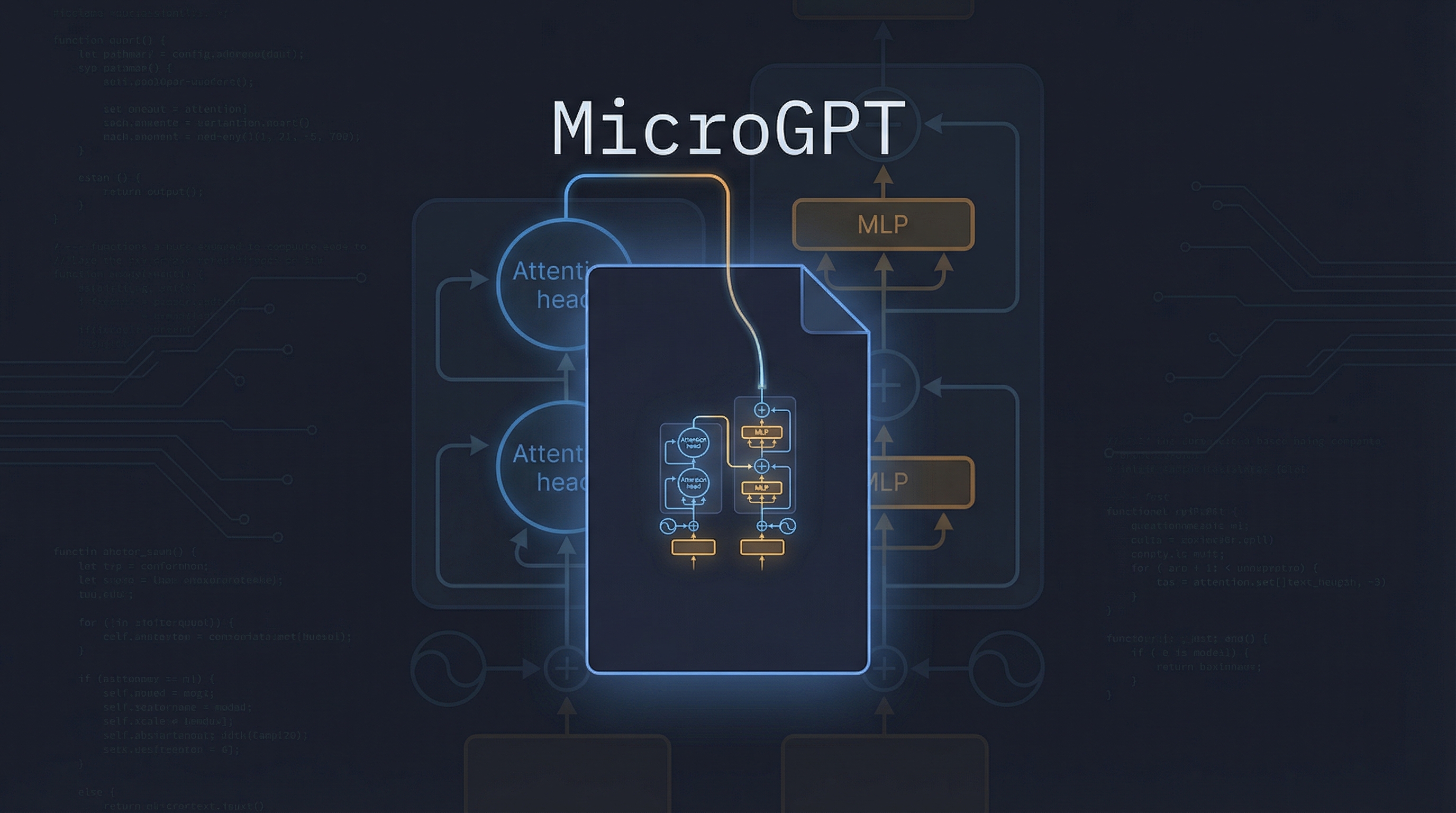
A single file. 200 lines. No dependencies. No PyTorch, no NumPy, no tensors — just pure Python scalars. MicroGPT by Andrej Karpathy implements a complete GPT-style language model that trains and generates text, exposing every mechanism that powers ChatGPT in code you can read in one sitting.
| *Source: Karpathy’s Blog Post | SNES-GPT — Assembly Port* |
What MicroGPT Teaches
The 200 lines contain six complete components — the same six that exist in every production LLM:
1. Dataset        → 32K names, one per line
2. Tokenizer      → Character-level (a-z + BOS = 27 tokens)
3. Autograd       → Custom Value class with backward()
4. Architecture   → Embeddings → Attention → MLP → RMSNorm
5. Training       → Cross-entropy loss + Adam optimizer
6. Inference      → Autoregressive sampling with temperature
The Autograd Engine
Every operation records its local derivative. One loss.backward() call chains them all via the multivariable chain rule:
class Value:
    def __init__(self, data, children=(), local_grads=()):
        self.data = data
        self.grad = 0
        self._children = children
        self._local_grads = local_grads
The Architecture (4,192 Parameters)
Same structure as GPT-2, miniaturized:
Input token
    ↓
Token Embedding (16-dim) + Position Embedding
    ↓
┌─────────────────────────────────┐
│  RMSNorm                        │
│  Multi-Head Attention (4 heads) │──→ residual connection
│  RMSNorm                        │
│  MLP (16 → 64 → 16)            │──→ residual connection
└─────────────────────────────────┘
    ↓
Output projection → 27 logits → softmax → next token
Key insight: Attention is a token communication mechanism (tokens look at each other). MLP is computation (each token thinks independently).
Training
# Tokenize: [BOS, e, m, m, a, BOS]
# Forward: feed tokens through model, build KV cache
# Loss: cross-entropy = -log(probability of correct token)
loss_t = -probs[target_id].log()
loss = (1 / n) * sum(losses)
loss.backward()  # One call computes ALL gradients
# Adam optimizer updates 4,192 parameters
Loss drops from ~3.3 (random guessing among 27 tokens) to ~2.37 over 1,000 steps.
Inference
temperature = 0.5
token_id = BOS
for pos_id in range(block_size):
    logits = gpt(token_id, pos_id, keys, values)
    probs = softmax([l / temperature for l in logits])
    token_id = random.choices(range(vocab_size), weights=probs)[0]
Generates plausible names: “kamon,” “karai,” “vialan” — not memorized from training data, but sampled from the learned distribution.
MicroGPT vs Production LLMs
| Aspect | MicroGPT | Production (GPT-4, Claude) |
|---|---|---|
| Data | 32K names | Trillions of tokens |
| Tokenizer | 27 characters | 100K+ subword vocabulary |
| Compute | Python scalars | GPU/TPU tensor operations |
| Parameters | 4,192 | 100B+ |
| Layers | 1 | 100+ |
| Training time | ~1 minute | Months on thousands of GPUs |
| Post-training | None | SFT + RLHF + constitutional AI |
The difference is scale, not mechanism. The same six components exist in both.
Community Example: SNES-GPT — MicroGPT on a Super Nintendo
Vincent Abruzzo ported MicroGPT to 65816 assembly and runs it on actual SNES hardware — proving that a transformer is just math, executable even on a 3.58 MHz processor from 1990.
Source: github.com/vabruzzo/snes-gpt (55 stars)
How It Works
| Aspect | Detail |
|---|---|
| Processor | 3.58 MHz 65816 CPU |
| Arithmetic | Q8.8 fixed-point (8 integer bits, 8 fractional bits) |
| Multiplier | SNES PPU hardware multiplier at $4202/$4203 |
| RAM | ~1KB WRAM for working buffers |
| Weights | 8KB stored directly in ROM cartridge |
| Parameters | 4,064 |
| Output | 20 generated names displayed via SNES graphics processor |
The Build Pipeline
make
# 1. Trains model in Python (~500 steps)
# 2. Quantizes weights to Q8.8 fixed-point
# 3. Generates exp() and inverse sqrt lookup tables (256 entries each)
# 4. Assembles 65816 source files (ca65)
# 5. Links final ROM (ld65) → build/snes_gpt.sfc
# 6. Run in Snes9x emulator
Assembly Source Structure
src/
├── main.asm       — SNES init, ROM header
├── gpt.asm        — Complete forward pass
├── math.asm       — Q8.8 arithmetic (multiply, divide, exp, rsqrt)
├── vector.asm     — Linear algebra primitives
├── inference.asm  — Generation loop + display
└── snes.inc       — Hardware register definitions
Debugging War Stories
The assembly port surfaced bugs that would never appear in Python:
- Register width mismatch —
.a16(16-bit accumulator) without.i16(16-bit index) caused 8-bit index instructions, misaligning the entire instruction stream - PRNG failure — byte-swap (
xba) substituted for left-shift produced a degenerate cycle where all 20 names were identical - Accumulator collision — fixed-point multiply and dot product shared zero-page variables, erasing sums mid-computation
The Philosophical Point
“The model doesn’t learn explicit rules, it learns a probability distribution.”
MicroGPT reveals that LLMs perform no magic — they’re a big math function mapping input tokens to a probability distribution over the next token. Understanding these 200 lines gives you genuine insight into how ChatGPT works. The SNES port proves the point further: if a 1990 game console can run a transformer, the mechanism really is just arithmetic.
How LearnAI Team Could Use This
- Transformer fundamentals lesson — Use MicroGPT as a readable from-scratch walkthrough before students move to PyTorch or larger model codebases.
- Autograd teaching module — Have learners trace one forward and backward pass through the custom
Valueclass to understand how gradients flow. - Architecture comparison lab — Compare MicroGPT’s tiny GPT-style stack against production LLM diagrams to separate mechanism from scale.
- Systems thinking exercise — Use the SNES-GPT port to show how model execution depends on arithmetic, memory layout, and hardware constraints.
Real-World Use Cases
- AI education workshops — Instructors can teach the full training loop without hiding mechanics behind tensor libraries.
- Debugging intuition for LLM engineers — Practitioners can inspect attention, loss, sampling, and optimizer behavior in a minimal codebase.
- Hardware-aware ML demos — The SNES port is a concrete example for lessons on quantization, fixed-point math, and constrained inference.
- From-scratch study groups — Learners can reimplement or modify one component at a time: tokenizer, autograd, attention, optimizer, or sampler.
Links
- MicroGPT blog post: karpathy.github.io/2026/02/12/microgpt
- SNES-GPT: github.com/vabruzzo/snes-gpt
- Related: Karpathy’s “End of Coding” Talk