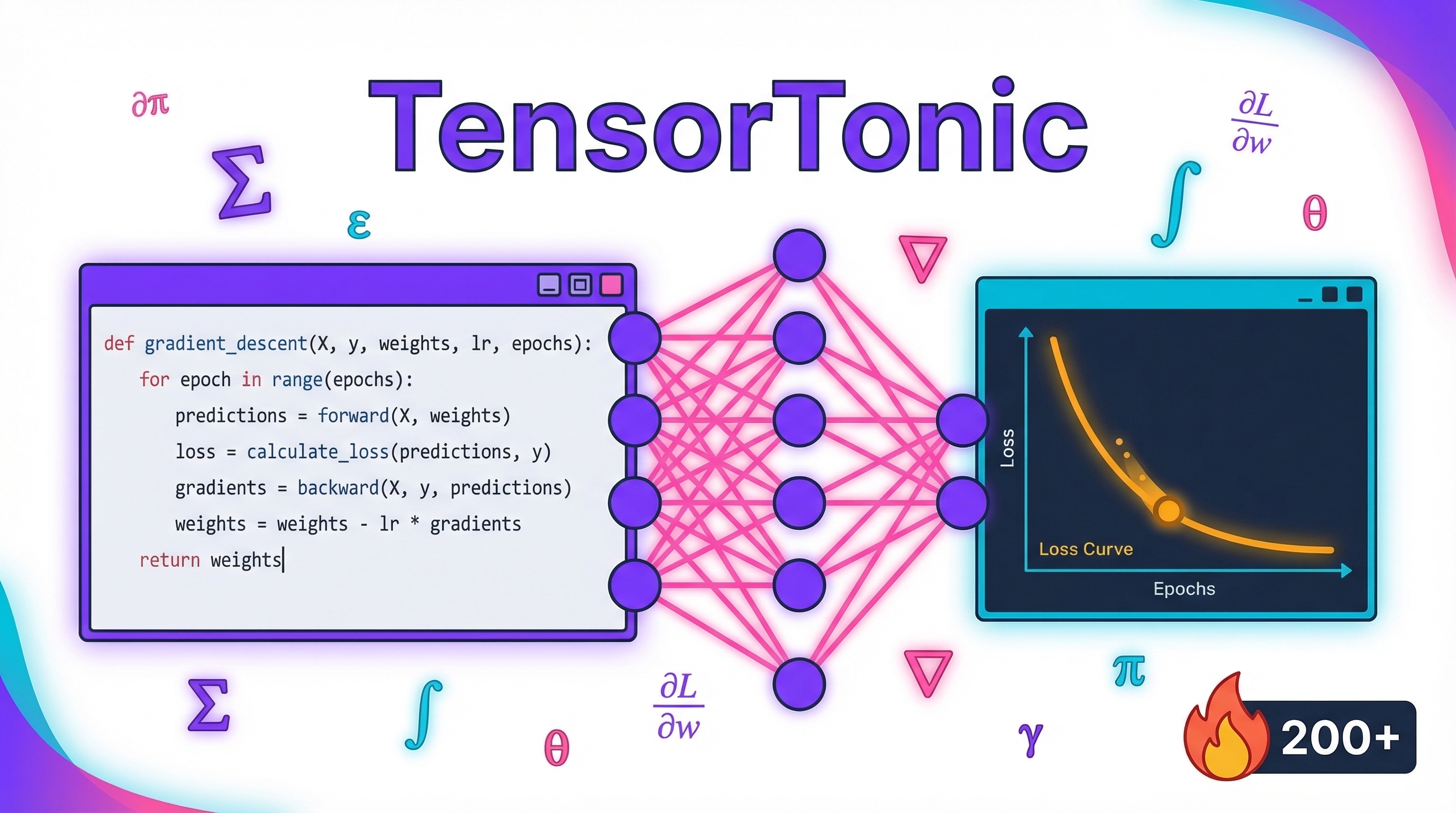
TensorTonic is an interactive platform where you learn machine learning by implementing algorithms from scratch — not by watching videos or reading textbooks. 200+ coding problems, from gradient descent to full Transformer architectures, all in a browser-based IDE with instant validation. It also includes interactive math visualizations (linear algebra through information theory) and a research paper implementation track where you build BERT, ResNet, GANs, and DDPM component by component.
| *Source: TensorTonic | ML Problems | Research Papers Track | ML Math Modules | GitHub - Solved Problems* |
What It Offers
| Track | Content | Link |
|---|---|---|
| 200+ ML Problems | Gradient descent → Adam → RNNs → Transformers | Implement from scratch, browser IDE |
| Research Papers | Transformers, DDPM, BERT, ResNet, GANs | Build SOTA architectures component by component |
| ML Math | 7 modules, 50+ topics with live visualizations | Linear algebra → probability → information theory |
How It Works
Pick a problem (e.g., "Adam Optimizer")
     ↓
Read the problem description + math background
     ↓
Write your implementation in the browser IDE
     ↓
Submit → instant validation (tests run in milliseconds)
     ↓
Track progress: streaks, leaderboards, achievements
No setup. No local environment. No pip install. Just open the browser and start coding.
Why This Philosophy Matters
TensorTonic follows the same philosophy as Karpathy’s MicroGPT — understanding the algorithm matters even when you stop writing it by hand. In the agent era, the engineers who understand what the algorithm does are the ones who can effectively direct agents to build with it.
The platform makes this concrete:
- Implement, don’t import — you write
gradient_descent()from scratch, notfrom sklearn import - Math is visual — interactive visualizations make linear algebra and calculus intuitive, not abstract
- Papers become code — reading a Transformer paper is one thing; implementing multi-head attention from the equations is another
How LearnAI Team Could Use This
Direct Use Cases
| Course Context | How to Use TensorTonic |
|---|---|
| Intro to AI/ML | Assign foundational problems: linear regression, gradient descent, k-means |
| Advanced ML | Research paper track: students implement Transformer attention, DDPM diffusion |
| Math for CS | ML Math modules as supplementary material with interactive visualizations |
| Capstone projects | Students demonstrate understanding by implementing relevant algorithms before using libraries |
Pedagogical Value
- Active learning — implementing > reading > watching. Research consistently shows this (AI Fluency Index findings apply here)
- Immediate feedback — browser IDE validates in milliseconds, tightening the learning loop
- Gamification — streaks and leaderboards drive engagement without requiring instructor effort
- No infrastructure burden — browser-based means no lab setup, no conda environments, no “it works on my machine”
- Complements agent-era skills — students who understand algorithms from scratch can better evaluate and direct AI agents that use those algorithms
Connection to LAI Research
TensorTonic is a natural complement to the LAI thesis. Research questions it enables:
- Do students who implement algorithms from scratch on TensorTonic perform better at directing AI agents to use those algorithms?
- How does interactive math visualization compare to traditional lecture for building ML intuition?
- Can TensorTonic problem completion predict success in agent orchestration tasks?
- What’s the minimum “implement from scratch” experience needed before students can effectively use library abstractions?
Real-World Use Cases
| Use Case | How TensorTonic Helps |
|---|---|
| Intro AI/ML courses | Assign browser-based implementation problems for linear regression, gradient descent, k-means, and neural network basics. |
| Advanced ML courses | Use the research paper track for Transformer attention, DDPM diffusion, BERT, ResNet, and GAN components. |
| Math for CS | Use interactive ML Math modules as supplementary visual material for linear algebra, probability, and information theory. |
| Capstone preparation | Have students implement core algorithms before relying on library abstractions in larger projects. |
Similar Resources
| Resource | Focus | Format |
|---|---|---|
| TensorTonic | 200+ ML algorithms from scratch | Browser IDE, gamified |
| MicroGPT | GPT in 200 lines of pure Python | Single file, educational (full wiki entry) |
| ML Visualized | Visual ML explanations | Interactive visualizations |
| R2D3 | Visual intro to ML | Scrollytelling |
| fast.ai | Practical deep learning | Video courses + notebooks |