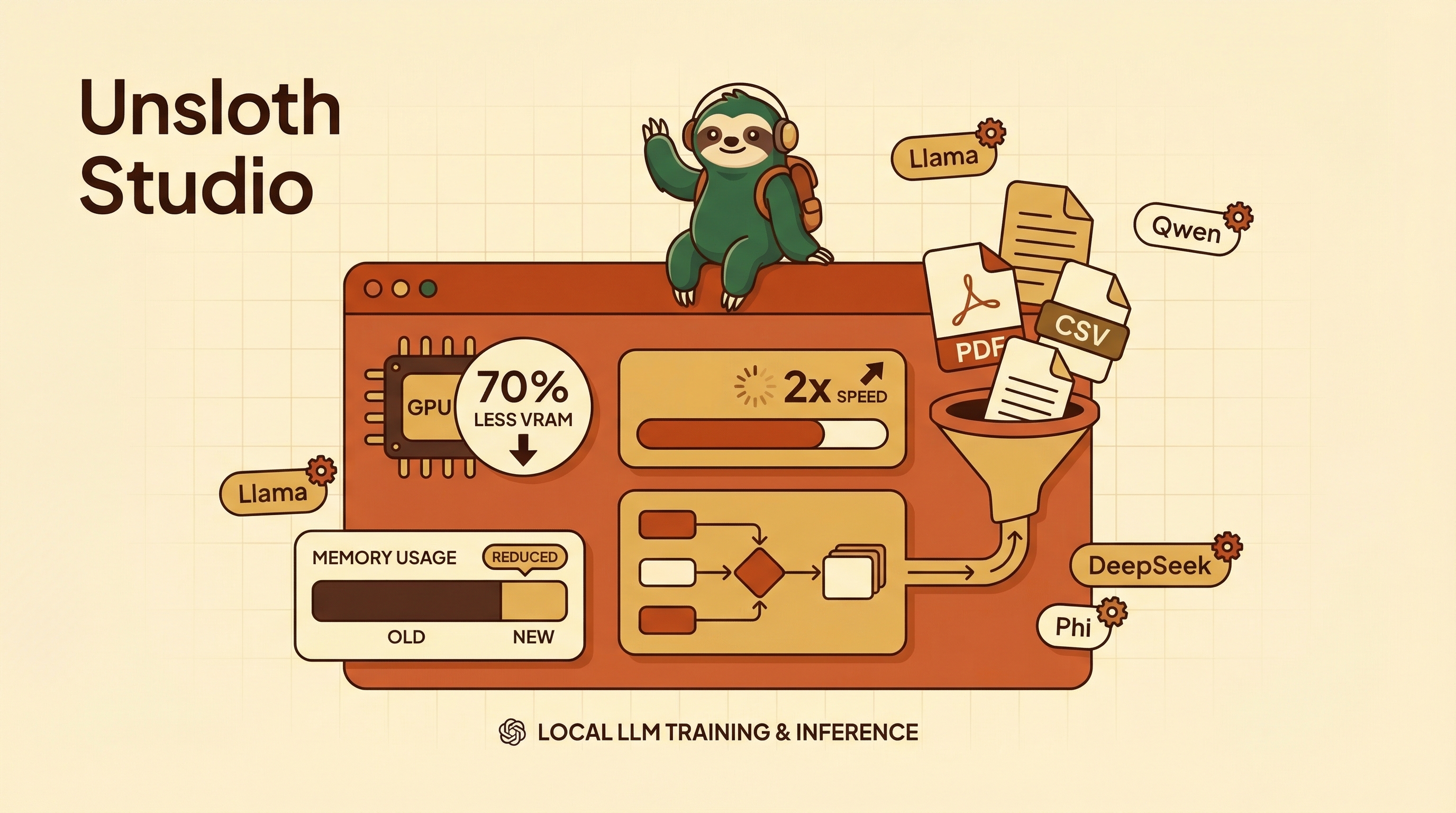
Unsloth Studio is an open-source, no-code Web UI that lets you train, run, and export LLMs from a single local dashboard. The headline numbers: 2x faster training, 70% less VRAM via QLoRA — a 7B model that used to need 24GB VRAM now runs on 16GB. It supports 500+ models (Llama 4, Qwen 3.5, DeepSeek, Gemma), auto-generates training datasets from PDFs/CSVs, and includes GRPO (the reinforcement learning technique behind DeepSeek-R1’s reasoning).
| *Source: GitHub - unslothai/unsloth | Unsloth Website | MarkTechPost | NVIDIA Blog: Fine-Tuning with Unsloth | SitePoint Tutorial* |
What It Does
| Feature | Details |
|---|---|
| Training | Fine-tune 500+ models with LoRA/QLoRA, 2x speed, 70% less VRAM |
| Inference | Run models locally, GGUF support for CPU-only machines |
| Dataset creation | Auto-generate training data from PDF, CSV, DOCX |
| GRPO training | DeepSeek-R1’s RL technique — reasoning via group relative policy optimization |
| Export | GGUF, Safetensors, auto-tuned inference parameters |
| Model comparison | Side-by-side output comparison across models |
| Code execution | Built-in environment to test model outputs |
Hardware Requirements
| Platform | Capability |
|---|---|
| NVIDIA GPU (RTX 30/40/50, DGX) | Full training + inference |
| Apple Silicon Mac | Inference now; MLX training coming soon |
| CPU only (any platform) | Chat inference with GGUF models |
| Windows / Linux / WSL | Full support |
Key: a 7B model fine-tune that previously needed a 24GB GPU now fits in 16GB — that’s a consumer RTX 4070 or equivalent.
Quick Start
# Install
pip install unsloth

# Launch the Studio UI
unsloth studio
Or via Docker — see installation docs.
Why This Matters
Democratization of fine-tuning. Before Unsloth, fine-tuning LLMs required deep ML expertise, expensive GPUs, and complex scripts. Now a no-code UI lets anyone with a consumer GPU create custom models from their own data.
Not just another inference tool. Coverage of Unsloth Studio makes an important distinction: Unsloth isn’t “LM Studio with training.” It’s a unified training + inference + export pipeline. Train a model, test it, export it as GGUF, and deploy — all in one interface.
QLoRA’s real impact. The 70% VRAM reduction isn’t marketing — it’s the practical result of 4-bit quantized LoRA fine-tuning. This means research labs with limited GPU budgets (like university labs) can train models that were previously only accessible to well-funded teams.
How LearnAI Team Could Use This
| Use Case | How |
|---|---|
| AI/ML course project | Students fine-tune a small model on domain-specific data (e.g., security vulnerability descriptions) |
| Understanding fine-tuning | No-code UI lets students focus on concepts (dataset quality, hyperparameters) not infrastructure |
| GRPO experiments | Students can experiment with the same RL technique that powered DeepSeek-R1 |
| Research on a budget | University GPU lab with RTX 3090s can train 7B models — previously impossible |
| Dataset creation exercise | Students prepare PDFs → auto-generate training data → fine-tune → evaluate |
Connection to LAI: Can students who fine-tune their own models develop better intuition for how LLMs work? Unsloth’s no-code approach makes this experiment feasible at scale.
Real-World Use Cases
- Domain-specific assistants — Fine-tune small models on company docs, support tickets, or course material for local deployment.
- Budget research labs — Run LoRA/QLoRA experiments on consumer NVIDIA GPUs instead of renting large cloud clusters.
- Private data workflows — Train and test local models without uploading sensitive datasets to hosted fine-tuning services.