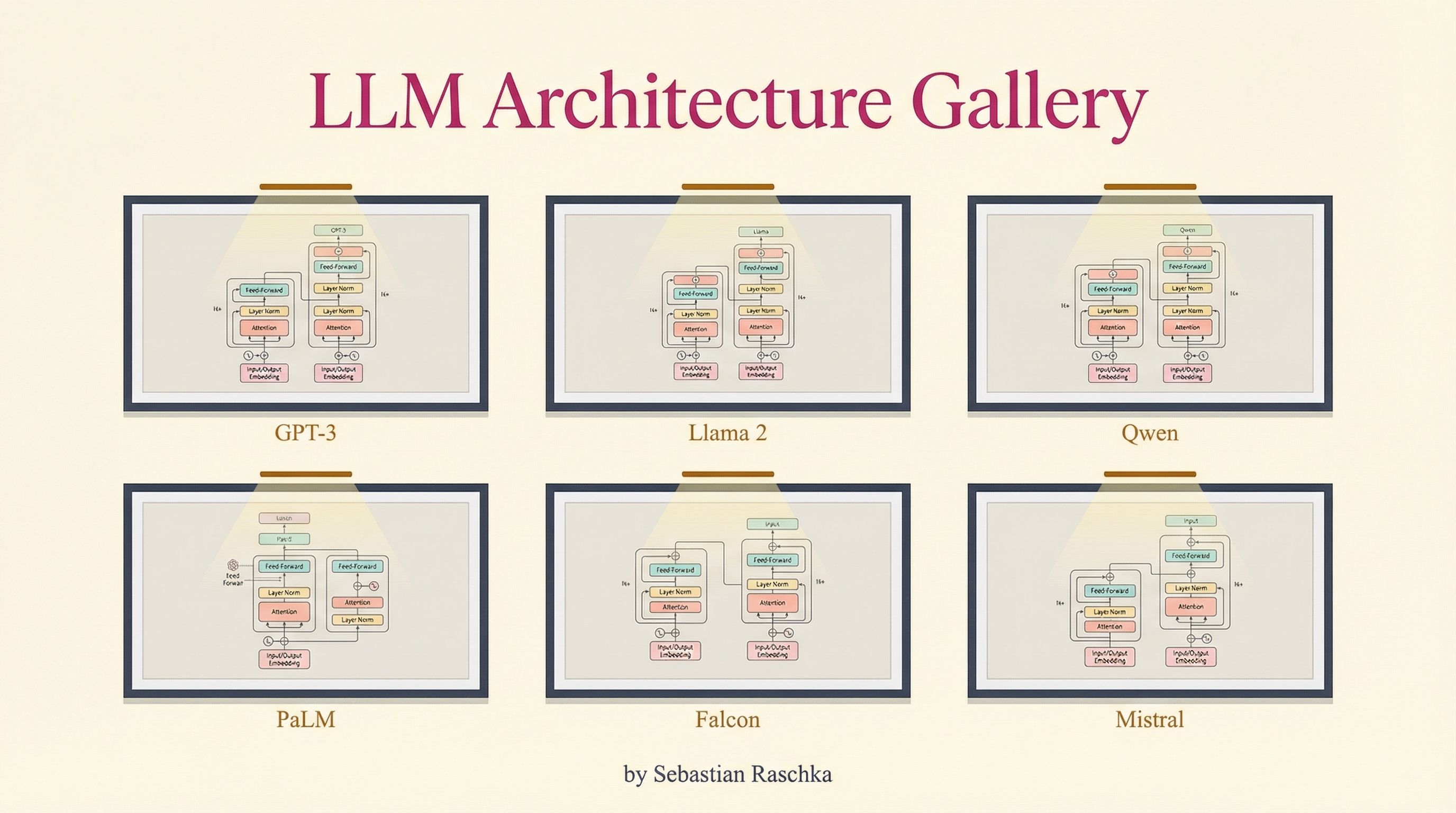
Sebastian Raschka’s LLM Architecture Gallery is a visual reference covering every major LLM architecture from GPT-2 to the present day. Each entry includes a detailed architecture diagram plus a fact sheet: scale, release date, decoder type (dense, sparse MoE, hybrid), attention mechanism, and key architectural innovation. Available as a high-resolution poster (14,570 x 12,490 px, 182 megapixels). 101K views in the first 24 hours.
| *Source: LLM Architecture Gallery | Adafruit: Visual Reference for LLM Architectures | GIGAZINE Coverage | Hacker News Discussion | LLMs from Scratch - GitHub* |
What’s Included
Each model entry shows:
| Field | Example |
|---|---|
| Architecture diagram | Detailed block diagram showing layers, attention, normalization |
| Scale | Parameter count, training data size |
| Release date | When the model was released |
| Decoder type | Dense, Sparse MoE, Hybrid |
| Attention mechanism | Multi-head, grouped-query, multi-query, sliding window |
| Key innovation | What makes this architecture different from predecessors |
Models Covered
The gallery spans the full history of decoder-only LLMs:
- Foundational: GPT-2, GPT-3
- Open-weight pioneers: LLaMA, Llama 2, Llama 3
- Chinese models: Qwen, Qwen 2.5, DeepSeek, DeepSeek-V3
- Google: Gemma, Gemma 2
- xAI: Grok
- 2026 additions: MiniMax, Ling, Sarvam, Llama 4
Based on Raschka’s deep-dive articles:
Why This Is a Must-Have Teaching Resource
1. Visual comparison beats text. Students can see the difference between multi-head attention and grouped-query attention instead of reading about it. Architecture diagrams make design decisions tangible.
2. Traces the evolution. The gallery shows how each model builds on predecessors — what changed from GPT-2 → GPT-3 → LLaMA → Llama 3 → Llama 4. Students learn architecture as a progression, not isolated designs.
3. Fact sheets enable comparison exercises. Give students the gallery and ask: “Why did Llama 3 switch from multi-head to grouped-query attention? What’s the tradeoff?” The data is right there.
4. Pairs with hands-on implementation. Use the gallery diagrams as blueprints → implement key components on TensorTonic → fine-tune with Unsloth Studio. Theory → visualization → implementation → practice.
5. Poster for the lab. The 182-megapixel poster can be printed and hung in a CS lab. Students reference it constantly. Physical artifacts in learning spaces drive retention.
Raschka’s Other Resources
Sebastian Raschka is also the author of:
- LLMs from Scratch — implement a ChatGPT-like LLM in PyTorch step by step (companion to his book)
- Build a Large Language Model (From Scratch) — Manning book
These form a complete learning stack: Gallery (see architectures) → Book/Repo (implement from scratch) → TensorTonic (practice problems) → Unsloth (fine-tune your own).
Further Reading
- LLM Architecture Gallery
- LLMs from Scratch - GitHub
- Hacker News Discussion (101K views)
- Adafruit Coverage
- Hyperion Consulting: Strategic Resource
How LearnAI Team Could Use This
- Use the gallery as a visual anchor in lessons on transformer evolution and model design tradeoffs.
- Create comparison exercises where learners explain why architectures moved from dense attention to GQA, MoE, or hybrid designs.
- Pair architecture diagrams with implementation labs using LLMs from Scratch or fine-tuning exercises.
Real-World Use Cases
- Educators can use the poster to teach architecture differences across GPT, Llama, Qwen, Gemma, DeepSeek, and other model families.
- AI teams can compare model design choices when selecting architectures for latency, context length, or deployment constraints.
- Learners can use the diagrams as references while implementing attention, normalization, and decoder blocks from scratch.