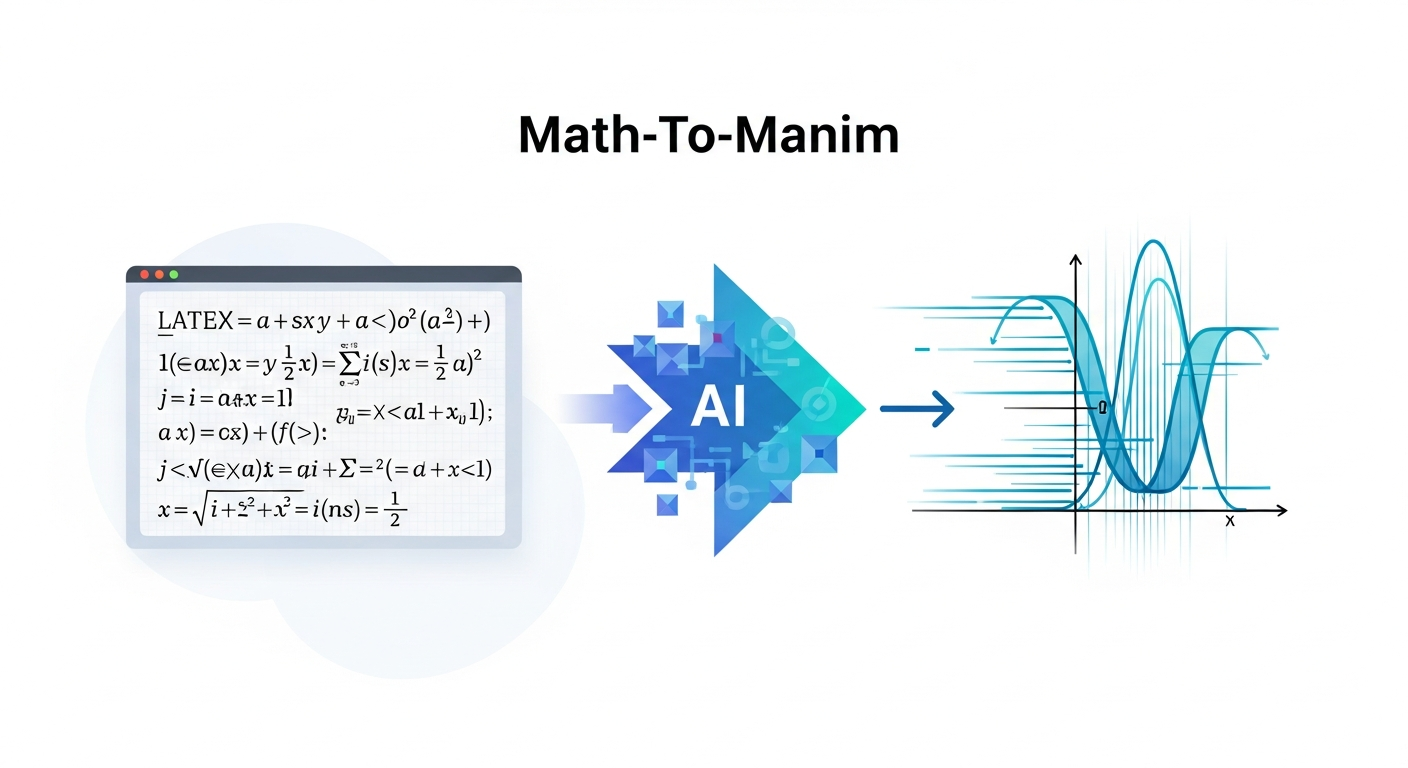
Math-To-Manim automates the pipeline from LaTeX formulas and mathematical concepts to Manim-animated videos using AI. What previously required writing custom Python animation code by hand — a skill set separate from mathematical expertise — is now driven by describing the concept and letting AI generate the Manim code and render it. The project ships with 55+ example topics spanning physics, mathematics, and computer science, making it immediately usable for educators and researchers.
| *Source: GitHub — HarleyCoops/Math-To-Manim | Weibo post by 祛框 OKmath (May 2026)* |
What Is Manim?
Manim (Mathematical Animation Engine) is the Python library 3Blue1Brown built to create the animations in his YouTube channel (6M+ subscribers). The library produces publication-quality mathematical animations — morphing equations, graph transformations, geometric proofs — that are notoriously difficult to produce with general-purpose video tools. The catch: writing Manim code requires both Python fluency and deep familiarity with its scene-graph API. That barrier is what Math-To-Manim removes.
The LaTeX → Animation Pipeline
Input: LaTeX formula or concept description
        ↓
   AI generates Manim Python code
        ↓
   Manim renders to animated video (.mp4)
        ↓
Output: Explainer animation ready to embed
The user describes a concept — in LaTeX, plain text, or both — the AI model generates the corresponding Manim scene code, and the renderer produces the video. No animation programming skill is required to generate output, though reviewing or debugging the generated code benefits from basic Python and Manim familiarity.
Key Capabilities
| Feature | Detail |
|---|---|
| Input format | LaTeX expressions, concept descriptions, physics equations |
| Output format | Manim-rendered animated video (MP4) |
| Example library | 55+ topics across math, physics, CS |
| Model support | OpenAI Agents SDK (primary); Codex CLI as optional alternative |
| Deployment | Local (clone repo, configure API key, run) |
| Example shown | GRPO (Geometry on a Response Manifold) animation |
Example Topics Covered
The 55+ bundled examples span:
- Physics — mechanics, electromagnetism, wave equations
- Pure mathematics — calculus, linear algebra, topology
- Computer science — algorithm visualization, data structures
- Machine learning — gradient descent, loss landscapes, attention mechanisms
The GRPO example (a reinforcement learning concept from recent LLM training research) shows the tool handling graduate-level material, not just high-school textbook content.
Setup
git clone https://github.com/HarleyCoops/Math-To-Manim.git
cd Math-To-Manim

# Basic install (Manim + core dependencies)
pip install -e ".[dev]"

# With render extras (recommended for full video output)
pip install -e ".[dev,render]"

# Set your OpenAI API key (primary model; Codex CLI is an optional alternative)
export OPENAI_API_KEY=your_key_here

# Generate an animation
math-to-manim generate "Explain the Fourier Transform with a rotating vector animation"
# or equivalently:
python -m math_to_manim.cli generate "Explain the Fourier Transform with a rotating vector animation"
Manim itself has additional system dependencies (LaTeX, Cairo, FFmpeg) — the repo README covers platform-specific setup.
How LearnAI Team Could Use This
- Lecture video production — convert any formula-heavy slide into a 30-second animated explainer without video editing skills; integrate directly into course modules
- CS concept visualization — animate algorithm steps, recursion trees, graph traversals, and sorting networks to replace static diagrams
- Student assignments — assign students to describe a concept in LaTeX and submit the AI-generated animation as a deliverable — combines math communication with AI tooling
- Research communication — turn paper figures and proofs into shareable animated clips for conference talks or social media outreach
- Teaching Manim itself — use the generated code as a starting point; students read and modify AI-generated Manim scenes to learn the library
Real-World Use Cases
| Scenario | How to use |
|---|---|
| CS professor explaining binary search | Describe the algorithm in pseudocode + LaTeX; render an animation showing array partitioning step by step |
| ML researcher explaining GRPO | Paste the loss function LaTeX; get a geometric animation of the response manifold |
| Math TA creating homework hints | Generate animations for each problem type; embed in course LMS |
| Conference presenter | Turn a 3-page proof into a 60-second animated summary slide |
| YouTube explainer channel | Automate the 3Blue1Brown-style production pipeline without hand-coding every scene |
Important Things to Know
- Manim system dependencies are non-trivial — LaTeX, FFmpeg, and Cairo must all be installed; expect 20–30 minutes of environment setup on a fresh machine
- Output quality varies by concept complexity — simple curve animations are reliable; highly custom layouts may need manual Manim code tweaks
- Model choice matters — the repo uses OpenAI Agents SDK as its primary backend; Codex CLI is documented as an optional alternative. It is not fully model-agnostic — swapping to an arbitrary API requires changes beyond a config key
- Rendered locally — computation happens on your machine; rendering times depend on animation length and complexity
- Not a drag-and-drop tool — this is a developer-facing pipeline; some comfort with the command line is required
- 3Blue1Brown’s Manim vs. community Manim — the original library (manimgl) diverged from the community fork (manim/ManimCE); Math-To-Manim targets ManimCE, the more actively maintained version