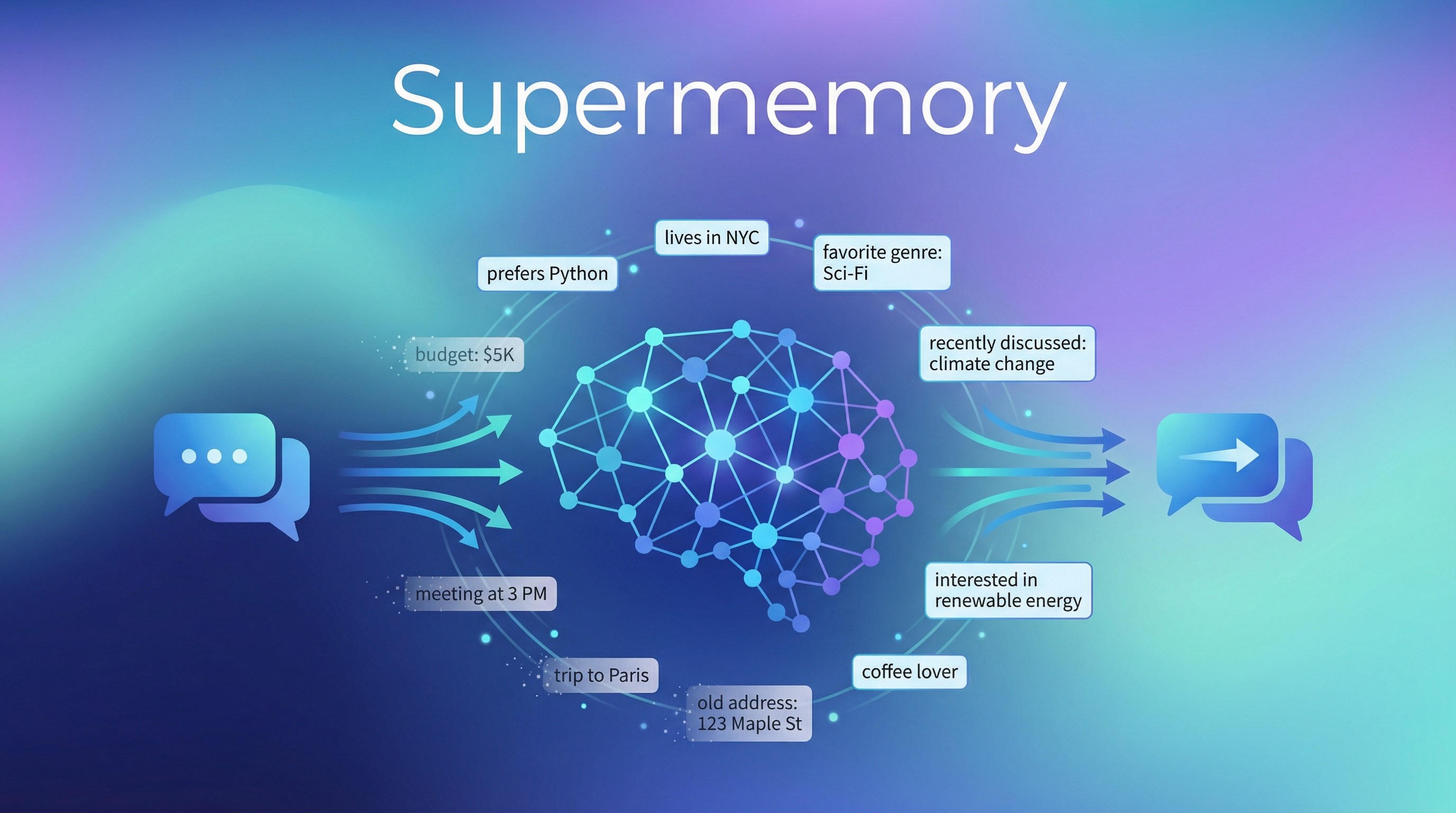
Your AI forgets everything between conversations. Ask it something you told it last week — blank stare. Supermemory fixes this with a unified memory and context API: it extracts facts from conversations, tracks changes over time, auto-forgets expired info, and gives any AI app a persistent, personalized memory layer. Ranked #1 on all three major memory benchmarks (LongMemEval, LoCoMo, ConvoMem).
| *Source: GitHub — supermemoryai/supermemory (21K+ stars) | 亚莱加德 on Douyin | supermemory.ai* |
Why Not Just RAG?
Traditional RAG retrieves the same documents for all users — it doesn’t know who’s asking. Supermemory is different:
Traditional RAG:
  User asks → Search docs → Same results for everyone → Answer

Supermemory:
  User asks → Search docs + recall user-specific facts → Personalized answer
                              │
                              ├── "User prefers Python over Java"
                              ├── "User's project uses PostgreSQL"
                              └── "User said yesterday: budget is $5K"
                                  (supersedes last month's "$10K")
Key difference: Supermemory tracks facts per user over time, handles contradictions (newer info supersedes older), and auto-forgets temporary context.
Core Capabilities
| Feature | What It Does |
|---|---|
| Fact extraction | Automatically pulls facts from conversations — no manual tagging |
| Temporal awareness | Knows that “I moved to NYC” supersedes “I live in SF” from last month |
| Auto-forgetting | Expired info (e.g., “meeting at 3pm today”) is purged automatically |
| User profiles | Auto-maintained context combining stable facts + recent activity (~50ms retrieval) |
| Hybrid search | RAG + memory queries combined — knowledge base docs + personalized context in one call |
| Multi-modal | PDFs, images (OCR), videos (transcription), code (AST-aware chunking) |
| Data connectors | Real-time sync with Google Drive, Gmail, Notion, OneDrive, GitHub |
Quick Start
As MCP Server (Claude Code / Cursor / VS Code)
npx -y install-mcp@latest https://mcp.supermemory.ai/mcp --client claude --oauth=yes
One command — Claude Code gains persistent memory across sessions.
As SDK
npm install supermemory # or: pip install supermemory
import { SuperMemory } from 'supermemory';
const client = new SuperMemory();

// Store a memory
await client.add("User prefers dark mode and uses vim keybindings");

// Retrieve user profile + search
const result = await client.profile({ user_id: "user123", search: "editor preferences" });
Framework Integrations
Drop-in wrappers for: Vercel AI SDK, LangChain, LangGraph, OpenAI Agents SDK, Mastra, Agno, n8n.
Benchmark Results
| Benchmark | What It Tests | Supermemory Score | Rank |
|---|---|---|---|
| LongMemEval | Long-term memory with knowledge updates | 81.6% accuracy | #1 |
| LoCoMo | Fact recall across extended conversations | Top | #1 |
| ConvoMem | Personalization and preference learning | Top | #1 |
The team also open-sourced MemoryBench — a benchmarking framework for comparing memory providers head-to-head.
How It Compares
| Supermemory | Mem0 | Zep | Letta | |
|---|---|---|---|---|
| Approach | Unified memory ontology | Graph-enhanced memory | Temporal knowledge graph | Self-editing memory (OS metaphor) |
| Temporal handling | Auto-supersede + auto-forget | Manual updates | Tracks fact changes over time | Archival store |
| User profiles | Auto-generated, ~50ms | Manual configuration | Built-in | Per-agent state |
| MCP support | Yes (one-command install) | Via community servers | No | No |
| Multi-modal | PDF, images, video, code | Text-focused | Text-focused | Text-focused |
| GitHub stars | 21K+ | 48K+ | 3K+ | 15K+ |
| Best for | Full-stack AI apps with personalization | Chatbots, personal assistants | Enterprise with compliance needs | Agent runtimes with autonomy |
Architecture: One Ontology, Not Five Systems
Most memory solutions require you to configure separate systems: vector DB for search, graph DB for relationships, key-value store for facts, profile builder for users. Supermemory consolidates everything into a single unified memory ontology:
┌─────────────────────────────────────────┐
│         Supermemory Unified Layer        │
│                                          │
│  ┌──────────┐  ┌──────────┐  ┌────────┐│
│  │ Fact     │  │ Search   │  │Profile ││
│  │Extraction│  │ (hybrid) │  │Builder ││
│  └────┬─────┘  └────┬─────┘  └───┬────┘│
│       │              │            │      │
│       └──────────────┼────────────┘      │
│                      ▼                   │
│           ┌──────────────────┐           │
│           │  Unified Memory  │           │
│           │  Ontology        │           │
│           └──────────────────┘           │
│                      │                   │
│       ┌──────────────┼────────────┐      │
│       ▼              ▼            ▼      │
│  ┌──────────┐  ┌──────────┐  ┌────────┐│
│  │Connectors│  │ Multi-   │  │ Auto-  ││
│  │(Drive,   │  │ modal    │  │ forget ││
│  │ Notion)  │  │(PDF,img) │  │        ││
│  └──────────┘  └──────────┘  └────────┘│
└─────────────────────────────────────────┘
No separate vector DB to configure. No graph DB to maintain. One system.
How LearnAI Team Could Use This
- Persistent course assistants — Give AI tutors memory across sessions so students don’t re-explain goals, misconceptions, or project context.
- Research project continuity — Store evolving facts about datasets, hypotheses, and results so research agents resume accurately.
- Personalized AI literacy coaching — Track each learner’s preferred tools, skill level, and recurring blockers.
- Faculty support workflows — Maintain context across syllabus design, assignment drafting, rubric iteration, and feedback cycles.
Real-World Use Cases
- Personal AI assistants — Remember user preferences, projects, deadlines, and recent decisions across conversations.
- Customer support agents — Retrieve account-specific history without forcing users to repeat context.
- AI coding agents — Preserve repository conventions, architectural decisions, and developer preferences across sessions.
- Enterprise knowledge apps — Combine shared documents with user-specific context for more relevant search.
- Sales workflows — Track changing customer needs, budgets, stakeholders, and follow-up commitments over time.
Links
- GitHub: supermemoryai/supermemory (21K+ stars)
- Docs: supermemory.ai/docs
- Console: console.supermemory.ai
- MemoryBench: Open-source benchmarking for memory providers
- MCP install:
npx -y install-mcp@latest https://mcp.supermemory.ai/mcp --client claude --oauth=yes