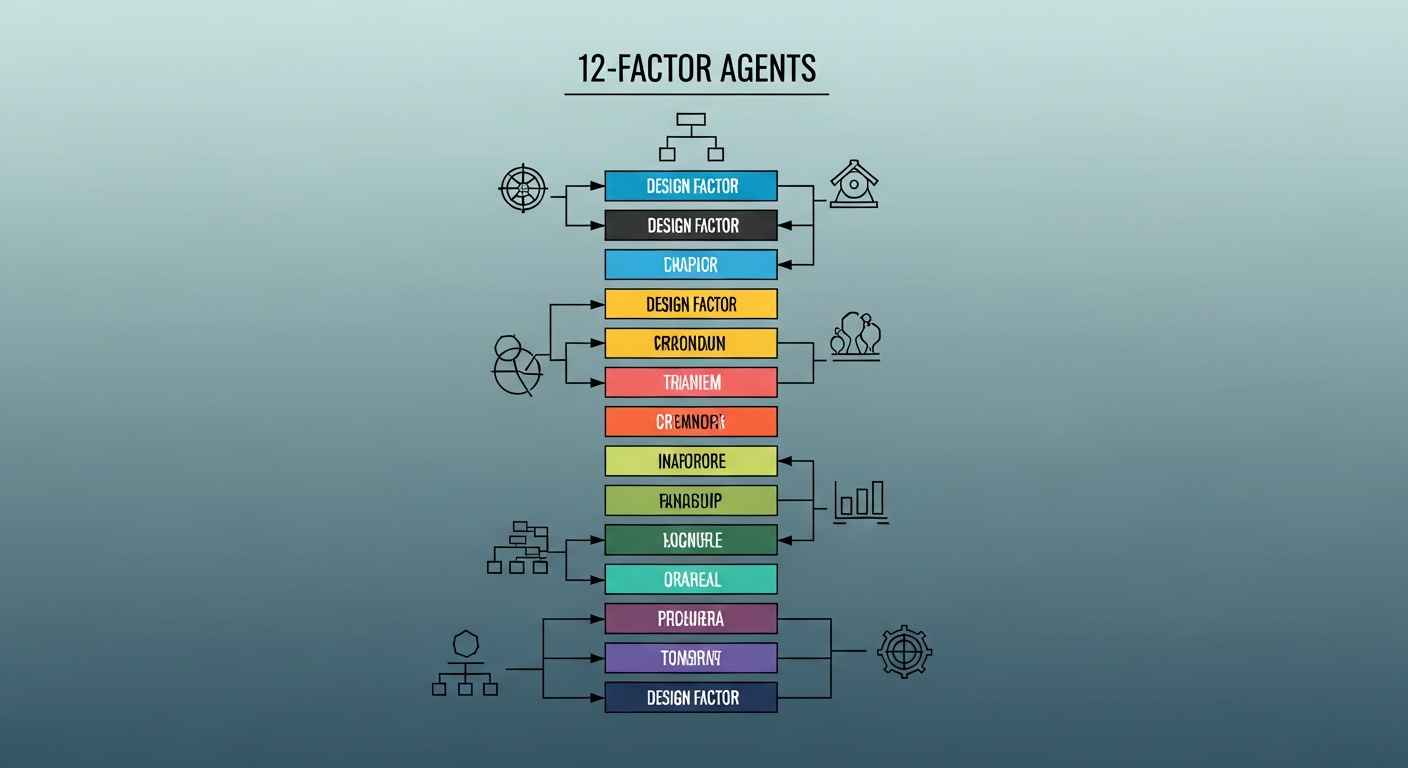
A set of 12 engineering design principles for building AI agents in production, analogous to the classic Twelve-Factor App methodology for cloud-native services. Distilled from interviews with 100+ SaaS builders working toward more agentic products, the framework addresses what the author frames as the defining challenge of AI agent development: the gaping distance between a compelling demo and a reliable, maintainable production system.
| *Source: Dex Horthy / HumanLayer (author) | GitHub: github.com/humanlayer/12-factor-agents | Stars: ~21.6k (May 2026) | Amplified by: 默魂 on Weibo (May 2026)* |
Background — The Demo-to-Production Gap
Most AI agent demos are deceptively clean: a single happy-path run, no interruptions, no partial failures, no ambiguous tool results. Production is the opposite. The 12-Factor Agents project emerged from a systematic question: what do teams that successfully ship production agents actually do differently from teams stuck at demo stage?
The answer, in the author’s framing, was not a better model or a better framework — it was engineering discipline applied at the agent layer. The 12 factors are that discipline, codified.
Crucially, the framework is framework-agnostic and model-agnostic. It does not prescribe LangChain, CrewAI, AutoGen, or any specific LLM. The factors operate at the level of design decisions, which means they apply regardless of your stack.
The 12 Factors at a Glance
| # | Factor | Core concern |
|---|---|---|
| 1 | Natural language to tool calls | Translate user intent into structured, executable actions |
| 2 | Own your prompts | Keep prompts in version-controlled code, not buried in framework magic |
| 3 | Own your context window | Manage what the model sees — don’t let frameworks silently overflow or truncate it |
| 4 | Tools are just structured outputs | Design tools as clean input/output contracts, not stateful side-effect blobs |
| 5 | Unify execution state and business state | Keep the agent’s internal state and your application state in sync explicitly |
| 6 | Launch/pause/resume with simple APIs | Agents must be interruptible and resumable — not fire-and-forget black boxes |
| 7 | Contact humans with tool calls | Human-in-the-loop is a tool call, not an exception or a halt |
| 8 | Own your control flow | Write explicit branching and looping logic; don’t delegate it entirely to the model |
| 9 | Compact errors into context | Errors are data; surface them back into the model’s context window for recovery |
| 10 | Small, focused agents over monoliths | Decompose into composable agents with narrow responsibilities |
| 11 | Trigger from anywhere, meet users where they are | Agents should be callable from any interface — CLI, Slack, webhook, UI |
| 12 | Make your agent a stateless reducer | Model the agent as a pure function over state; simplifies testing, replay, and debugging |
What Makes This Valuable
The Chinese tech community post that surfaced this project called out the framework’s most important quality: its 视角 (perspective/viewpoint). The 12 factors don’t tell you which library to use — they tell you how to think about your agent’s architecture. This is rare. Most agent tutorials focus on getting a demo running; the 12-factor framework focuses on getting it running reliably at 2am when you’re not watching.
Three factors deserve special attention for practitioners:
Factor 6 — Launch/pause/resume: Production agents get interrupted. A user closes a browser tab. An API rate-limits. A human approver takes three hours. Agents built without pause/resume capability either block an entire thread or lose state entirely. This factor forces the design question up front.
Factor 8 — Own your control flow: The temptation in agentic systems is to let the model decide what to do next at every step. This produces unpredictable loops and compounding errors. Explicit control flow — written as code — is auditable, testable, and debuggable. The model reasons; your code orchestrates.
Factor 12 — Stateless reducer: Borrowed from functional programming. The core idea is to design your agent so its step logic resembles a pure function over state — if you model it as (state, event) → new_state (this framing is interpretive analysis, not a direct quote from the repo), you can replay any run from any checkpoint, write deterministic unit tests, and reason about failure modes without a running LLM. This is the architectural foundation that makes the other 11 factors coherent.
Relationship to 12-Factor App
The original 12-Factor App (Heroku, 2011) gave cloud developers a vocabulary for building portable, scalable web services. 12-Factor Agents does the same for AI systems: it provides a shared vocabulary for agent engineering decisions so that teams can critique and improve each other’s designs without talking past each other.
The analogy is intentional and instructive. Just as 12-Factor App didn’t invent microservices or stateless HTTP — it named and organized practices that already worked — 12-Factor Agents names practices that production teams were already discovering the hard way.
How LearnAI Team Could Use This
- Capstone project rubric — when students build multi-step agents as final projects, grade against the 12 factors: does it own its control flow? Is it pausable? Are errors surfaced back into context? This gives evaluators a structured lens beyond “did it work once.”
- Agent architecture review checklist — before any team deploys an agent to users, run through the 12 factors as a pre-flight checklist. Flag which factors are unaddressed and what the risk is.
- Curriculum anchor for AI Engineering module — use as the organizing framework for a week on production agent design. Each factor becomes one lecture topic with a hands-on exercise.
- Counterpoint to “just use a framework” advice — students often reach for LangChain or AutoGen as a first instinct. 12-Factor Agents provides a principled argument for understanding the layers before abstracting them away.
- Bridge between CS fundamentals and AI practice — factors like stateless reducer (Factor 12) and explicit control flow (Factor 8) connect directly to concepts students already know from data structures and programming languages courses. Use these as bridges.
Real-World Use Cases
| Scenario | How to use |
|---|---|
| Evaluating a new agent framework | Map the framework’s abstractions against the 12 factors — which factors does it handle for you, which does it hide from you? |
| Debugging a production agent failure | Walk through factors 5, 8, and 9 first: is state unified? Is control flow explicit? Are errors surfacing into context? |
| Onboarding a new engineer to an agent codebase | Use the 12 factors as a reading guide — ask them to annotate where each factor is (or isn’t) implemented |
| Writing an agent design doc | Structure the design doc around the 12 factors as section headings; forces completeness |
| Interviewing agent engineers | Ask candidates to critique a demo agent against the factors; reveals depth of production thinking |
| Post-mortem after an agent incident | Which factor(s) were violated? Build a remediation plan that explicitly addresses the gap |
Important Things to Know
- Framework-agnostic by design — the factors make no recommendation about LangChain, AutoGen, CrewAI, Claude Code, or any specific LLM. They operate at the design-decision layer, which means they’re durable across the framework churn of 2025-2026.
- Distilled from practitioner interviews, not academic research — the authority here is empirical (interviews with 100+ SaaS builders working toward more agentic products) not theoretical. This is a strength for practitioners and a limitation for formal analysis.
- The ~21.6k GitHub stars (May 2026) signal community resonance — the project reached this milestone quickly, suggesting the demo-to-production problem is widely felt. High star counts on engineering frameworks sometimes reflect aspiration more than adoption; evaluate the actual factors on their merits.
- Complements, does not replace, framework knowledge — knowing the 12 factors doesn’t mean you shouldn’t use LangChain. It means you’ll use it with eyes open about which decisions the framework is making for you.
- The “12” number is deliberate branding, not a claim of completeness — the analogy to 12-Factor App is a communication device. Real production systems will encounter problems not covered by any 12-item list.