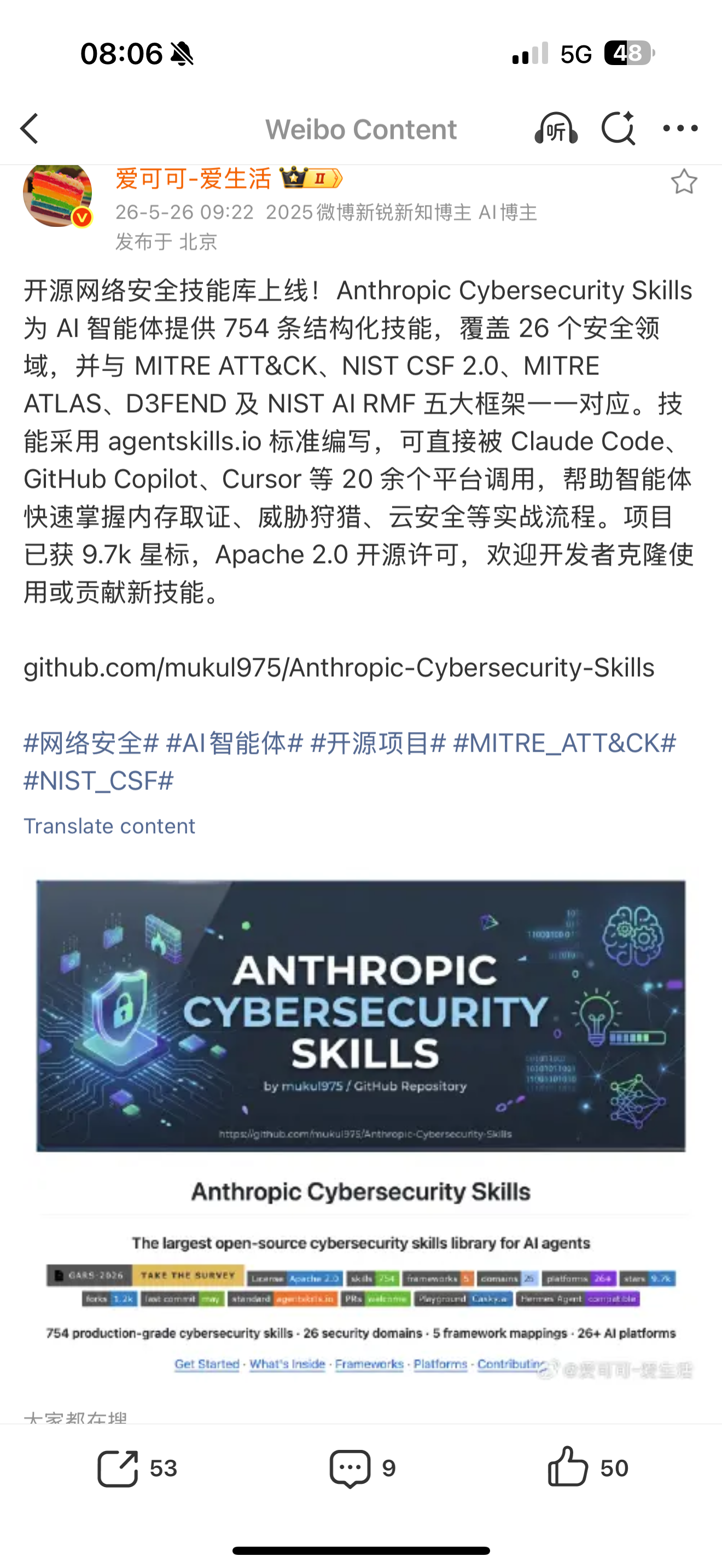
mukul975/Anthropic-Cybersecurity-Skills is a community-created library of structured cybersecurity skills for AI agents. The repository currently describes itself as 817 skills across 29 domains, mapped to frameworks such as MITRE ATT&CK, NIST CSF 2.0, MITRE ATLAS, D3FEND, NIST AI RMF, and MITRE F3. Treat quality labels in the upstream README as the project’s own claim, not as LearnAI validation.
Source: GitHub — mukul975/Anthropic-Cybersecurity-Skills
Critical Caveat
Despite the repository name, the project states it is an independent community project and not affiliated with Anthropic PBC. It also contains dual-use security material. Use it only for lawful, authorized systems, labs, defensive analysis, and teaching.
Why It Belongs Here
Security is where agent skills become more than convenience. A generic agent can say vague things about incident response; a skill library can give it a structured workflow:
incident question
  -> choose domain skill
  -> follow evidence steps
  -> map to framework
  -> document findings
  -> separate known / inferred / unknown
That makes it useful for teaching:
| Course use | Example activity |
|---|---|
| Security fundamentals | Map an alert to ATT&CK tactics and techniques |
| AI safety | Compare prompt injection and traditional intrusion models |
| Incident response | Walk through a memory, network, or cloud investigation |
| Compliance literacy | Show how one skill maps to multiple frameworks |
How Students Should Use It
Do not start with “hack this.” Start with a controlled lab:
- Pick one defensive domain, such as log triage or malware traffic analysis.
- Open the relevant skill.
- Follow the workflow on a toy dataset or CTF artifact.
- Record which claims are evidence-backed and which are guesses.
- Compare the skill’s checklist with a human-written security playbook.
What To Watch
- Large skill libraries can create routing confusion. Use one domain at a time.
- Dual-use instructions require clear authorization boundaries.
- Framework mappings are useful, but they do not prove an incident happened.
- For class use, strip or sandbox offensive paths unless the assignment is explicitly red-team training.
Best LearnAI Use
Use this as a security workflow library, not as a magic security expert. The page pairs well with AI agent benchmark cheating because both show why agent behavior needs structured controls and evidence trails.