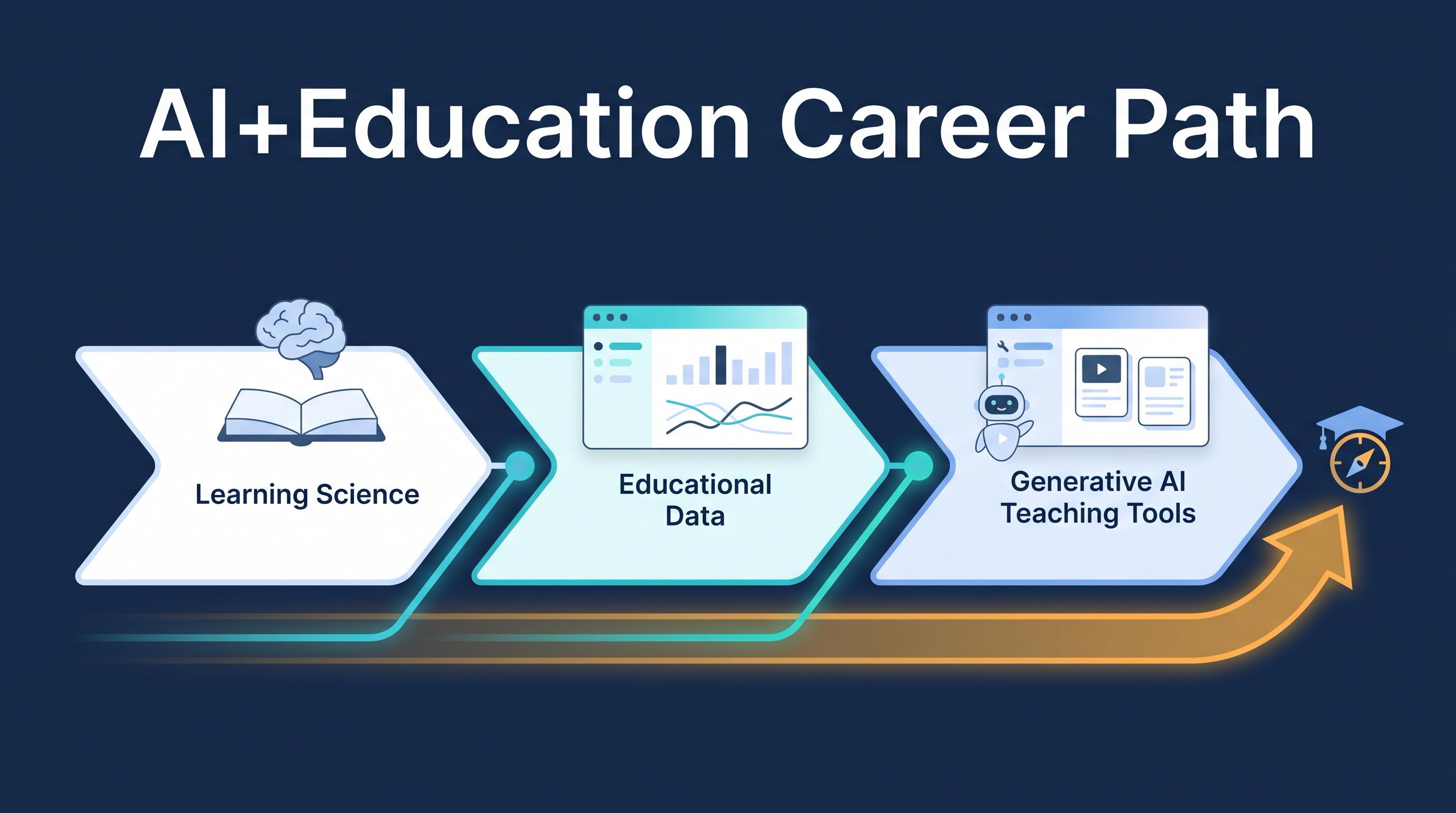
A useful career-path point: AI+Education is not just “make a chatbot tutor.” The stronger path combines three literacies: how people learn, how educational data behaves, and how to build AI tools that teachers can actually use. For students, this is a better map than chasing whichever EdTech tool is trending this month.
| *Source: UNESCO: Artificial intelligence in education | Society for Learning Analytics Research | Journal of Educational Data Mining* |
This is why the page treats AI+Education as human-centered system design, not just automation: UNESCO’s framing emphasizes inclusion, teacher/student competency, and risk management.
The Three-Layer Career Map
AI+Education builder
        |
        +-- Learning science
        |     How people learn, forget, transfer, and misunderstand
        |
        +-- Educational data
        |     Logs, assessments, LMS traces, tutor interactions, privacy
        |
        +-- Generative AI tools
              Lesson generation, feedback, simulation, tutoring, workflows
The first mistake is treating education as a content-delivery problem. If the product only generates explanations faster, it may still fail because it ignores misconception repair, assessment design, teacher workload, classroom constraints, and student motivation.
The second mistake is treating AI+Education as pure pedagogy. Modern learning environments generate logs, quiz attempts, LMS events, drafts, feedback, and interaction traces. Students who can analyze that data responsibly have a different career profile than students who only know prompt tricks.
The third mistake is treating GenAI as the whole field. Generative models are now the interface layer, but the durable work is still system design: what data enters, what feedback returns, what a teacher can inspect, and what a student is forced to think through.
What Each Layer Means
| Layer | Student should learn | Why it matters |
|---|---|---|
| Learning science | Cognitive load, feedback, transfer, misconceptions, formative assessment | Prevents “AI tutor” products that answer questions but do not improve learning |
| Educational Data Mining | Student-modeling data, assessment artifacts, LMS activity, tutoring-system traces | Turns classroom interaction into evidence while respecting privacy and validity limits |
| Learning analytics | Collect, interpret, and communicate learning data for action | Helps instructors and programs decide what to change, not just what happened |
| Generative AI workflows | Prompting, agents, retrieval, tool use, verification, human-in-the-loop design | Lets students build teaching tools that produce inspectable materials, not black-box magic |
| Product and classroom constraints | Accessibility, student-data privacy such as FERPA in the U.S., teacher time, grading policy, institutional adoption | Most education products fail here, not at the demo layer |
The key is the intersection. A student who only knows ML may build a clever model that no teacher can use. A student who only knows education may lack the engineering fluency to build the tool. A student who can connect both is better prepared for roles such as learning engineer, EdTech AI engineer, curriculum-tool builder, or AI education researcher.
A Practical Student Roadmap
For a CS student, the path can be concrete:
| Semester focus | Build / study | Proof of skill |
|---|---|---|
| Foundations | Python, web apps, databases, basic ML, human-centered design | A small learning app with persistent student state |
| Learning science | Read about formative feedback, misconception repair, assessment design | A lesson redesign explaining what cognitive bottleneck it targets |
| Educational data | Work with quiz logs or LMS-like traces; practice privacy-safe analysis | A notebook that finds learning patterns without overclaiming causality |
| GenAI tooling | Build an AI feedback assistant or lesson-material generator | The tool shows sources, asks before grading, and logs decisions |
| Evaluation | Compare AI feedback against a rubric or instructor judgment | A short report: what improved, what failed, what should not be automated |
This roadmap deliberately avoids “learn every model architecture first.” Model knowledge matters, but most useful AI+Education work is about fitting AI into the learning process responsibly.
What To Ignore From The Screenshots
The screenshots mention specific salary examples and company names. Treat those as leads, not facts. Salary numbers age quickly, vary by location and seniority, and should not be copied into a student guide unless verified from current job postings or compensation datasets.
The more durable signal is the role shape:
| Trend-like claim | Durable version |
|---|---|
| “AI education salaries are high” | There is demand for people who combine education knowledge, data skill, and AI tooling |
| “Company X is hiring” | Watch EdTech, tutoring, learning-platform, and AI-lab education teams |
| “Prompting is the job” | Prompting is one layer; the stronger role includes evaluation, product judgment, and data responsibility |
| “Teachers will be replaced” | The better opportunity is teacher empowerment: tools that help teachers create, inspect, and adapt materials |
How This Connects To Existing LearnAI Pages
This entry is the career map. It should sit above several deeper pages:
| Existing page | Role in the map |
|---|---|
| AI in Education — Teacher’s Factory | Why teacher empowerment is a better design target than student shortcutting |
| OpenMAIC | Example of a multi-agent classroom product pattern |
| Turn Claude Code into Claude Teacher | Small personal workflow for learning while coding |
| AI Mastery Games | Interactive AI literacy as a teaching format |
| Learning in the AI Era | Student-side learning posture: amplify thinking, do not outsource it |
How LearnAI Team Could Use This
- Student advising — give this page to CS students who say they are interested in “AI in education” but do not yet know which skills to build.
- Course design — use the three-layer map to connect CS courses with education research: software design, data mining, HCI, and AI literacy.
- Project scoping — require student AI+Education projects to name the learning problem, the data trace, and the teacher workflow before building a demo.
- Faculty collaboration — use this as a shared vocabulary page when talking with education, psychology, and learning-science colleagues.
Real-World Use Cases
| Scenario | What the student builds |
|---|---|
| CS course assistant | A tool that gives rubric-grounded hints without revealing full answers |
| Writing feedback | A feedback system that classifies revision needs and links to examples |
| Learning analytics dashboard | Instructor-facing signals from quiz attempts, not student surveillance theater |
| AI literacy workshop | Activities that teach students when AI helps, when it harms, and how to verify |
| Adaptive practice | A small tutor that tracks misconception types and chooses the next question |
Important Things To Know
- Learning data is sensitive. Privacy, consent, retention, and bias matter before model choice.
- Accuracy is not enough. A correct answer can still be pedagogically bad if it removes the student’s productive struggle.
- Teachers need inspection surfaces. If the teacher cannot see why the AI suggested something, they cannot trust it.
- Evaluation is part of the product. Every AI+Education tool should have a rubric, a human review path, and a failure log.
- The best students will be bilingual across fields. They can talk to teachers about assessment and to engineers about logs, APIs, and model limits.