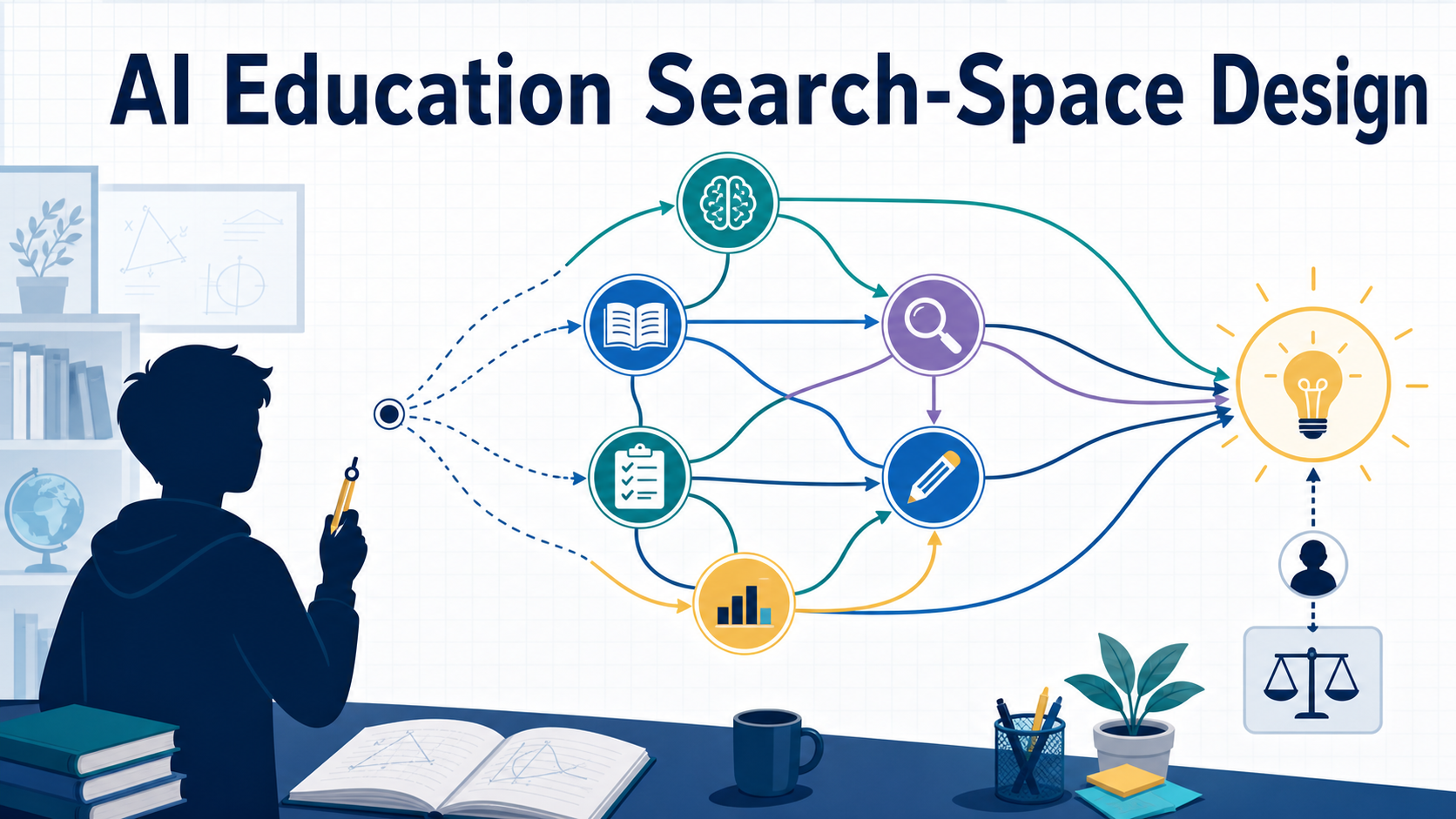
AI education should not only teach students how to get better answers faster. It should teach them how to widen the space of possible answers before they converge. The useful shift is from “one chatbot gives one polished response” to search-space design: decomposing a learning task into exploration, verification, and synthesis steps that keep the student in charge.
| *Source / evidence base: Hao et al., Nature 649, 1237-1243 (2026) and the arXiv version for the science-of-science pattern | OECD Digital Education Outlook 2026 for the learning-performance distinction | UNESCO AI Competency Framework for Students and AILit Framework for AI literacy, agency, ethics, and responsible use* |
The Education Angle
The Nature paper on AI in science reports a useful paradox: scientists using AI tools had higher individual output and impact, while AI-augmented science showed narrower collective topical breadth and lower follow-on engagement. That is population-level science-of-science evidence, not a direct study of students. Still, it gives AI education a sharp warning:
AI can make a person faster
without making the search broader.
For students, a plausible analogous risk is not just cheating but premature convergence. A student asks for a summary, gets a clean answer, trusts the frame, and never notices the missing counterexample, the weak source, or the adjacent idea the model did not retrieve.
That is why the question “Should students use AI?” is too small. A better question is:
Does this AI workflow make the student think wider
before it helps them produce faster?
OECD’s 2026 education outlook warns that general-purpose GenAI can improve task performance without necessarily producing durable learning gains when it is used without pedagogical guidance. UNESCO and the AILit Framework both push AI literacy beyond tool use toward responsible, critical, and creative engagement with AI systems. Search-space design is a practical way to turn that principle into classroom workflow.
From One Chat to a Learning Graph
Most students start with a line:
ask AI -> get answer -> edit answer -> submit
That workflow is fast, but it collapses exploration and judgment into one model response. A better learning workflow is a graph:
                 ┌─> examples ───────────┐
concept ────────>├─> counterexamples ────┤
                 ├─> textbook check ─────┼─> student synthesis
                 ├─> practice problems ──┤
                 └─> weak-spot diagnosis ┘
Each node has one bounded job. Each edge exists only when the next step actually needs the previous result. The student does not outsource the final answer; the student designs the search and owns the synthesis.
| Old AI use | Search-space design |
|---|---|
| “Explain chapter 4.” | “Explain the concept, then find examples, counterexamples, and common misconceptions.” |
| “Write my outline.” | “Generate three possible argument structures, then compare what each one misses.” |
| “Check my essay.” | “Run separate checks for structure, evidence, clarity, citation gaps, and prompt fit.” |
| “Give me practice questions.” | “Generate questions, grade my answers, diagnose weak spots, then retest only the weak spots.” |
The difference is not more prompting tricks. It is workflow topology.
A Student Graph Pattern
A reusable pattern for learning is the exploration diamond:
                 fan out
                    │
        ┌───────────┼───────────┐
        │           │           │
   explain       examples   counterexamples
        │           │           │
        └───────────┼───────────┘
                 verify
                    │
              student synthesis
Use it whenever a task has multiple independent parts:
- Explain node — ask for the core idea in plain language.
- Example node — ask for worked examples in the course domain.
- Counterexample node — ask when the idea breaks or does not apply.
- Source node — check the answer against class notes, textbook pages, assigned readings, or reputable sources.
- Practice node — generate problems that test transfer, not memorization.
- Weak-spot node — diagnose the pattern in wrong answers.
- Synthesis node — the student writes the final explanation or solution.
The final node should be human. That is where students consolidate learning: choosing what matters, resolving conflicts, and explaining the concept in your own words.
How to Teach It
Teach students to mark every AI-assisted task with three labels:
| Label | Question | Example |
|---|---|---|
| Explore | What else should I look at? | counterexamples, alternative hypotheses, adjacent fields |
| Verify | What would prove this wrong? | textbook check, source/date check, worked solution comparison |
| Synthesize | What do I now believe and why? | student-written explanation, final outline, corrected solution |
This turns AI literacy into a concrete practice. Students are not only learning “use ChatGPT ethically.” They are learning how to structure inquiry.
A classroom activity can be simple:
- Give students one short reading or one difficult concept.
- Let one group use a single chatbot prompt.
- Let another group use a graph workflow with exploration and verification nodes.
- Ask both groups to explain the concept without AI.
- Compare breadth, accuracy, originality, and confidence calibration.
The assessment target is not the prettiest output. It is whether students can identify what the first answer missed.
What This Prevents
Search-space design is a guardrail against the worst version of AI education:
faster homework
narrower curiosity
cleaner writing
less original thought
It does not reject AI. It rejects shallow AI use.
The goal is to teach students that AI output is not the destination. It is one node in a learning system. Good students learn to ask:
- What did the model retrieve too easily?
- What did it ignore?
- What source would change the answer?
- What counterexample would break the explanation?
- What do I understand well enough to defend without the model?
That is the education opportunity. AI can speed up production, but teachers can design workflows that widen attention first. If students learn that pattern, they are not just becoming better AI users. They are learning how serious thinking is organized.
Caveats
- The Nature paper studied scientists and scientific fields, not students directly. The student framing here is an analogy and curriculum hypothesis.
- “Search-space design” is a teaching label, not a settled academic term.
- Graph workflows are overkill for tiny tasks. Use them for research, essay planning, exam prep, project work, and hard concepts with multiple possible explanations.
- Academic integrity rules still matter. A learning graph should make student thinking more visible, not hide AI authorship.