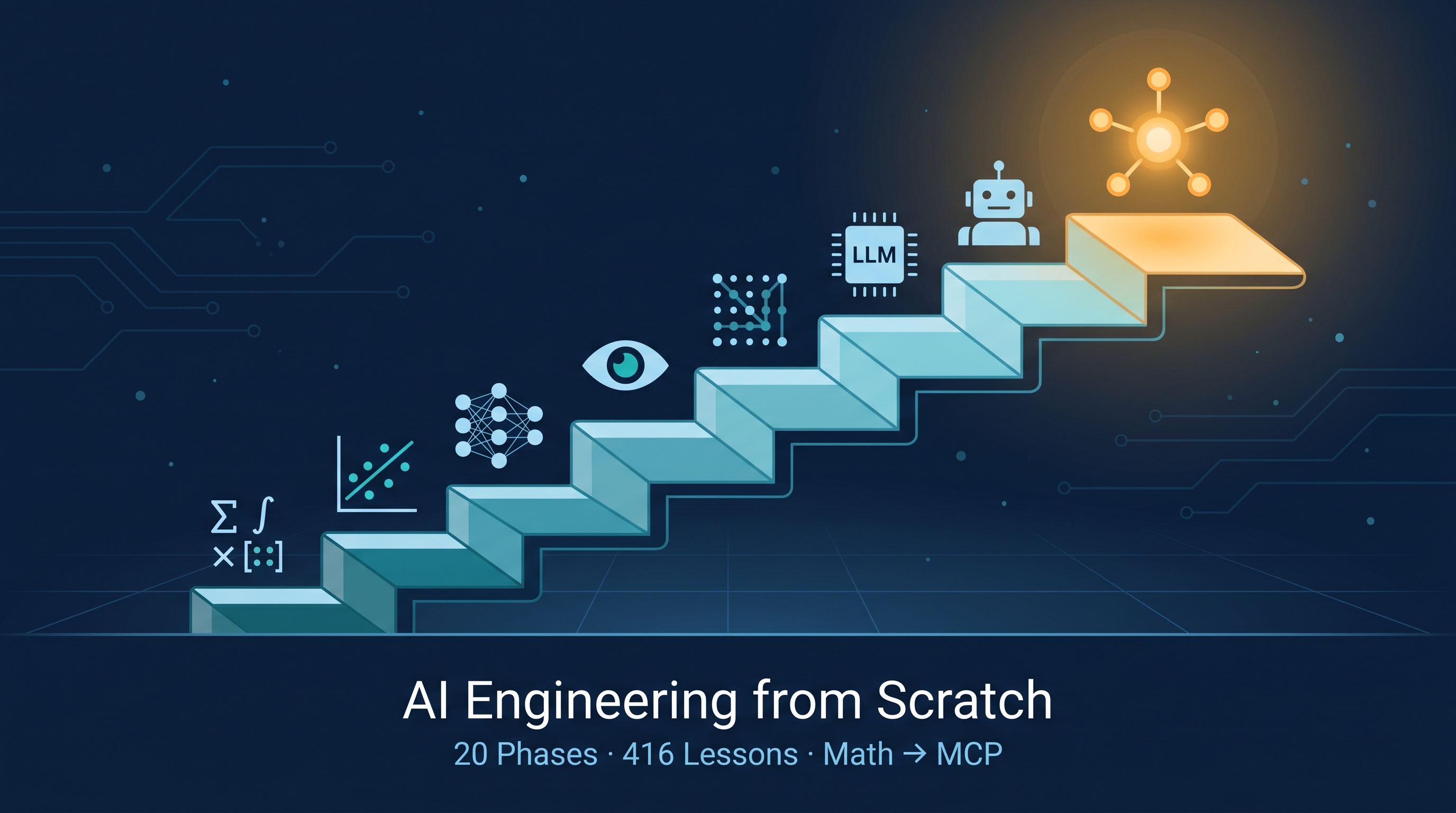
Rohit Ghumare’s ai-engineering-from-scratch is an unusually broad open-source AI curriculum that surfaced in 2026: 416 lessons across 20 phases (00–19), taking a learner from raw linear algebra to shipping a multi-agent system on MCP — with every algorithm derived from math first, then re-implemented with frameworks, then shipped as a reusable artifact (prompt, skill, agent, or MCP server). ~7K stars on the repo at the time of writing, MIT-licensed, and structured so individual phases can be forked as standalone bootcamps. It is the closest single-repo attempt at “learn the full stack of modern AI from one place.”
| *Source: GitHub — rohitg00/ai-engineering-from-scratch | Course site — aiengineeringfromscratch.com | Rohit Ghumare on X — @ghumare64 | Skillget listing | Weibo highlight by 蚂工厂* |
The Pitch
“84% of students already use AI tools. Only 18% feel prepared to use them professionally.”
The curriculum exists to close that gap. Not “learn ChatGPT prompts” — actually learn what’s happening when you call a model. Every phase ends with a working artifact you can install into Claude Code, Cursor, or any MCP-compatible agent.
The 20 Phases
| # | Phase | Lessons |
|---|---|---|
| 0 | Setup & Tooling | 12 |
| 1 | Math Foundations | 22 |
| 2 | ML Fundamentals | 18 |
| 3 | Deep Learning Core | 13 |
| 4 | Computer Vision | 28 |
| 5 | NLP: Foundations to Advanced | 29 |
| 6 | Speech & Audio | 17 |
| 7 | Transformers Deep Dive | 14 |
| 8 | Generative AI | 14 |
| 9 | Reinforcement Learning | 12 |
| 10 | LLMs from Scratch | 22 |
| 11 | LLM Engineering | 15 |
| 12 | Multimodal AI | 25 |
| 13 | Tools & Protocols (MCP, A2A) | 23 |
| 14 | Agent Engineering | 30 |
| 15 | Autonomous Systems | 22 |
| 16 | Multi-Agent & Swarms | 25 |
| 17 | Infrastructure & Production | 28 |
| 18 | Ethics, Safety & Alignment | 30 |
| 19 | Capstone Projects | 17 projects |
Total: 20 phases (00–19), 416 lessons, an estimated ~320 hours end-to-end, MIT license. Languages used across implementations: Python (primary), TypeScript, Rust, Julia.
The phases stack — Phase 1 is for someone new to ML, Phase 10 for someone already fluent in deep learning, Phase 14 for someone with senior engineering background. You don’t have to start at 0; Phase 0 (Setup & Tooling) is the on-ramp for learners who want a guided environment setup.
Lesson Anatomy — The 6-Step Arc
Every lesson follows the same shape, which is the secret of the curriculum’s coherence:
1. Motto       — the one-line core idea
2. Problem     — concrete pain that this lesson solves
3. Concept     — intuition and visual diagrams
4. Build It    — derive the algorithm from raw math, no frameworks
5. Use It      — re-implement using PyTorch / scikit-learn / etc.
6. Ship It     — produce a reusable artifact: prompt, skill, agent, or MCP server
Step 4 is the pedagogical bet. By the time PyTorch shows up in step 5, you already know what the framework is hiding. This is the “build a GPT from scratch then use HuggingFace” approach scaled to the entire stack.
Step 6 is the productivity multiplier. Every lesson outputs something you can immediately reuse — a prompt template for a workflow, a SKILL.md for Claude Code, an agent definition, an MCP server. The curriculum doubles as a personal toolkit.
File Layout
ai-engineering-from-scratch/
├── phases/
│   └── 14-agents/
│       └── 03-reflexion/
│           ├── docs/en.md         # narrative + diagrams
│           ├── code/              # implementations
│           │   ├── from-scratch/  # raw-math version
│           │   └── framework/     # PyTorch / langchain version
│           └── outputs/           # the shippable artifact
│               ├── prompt.md
│               ├── SKILL.md
│               ├── agent.json
│               └── mcp-server/
Reusable artifacts get aggregated into SkillKit — Rohit’s complementary install layer that turns this curriculum’s outputs into a personal agent library.
Built-In Claude Code Skills
The course ships two Claude Code skills:
/find-your-level— a placement quiz that drops you at the right phase based on your existing math + ML + LLM background/check-understanding <phase>— a per-phase eval that grades your grasp on the math, the code, and the artifact
This makes the curriculum adaptive in a way most free courses aren’t.
What This Is Not
To save time:
- Not videos. No 5-minute lecture clips. Markdown + diagrams + code that runs on your laptop.
- Not API tutorials. The point is to understand the abstraction beneath the API.
- Not a bootcamp. No instructor, no cohort. You set the pace; the artifacts measure progress.
- Not a survey course. Each lesson goes deep enough that you can re-derive the result without notes.
How It Compares
| Resource | Strength | Where This Wins |
|---|---|---|
| Stanford CS336 | Rigorous LM-focused course | This is 5× broader (math → multi-agent → MCP) |
| Karpathy YouTube | Iconic from-scratch builds | This is structured 416-lesson curriculum, not standalone videos |
| Andrew Ng / deeplearning.ai | Polished video courses | This goes deeper into agents, MCP, production, and ships artifacts |
| fast.ai | “Top-down” applied DL | This is “bottom-up” — derive first, then frame |
| Hugging Face course | Excellent for transformers + NLP | This covers full stack including agents, RL, MCP, safety |
| Agentic AI Engineer Roadmap 2026 | 8-pillar roadmap (curated reading list) | This is the actual implementation curriculum behind that roadmap |
How to Use It Pragmatically
~320 hours is a lot. Three realistic paths:
- Cover-to-cover (rough order of one year at ~6 hrs/week): for full-stack mastery. The capstone projects make this resume-credible.
- Phase-by-phase, on-demand: drop into the phase you need for current work. Most lessons are self-contained.
- Artifacts-first: skim Steps 1–3 of each lesson, build the Step 6 outputs directly into your Claude Code skill library, learn the depth later when an artifact misbehaves.
Path 3 is closest to Boris Cherny–style workflows — ship the artifact, learn the theory when something breaks.
How LearnAI Team Could Use This
- Fork as a LearnAI-branded curriculum. MIT license + explicit forking guide. Rename phases, add LearnAI-specific case studies, gate cohorts on
/check-understandingevals. - Phase 14 (Agent Engineering) as a standalone course. 30 lessons — a coherent module on agentic AI for a LearnAI cohort.
- Phase 13 (Tools & Protocols, MCP, A2A) as MCP onboarding. Replace your team’s “intro to MCP” doc with this phase.
- Capstone projects (Phase 19) as graded final projects. 17 end-to-end shipping projects — a strong fit for a semester capstone.
- Mine the
outputs/folders for skill templates. With 416 lessons each shipping a reusable artifact, the cumulative library of prompts / SKILL.md / agents / MCP servers is substantial. - Run
/find-your-levelon incoming students to place them by ability, not by year-in-school.
Real-World Use Cases
- Self-taught engineers — the “math-first” approach builds real intuition that lets you debug models, not just train them.
- Career-changers — the artifact-shipping structure makes every lesson a portfolio piece. By Phase 14, your GitHub is a credible AI-engineering resume.
- Bootcamp providers — fork it, rebrand, layer cohort support. The hardest part (curriculum design) is done.
- Internal upskilling programs — corporate L&D teams can adopt this as the “AI engineering” track. Cheap, MIT-licensed, current.
- Research orgs — Phase 1, 7, 8, 9, 10 are sufficient grounding for ML-research onboarding. Cheaper than a master’s program.
- MCP / Claude Code skill authors — every artifact in
outputs/is a starting template for production skills.
Links
- Main repo: github.com/rohitg00/ai-engineering-from-scratch (7K+ stars, MIT)
- Course site: aiengineeringfromscratch.com
- SkillKit (companion): github.com/rohitg00/skillkit
- Forking guide: FORKING.md
- Author: @ghumare64 on X