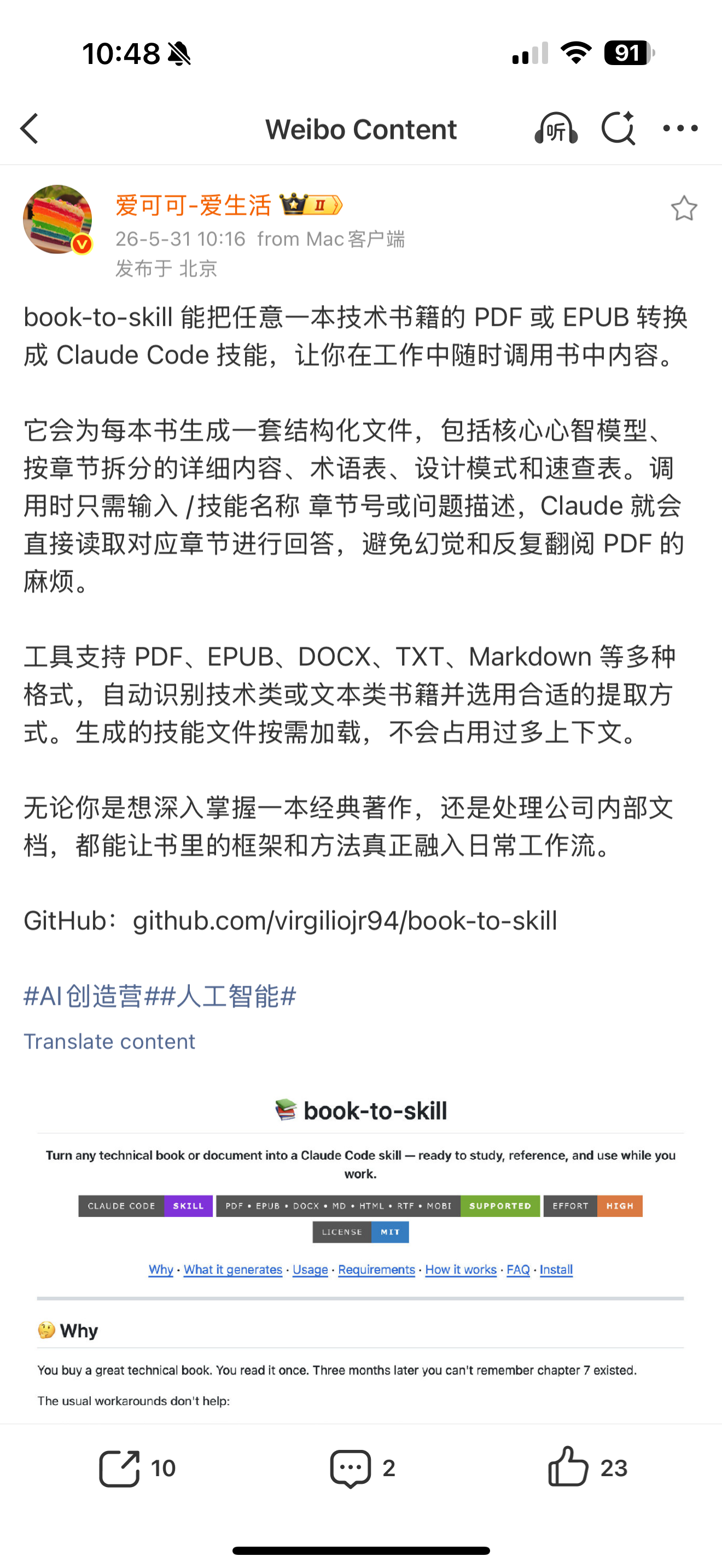
book-to-skill converts a technical book, document folder, or source collection into a reusable agent skill. The point is not to summarize a book once. The point is to make the book loadable on demand while an agent is working.
Source: GitHub — virgiliojr94/book-to-skill
The Core Idea
A normal PDF workflow is weak:
PDF search -> page hits -> human re-reads -> agent guesses from partial context
book-to-skill tries to turn the same material into:
SKILL.md
chapters/
glossary.md
patterns.md
cheatsheet.md
The agent can then load the specific chapter, pattern, or glossary entry relevant to the current task.
Why This Matters for LearnAI
This is close to the missing bridge between a personal knowledge base and an executable learning workflow. A student can convert a dense book into a skill, then ask an agent to apply the book’s frameworks while writing code, planning experiments, or reviewing a paper.
Useful examples:
| Source material | Resulting skill use |
|---|---|
| AI textbook | Ask for chapter-grounded explanations while implementing concepts |
| Security manual | Apply a checklist during code review |
| Research-method book | Use decision rules while designing a study |
| Course notes | Turn a syllabus into a reusable study assistant |
Suggested Workflow
# Example from the project README pattern
/book-to-skill ./my-book.pdf
Then ask the generated skill questions that require the source structure:
Use the generated skill to explain the chapter 4 framework and apply it to this project plan.
Caveats
- It is only as good as the extracted structure. Inspect the generated
SKILL.mdbefore trusting it. - Do not feed copyrighted books into a public repo.
- A generated skill is not a replacement for reading. It is a retrieval and application layer.
- For course use, prefer open-license books or material you wrote.
Best LearnAI Use
Use this for “read once, reuse many times” material: internal course notes, public textbooks, tool manuals, and research-method references. It fits the wiki cleanup goal because it turns many scattered notes into a smaller number of reusable knowledge modules.