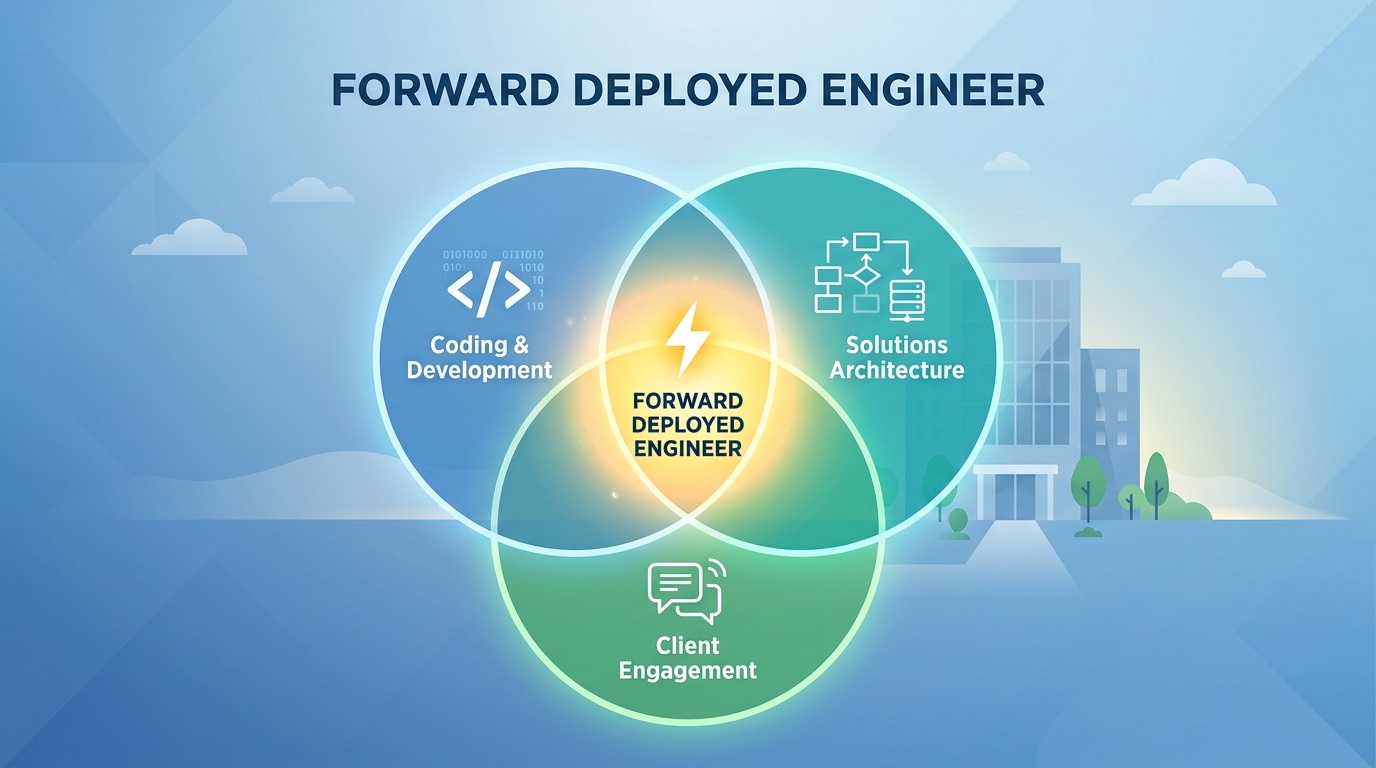
A Forward Deployed Engineer (FDE) — 前线部署工程师 — is a software engineer who embeds with customer teams (often including on-site travel) and builds rather than advises: writing code, proposing architecture, integrating systems, and debugging in real time, all while serving as the primary technical point of contact. The role is an implementation-heavy engineering and consulting hybrid — its defining characteristic is ownership of working systems and direct accountability for deployment outcomes, not just recommendations. In the AI era, a single FDE equipped with modern AI coding tools can now deliver at a scale that previously required a larger team.
Source: Weibo post by 宝玉 xp (微软 ASP.NET 最有价值专家), 2026-05-15, via baoyu.io. Analysis and teaching framing added by LearnAI team. Role also documented in live job postings: Anthropic FDE · OpenAI FDE · Scale AI FDE · Palantir FDSE.
What makes FDE different from a consultant
The easiest mistake is to hear “on-site technical advisor” and think “expensive consultant.” The distinction is real but exists on a spectrum — many technical consultants and professional-services engineers also write code. What separates the FDE archetype is where accountability lands: the FDE personally owns the working system, not just the recommendation for one.
| Dimension | Traditional Consultant | Forward Deployed Engineer |
|---|---|---|
| Primary deliverable | Recommendations, reports, roadmaps | Working code, integrated systems, shipped features |
| Relationship to implementation | Hands off once advice is given | Personally builds and owns the implementation |
| Client accountability | “Our report recommended X” | “I built X; let me fix it” |
| Autonomy level | Usually backed by a team of specialists | Often works with limited backup — coder + architect + consultant in one engagement |
| Value signal | Reputation of the firm | Personal technical depth and shipping velocity |
| Time to value | Weeks to months (report → decision → team → build) | Days to weeks (direct build) |
The classic challenge a new FDE faces — and which the original Weibo post flags directly — is that clients will ask “aren’t you just a consultant?” The answer is demonstrated, not explained: you open your laptop, write the integration, run the tests, and show the result. That’s the job.
Where the FDE / consultant boundary gets blurry
This is worth stating plainly because most explainers gloss over it. Many roles sit in the middle:
- Solutions Engineers at SaaS companies write demo code, build integrations, and work directly with prospects — but are typically backed by a product and eng team.
- Professional Services Engineers at larger vendors do implementation work on-site, but often with defined scope and a PM behind them.
- Technical Account Managers (technical track) at hyperscalers troubleshoot, prototype, and advise — often writing real code — but their success metric is account health, not shipped features.
- FDSEs (Forward Deployed Software Engineers) at Palantir are perhaps the best-known version: they build production systems at client sites, sometimes for months, with significant autonomy.
The useful signal is: who is accountable when the production system breaks at 2am? The further that accountability sits with the individual engineer rather than a firm or product team, the more FDE-like the role is. When evaluating a job description, look for: ownership language, “you will build/ship/integrate” (not “you will advise/recommend”), and a lack of a dedicated implementation team behind you.
The FDE skill stack
Being a good FDE requires breadth unusual even for senior engineers. The table below ranks skills by criticality for the role specifically — not for software engineering in general.
| Skill | Why it matters for FDE |
|---|---|
| Full-stack implementation | You cannot offload any tier — front, back, infra — to a teammate who isn’t there |
| System / architecture design | You propose the overall solution; no separate architect reviews it before the client sees it |
| API integration & debugging | Roughly half of on-site time is connecting systems that weren’t designed to work together |
| Communication & async writing | You are the interface between client stakeholders and technical reality; clear writing prevents scope creep |
| Rapid diagnosis under pressure | Production bugs appear in client environments you’ve never seen before; you own the incident |
| Diagram and documentation production | PPT decks, architecture diagrams, and data-flow charts are part of the deliverable, not afterthoughts |
| Autonomous context-switching | A single day can move from debugging a failing webhook → whiteboarding a DB schema → presenting to a VP |
| AI tooling fluency | In 2026, FDE leverage depends heavily on how effectively one person can amplify with LLM coding tools |
A critical prerequisite the role description often understates: you must already be a solid engineer before you go on-site. The client environment is the wrong place to learn foundational skills. Most FDE roles at major AI companies (Anthropic, OpenAI) skew experienced — 3+ years of production engineering — though some Palantir and Scale AI paths have brought in earlier-career engineers with strong fundamentals and fast ramp expectations.
Time allocation breakdown
Based on the Weibo source (and consistent with how similar roles at major tech companies operate), a realistic week for an on-site FDE looks like this:
| Activity bucket | Approx. share | What it actually involves |
|---|---|---|
| Integration, debugging, and testing | ~50% | Connecting the client’s existing systems to the AI solution; chasing environment-specific bugs; writing and running test suites; validating data pipelines |
| Communication and meetings | ~25% | Syncing with client stakeholders, writing progress updates, presenting architecture options, managing expectations on scope and timeline |
| Core coding (net-new features) | ~25% | Writing new application logic, building new endpoints, scaffolding new modules |
The 50% integration figure surprises engineers who romanticize the role as mostly building new things. In enterprise environments, the existing system is almost always more complex, more undocumented, and more fragile than any demo environment suggested. FDE productivity is bottlenecked less by “can you write code” and more by “how fast can you understand and navigate a foreign codebase under time pressure.”
Why AI is making FDE more powerful
The FDE role predates LLMs — Palantir built an early version of it into their business model — but AI tooling has qualitatively changed the leverage a single FDE can produce.
Before AI tools: One FDE could handle integration and communication, but complex greenfield development required pulling in additional engineers from headquarters. Solo capacity was a real constraint.
With AI tools (2026): A fluent Claude Code / Codex user can generate scaffolding, write boilerplate integrations, produce architecture diagrams, draft documentation, and debug across unfamiliar codebases in a fraction of the time. The 25% coding block can now punch above its weight — a single skilled FDE can ship at a pace that previously required pulling in additional engineers.
The specific leverage points:
- Codebase onboarding: An LLM can summarize a foreign repo’s structure in minutes, materially cutting the “where is this defined?” friction that eats hours in client environments
- Integration code generation: Standard API glue code (OAuth flows, webhook handlers, data transformations) is exactly the type of repetitive, pattern-heavy work LLMs excel at
- Architecture diagramming: Tools that convert natural-language descriptions into architecture diagrams remove a bottleneck that used to eat FDE hours
- Documentation drafts: First drafts of technical specs, runbooks, and meeting summaries — offloaded to LLM, edited by FDE
The implication: FDE roles are expanding at companies that sell AI solutions to enterprises, because the deployment problem (making AI work in a client’s specific environment) is real and hard, and a skilled AI-fluent FDE is disproportionately productive compared to a naive “send three engineers” approach.
A critical skill gap to watch: not all engineers who are good coders are good FDEs. The role selects heavily for comfort with ambiguity, client-facing communication, and autonomous decision-making under incomplete information. AI amplifies the technical output but doesn’t substitute for the soft skills.
How LearnAI Team Could Use This
Career guidance for CS students is the primary use case here. As Monmouth CS graduates increasingly consider AI-adjacent roles, FDE sits in an interesting and underexplained niche — more technical than a PM, more client-facing than a standard SWE, and more autonomous than either. Students who are both technically strong and comfortable communicating with non-engineers should know this role exists.
- CS-310 (Advanced OO Programming & Design) connection: The FDE role is a live argument for why OO design principles matter in practice. An FDE who can’t quickly read and extend an unfamiliar class hierarchy, understand dependency injection patterns, or navigate a layered architecture will be slow and error-prone on-site. Use FDE as a motivating professional context for why CS-310 content is career-relevant. Concrete artifact: a one-week “integration lab” where students receive an undocumented starter codebase, a fictional client brief, and must integrate a new API endpoint — graded on how fast they orient, how cleanly they extend, and how clearly they explain their decisions in a mock client write-up.
- CS-336 (Program Analysis for Security) connection: Enterprise clients have security requirements — sometimes strict ones. FDEs regularly need first-pass security judgment on integrations (API key handling, injection risks, authentication flows, data exposure) before escalating to a dedicated security team. CS-336’s program analysis lens — taint tracking, information flow, vulnerability identification — maps directly to the “review this integration before we ship it” moment in a real engagement. Softer framing: “What would break if the client’s security team audited this code you just wrote?”
- “Full-stack AI practitioner” framing for curriculum: FDE is a useful archetype when introducing students to the idea that modern AI roles are not just “prompt engineering” or “model training.” The FDE is the deployment-layer engineer — the person who makes AI actually work in the real world. This framing helps students see a concrete career path between “I know ML theory” and “I ship AI features.”
- Job description comparison exercise: Give students three real job postings — one labeled “FDE,” one labeled “Solutions Engineer,” one labeled “Implementation Engineer” — and ask them to identify: (a) which role owns the production system, (b) who they report to when it breaks, and (c) what skills each posting weights. This builds pattern recognition for the “FDE in disguise” problem before students enter the job market.
- Mock client-discovery exercise: Pair students up — one plays the FDE, one plays the enterprise stakeholder. The “FDE” must elicit enough technical context in 20 minutes to propose an integration architecture. Debrief on what questions surfaced the most useful information. Maps to CS-310 requirements-gathering and CS-336 threat-modeling alike.
- Student portfolio checklist: An FDE-ready student portfolio should include: (1) a project where they integrated two external APIs they’d never used before, (2) a written technical postmortem on something that broke, (3) a short architecture diagram they created for a non-technical audience. These three artifacts signal FDE readiness better than GPA alone.
- Guest speaker opportunity: FDEs at AI-first companies (Anthropic, Scale AI, Palantir, enterprise AI startups) are a natural guest speaker category. Their “war stories” from client environments translate well to CS students because they’re grounded in real code, real bugs, and real organizational friction.
- Internship and job search framing: Help students recognize when a job description is effectively an FDE role even if it doesn’t use that title. Look for: “work directly with clients,” “integration,” “technical implementation,” “own the deployment,” and “limited support team” appearing together in the same posting.
Real-World Use Cases
| Scenario | Description |
|---|---|
| Enterprise AI vendor deployment | A company selling an AI document-processing product embeds an FDE at a Fortune 500 client to integrate the product with the client’s SAP system, debug edge cases in the client’s document formats, and train the client team — all in one person |
| AI startup GTM motion | Early-stage AI startup uses FDE model instead of a large sales engineering team: one technical co-founder or senior engineer works on-site with the first 5 clients, learning deployment friction firsthand and feeding it back into the product |
| Systems integrator AI practice | A consulting firm’s AI practice restructures around FDE-style delivery — engineers who write code, not just slide decks — to compete with pure-software AI vendors on deployment speed |
| Internal “embedded engineer” model | Large enterprise’s central AI team deploys FDE-style engineers to individual business units to help teams adopt AI tools: building integrations, customizing workflows, debugging model outputs, and documenting what works |
| Government / regulated industry AI adoption | Regulated sector (healthcare, finance, defense) adoption of AI requires an on-site technical presence that understands both the AI tools and the compliance constraints — a classic FDE deployment context |
Important things to know
- FDE skews experienced, but the spectrum is wider than most explainers admit. Major AI lab FDE roles (Anthropic, OpenAI) typically want 3+ years of production engineering. Palantir FDSE and Scale AI equivalents have historically hired strong earlier-career engineers with fast ramp expectations. In all cases: you need to be able to build systems independently before the client engagement — the deployment site is not a learning environment.
- The autonomy is the feature and the risk. There’s no senior engineer looking over your shoulder. This is attractive to engineers who want ownership, and stressful for engineers who want structure. Know which you are before pursuing the role.
- “AI is making FDE more powerful” does not mean “AI lets you fake being an FDE.” LLM tools amplify genuine engineering skill. They don’t substitute for it. An engineer who can’t debug a broken integration without LLM help in a familiar environment will not be able to do so in an unfamiliar client environment either.
- The role has soft-skill prerequisites that are rarely stated. Written and verbal communication, stakeholder management, and the ability to say “I don’t know yet, but here’s how I’ll find out” in a client meeting are load-bearing skills. Technical depth alone is insufficient.
- Watch for the title in disguise. Many companies post “Solutions Engineer,” “Technical Account Manager (technical track),” “Implementation Engineer,” “AI Deployment Engineer,” or “Customer Engineer” for roles that are functionally FDE. The title varies; the pattern — on-site, builds code, owns integration, communicates with client — is the signal.
- Companion entries in this wiki:
- What is Agentic Engineering? A Teaching Primer — the engineering discipline FDEs are deploying
- Harness Engineering — The Real Bottleneck Isn’t the Model — the orchestration layer FDEs commonly build and debug
- Beyond /goal — The Orchestrator + Headless Pattern for Long-Running Claude Sessions — tooling pattern relevant to FDE productivity
- Agentic AI Engineer Roadmap 2026 — Eight Pillars from Prompt to Production — skill-building roadmap adjacent to FDE preparation