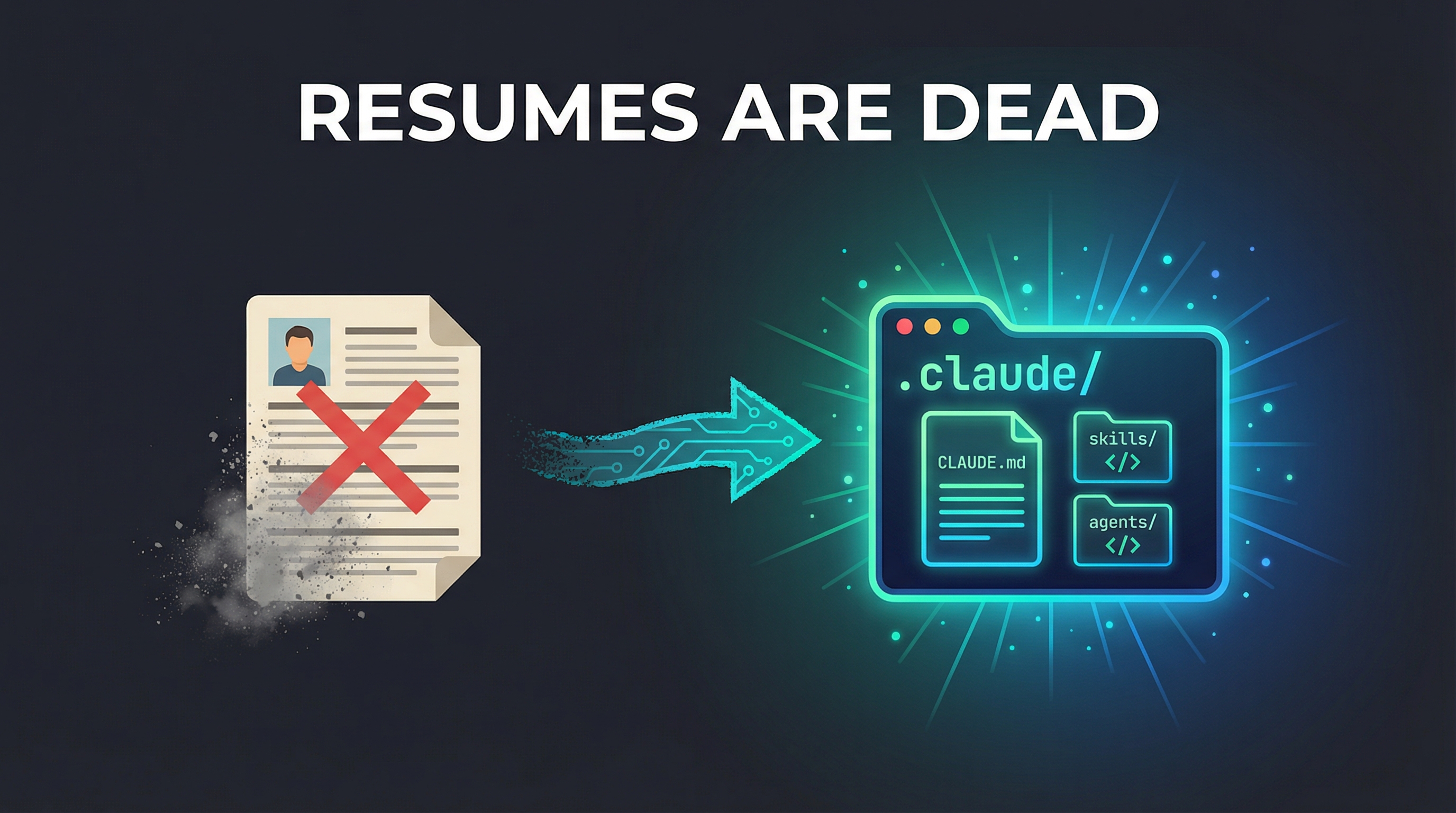
AI blogger Nav Toor made a provocative argument: in 2026, your .claude/ directory — CLAUDE.md, skills, MCP configs — is replacing the traditional resume as a developer’s most important professional artifact. The data backing this claim is hard to dismiss.
| *Source: Nav Toor on X | 默庵·超级个体 on Xiaohongshu (2026-04)* |
The Data: Three Shifts Happening Simultaneously
1. AI Is Writing the Code
| Metric | Number |
|---|---|
| GitHub PRs completed via Claude Code | 4% of all public PRs (and growing) |
| Projected by end of 2026 | 20%+ |
| Developers using AI coding tools weekly | 84% |
| Top tech companies: AI tool usage | 95% |
| Workers with >50% of work done by AI | 75% at top firms |
2. Junior Jobs Are Disappearing
Junior developer job postings dropped 67% from 2024 to 2025. Many remaining “junior” listings actually require senior-level experience. The entry-level funnel is collapsing — not because juniors aren’t needed, but because the definition of “entry-level work” has changed.
3. Interviews Are Changing
Interviewers no longer test if you can write code from scratch. They observe how you collaborate with AI.
Tyler Folkman (hiring manager) described the new evaluation:
“The key distinction: is this developer casually playing with AI, or using AI to deliver production software? Can they write specs first? Critically review AI output? Write tests? Or do they treat AI as a wish-granting pool — generate and ship without checking?”
The interview questions that matter now:
| Old Interview | New Interview |
|---|---|
| “Write a binary search” | “How do you verify AI-generated code?” |
| “Explain this algorithm” | “Show me your CLAUDE.md — what rules do you set?” |
| “Debug this function” | “Walk me through how you’d spec this feature for an AI agent” |
| “What languages do you know?” | “What’s in your .claude/ folder?” |
Your .claude/ Folder as Portfolio
Nav Toor’s argument: your .claude/ directory reveals more about your engineering judgment than any resume line item.
.claude/
├── CLAUDE.md ··············· Your engineering philosophy
│                             - What coding standards do you enforce?
│                             - How do you handle errors?
│                             - What architecture decisions matter to you?
│
├── rules/ ·················· Your quality standards
│   ├── code-style.md         - Do you have opinions about code?
│   └── testing.md            - Do you write tests or skip them?
│
├── commands/ ··············· Your workflows
│   ├── review.md             - How do you review code?
│   └── deploy.md             - What's your deployment process?
│
├── skills/ ················· Your domain knowledge
│   └── domain/SKILL.md       - What expertise have you encoded?
│
└── agents/ ················· Your delegation strategy
    ├── reviewer.md           - How do you break work into roles?
    └── security.md           - Do you think about security?
What Each File Reveals
| File | What It Shows About You |
|---|---|
| CLAUDE.md | Your engineering values — do you prioritize correctness? Testing? Documentation? |
| rules/ | Your coding standards — do you have opinions, or do you accept defaults? |
| commands/ | Your process maturity — have you automated repeatable workflows? |
| skills/ | Your domain depth — what specialized knowledge have you encoded? |
| agents/ | Your architectural thinking — can you decompose problems into roles? |
| hooks/ | Your safety awareness — do you enforce constraints programmatically? |
“I Can Write Python” Means Nothing Now
The punchline from 默庵’s analysis:
“‘I can write Python’ on a resume has lost all differentiating value. What interviewers actually want to see is: can you harness AI to build real, working software?”
This means:
- Writing specs before generating code
- Critically reviewing AI output (not blindly accepting)
- Writing tests (not treating AI as a wish-granting pool)
- Understanding architecture (not just syntax)
- Knowing when AI is wrong (not agreeing with everything it says)
What This Means for Students
This is directly relevant for CS education:
What to Teach
| Old Curriculum Focus | New Curriculum Focus |
|---|---|
| Syntax and language features | Problem decomposition and specification |
| Writing code from scratch | Reviewing and verifying AI-generated code |
| Individual coding assignments | AI-collaborative project workflows |
| “Does it compile?” | “Is it correct, tested, and maintainable?” |
| Resume building | Portfolio of .claude/ configurations and project setups |
The New Student Portfolio
Instead of a GitHub profile with toy projects, the new portfolio might look like:
- CLAUDE.md files — showing engineering judgment across different projects
- Custom skills — domain knowledge encoded as reusable AI skills
- Automated workflows — commands and hooks showing process maturity
- Verified AI output — projects with tests proving the student can evaluate AI work
How LearnAI Team Could Use This
- Career readiness modules — Have students build and explain a project-specific
CLAUDE.mdas evidence of engineering judgment. - Portfolio reviews — Evaluate whether students can document AI collaboration workflows, verification habits, and domain constraints.
- AI coding workshops — Use the
.claude/folder as a concrete artifact for teaching spec-writing, review discipline, and safe delegation. - Employer conversations — Translate hiring-market changes into curriculum: students need to show how they direct and verify AI-generated work.
Real-World Use Cases
- Junior developer portfolio — A candidate shares repos with
CLAUDE.md, tests, and custom commands showing collaboration with coding agents. - Mock technical interview — Students walk through how they spec features, review AI output, and prove correctness with tests.
- Capstone project setup — Teams define shared AI rules, commands, and review workflows before implementation begins.
- Career coaching — Advisors help students turn AI-assisted projects into evidence of process maturity and engineering judgment.
The Counterargument
To be fair: Nav Toor’s framing is deliberately provocative. Resumes aren’t literally dead — hiring processes are slow to change, and most companies still use traditional screening. But the direction is clear: the ability to collaborate with AI is becoming more important than the ability to write code alone. Whether that shows up as a .claude/ folder or some other artifact, the signal employers want is changing.
Links
- Nav Toor on X: heynavtoor
- Tyler Folkman on hiring: Referenced in Nav Toor’s analysis
- Related: Junior Dev Resume in the Age of AI (DEV Community)