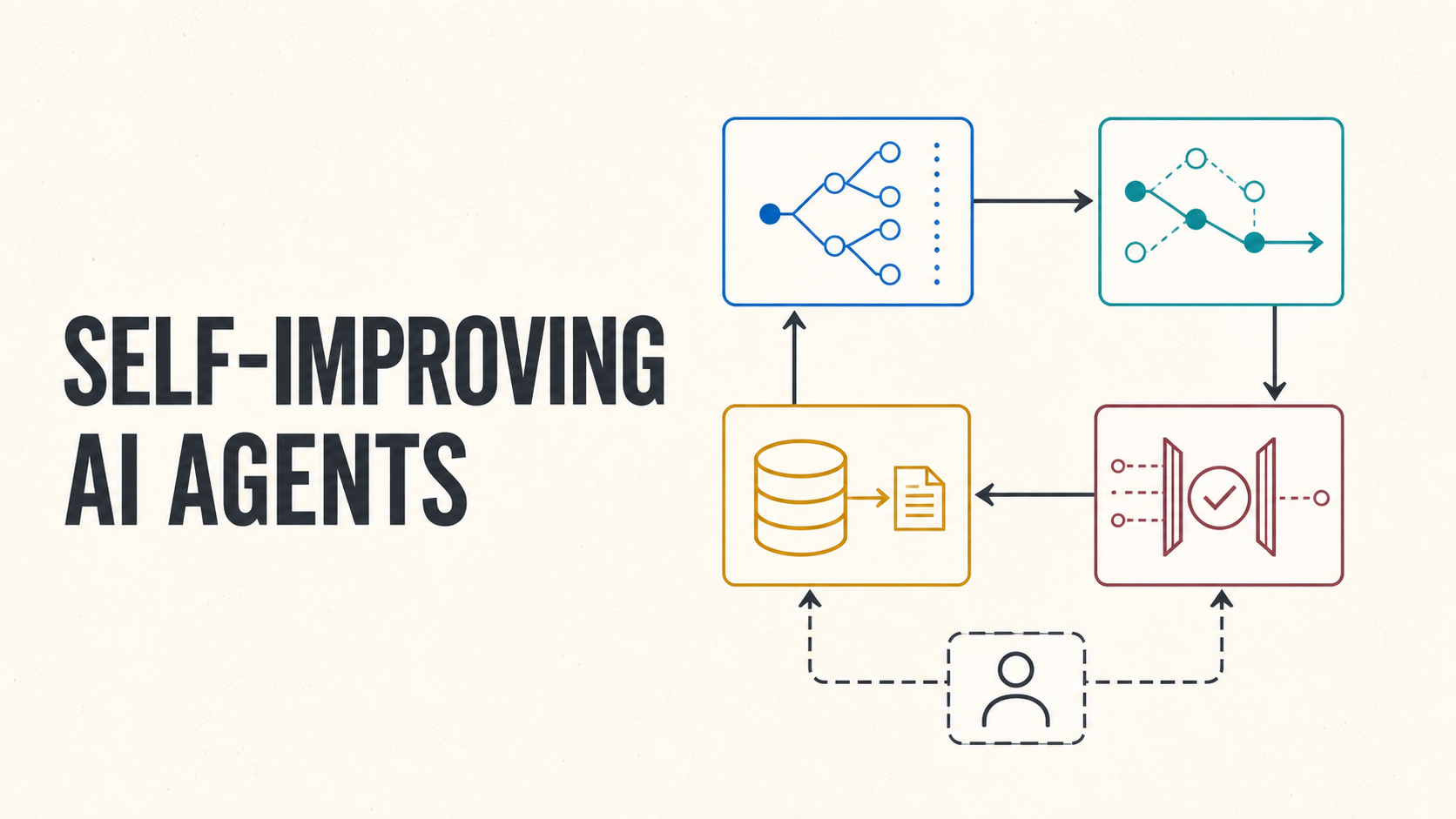
Stanford CS329A studies a demanding question: how can an AI agent improve through search, feedback, interaction, training, and evaluation rather than merely produce one response? This learning path connects the nine public Stanford Online lecture videos used in this series into one system model, with companion teaching material for every part.
| *Source: official CS329A course site | Stanford Online CS329A videos | individual lecture sources and readings are listed in each part* |
This page is an independent educational companion, not an official Stanford summary. Statements attributed to a lecture are separated from teaching synthesis and implementation advice.
This map is organized around the public lecture videos. Consult the official course site for the authoritative syllabus and reading list.
Start Here: The 20-Minute Course
Begin with the ten-slide overview. It gives a compact companion map of the course themes through one bounded system model and four questions: generation, verification, persistence, and budget. The PPTX contains a timed teaching script in its speaker notes; the PDF is the fastest reading format.
Download the 20-minute PDF · Download the editable PPTX with speaker notes · Open the contact sheet
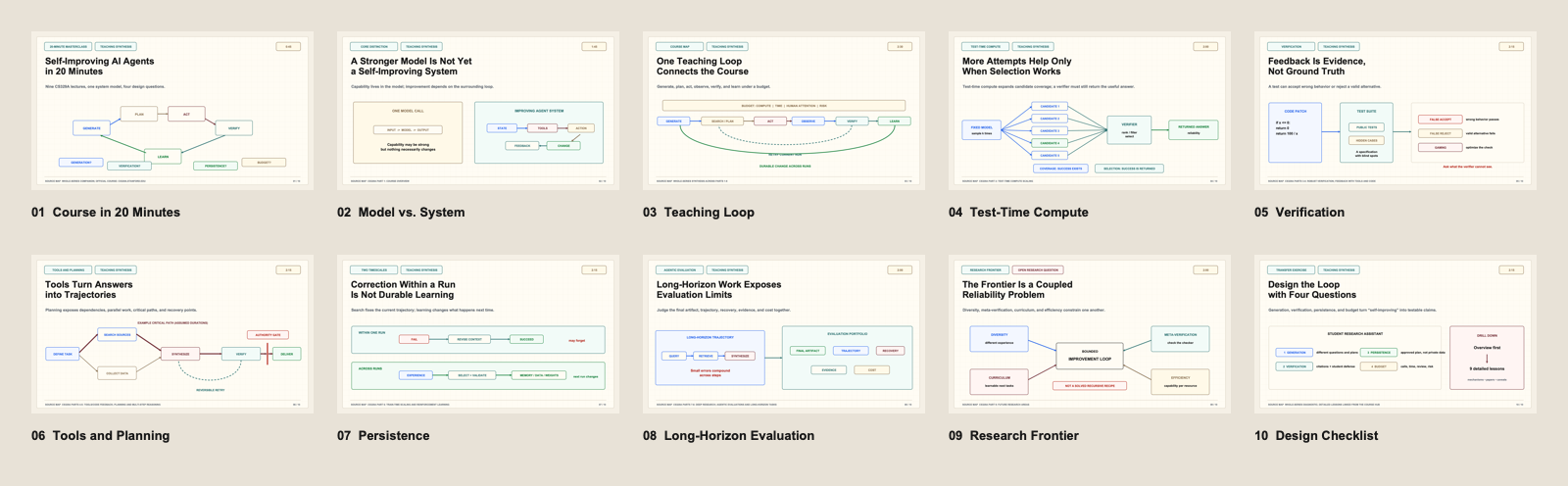
Use the overview first. Then open the nine detailed posts below when you want the lecture evidence, mechanisms, papers, longer slide decks, teaching questions, homework, and failure boundaries behind each component.
The Course in One System
The system model below is this companion’s synthesis, not a quoted Stanford framing.
The nine lectures can be read as one improvement loop:
                         fixed model                         updated system
                            |                                     ^
                            v                                     |
task -> generate -> search / plan -> act -> observe -> verify -> learn
          |             |                 |          |          |
          |             |                 |          |          +-- training, memory,
          |             |                 |          |              tools, artifacts
          |             |                 |          +-- tests, critics, evidence
          |             |                 +-- environment and tool feedback
          |             +-- inference-time compute and workflow structure
          +-- model capability and candidate diversity
Four questions recur throughout the series:
- Generation: Where do useful alternatives come from?
- Verification: What evidence distinguishes progress from a plausible mistake?
- Persistence: What, if anything, survives after the current run?
- Budget: Where should the system spend compute, time, human attention, and risk?
Complete Course Map
| Part | Central question | Learn this distinction | Materials |
|---|---|---|---|
| 1. From Scaling to Self-Improving Agents | What makes an agent self-improving? | Model capability vs. the system around it | Wiki · Video |
| 2. Test-Time Compute Scaling | How should a fixed model spend more inference compute? | Coverage vs. returned-answer reliability | Wiki · Video |
| 3. Robust Verification | When can a system trust its checker? | Verification signal vs. ground truth | Wiki · Video |
| 4. Learning from Feedback with Tools and Code | How does an agent turn interaction into usable feedback? | Feedback as evidence vs. feedback as truth | Wiki · Video |
| 5. Planning and Multi-Step Reasoning | When should an agent search, decompose, or parallelize? | Critical path vs. total work | Wiki · Video |
| 6. Train-Time Scaling and Scaling RL | How can verified experience change model behavior? | Inference-time search vs. weight updates | Wiki · Video |
| 7. Self-Improvement and Deep Research Agents | How do search agents produce stronger research artifacts? | More retrieved material vs. better-supported conclusions | Wiki · Video |
| 8. Agentic Evaluations and Long-Horizon Tasks | How do we measure work that unfolds over time? | Short benchmark score vs. real task capability | Wiki · Video |
| 9. Future Research Areas | What must improve next? | Component progress vs. system-level self-improvement | Wiki · Video |
An Alternative Study Order
The official sequence is coherent, but it becomes easier to retain when divided into four stages.
Stage 1 — Build the Reliability Model
Read Parts 1–3 together.
generate more candidates
        +
allocate inference compute
        +
select with a verifier
        !=
automatic reliability
The essential lesson is that extra compute helps only when generation and selection work together. A correct candidate that the verifier fails to select does not improve the returned answer.
Stage 2 — Design the Improvement Loop
Read Parts 4–6 together.
environment feedback -> planning/search -> verified trajectories -> learning
Here the focus moves from answering to improving. Tools and tests produce observations; planning controls dependencies and search; reinforcement learning or self-training can turn selected experience into changed behavior. Each arrow can introduce bias or error.
Stage 3 — Test the Agent on Real Work
Read Parts 7–8 together.
Deep research makes the system assemble evidence across many steps. Agentic evaluation asks whether the resulting process remains useful over longer horizons and professional tasks. These lectures prevent a common mistake: treating a short benchmark score as a complete measure of agency.
Stage 4 — Identify the Research Frontier
Use Part 9 to revisit the entire system. In this companion’s synthesis, its examples connect diversity-preserving multi-agent training, verifier and meta-verifier design, proposer-solver curricula, and compute-efficient deployment. These are research directions, not a settled recipe for recursive self-improvement.
The Three Most Important Boundaries
1. More Attempts Do Not Guarantee a Better Returned Answer
pass@k or coverage asks whether at least one attempt succeeds. A deployed system must still identify and return that attempt. Always report generation and selection separately.
2. Feedback Is Not Ground Truth
Unit tests, tool output, reward models, constitutions, critics, and human ratings all provide evidence under a specification. They can be incomplete, noisy, exploitable, or misaligned with the actual objective.
3. Correction Is Not Necessarily Learning
within-run improvement: retry, revise, backtrack, search
across-run improvement: update weights, memory, tools, data, or durable artifacts
An agent that fixes one answer and forgets the lesson next time corrected a trajectory; it did not necessarily acquire persistent capability.
How to Study Each Part
Use the same five-pass method for every lecture:
| Pass | Action | Evidence of understanding |
|---|---|---|
| 1. Map | Read the wiki overview and inspect the contact sheet | State the lecture’s central problem in one sentence |
| 2. Watch | Watch the public lecture with the deck beside it | Mark one claim, one mechanism, and one limitation |
| 3. Reconstruct | Redraw the main loop without looking | Explain every arrow and feedback signal |
| 4. Challenge | Answer the diagnostic questions in the teaching guide | Identify a failure case the method does not solve |
| 5. Transfer | Apply the idea to a student, research, or coding workflow | Define the generator, verifier, persistence, and budget |
Course-Level Assignment
Design a bounded self-improving agent for one real task. Good choices include literature review, coding, study support, data analysis, or course-material preparation.
Your submission must include:
- a workflow graph showing generation, tools, feedback, verification, retry, and stop conditions;
- separate metrics for candidate coverage and final-answer reliability;
- a verifier threat model explaining false acceptance and false rejection;
- a compute budget for inference, training, and human review;
- a persistence policy stating what the system may retain across runs;
- an evaluation plan that includes both short tasks and a longer-horizon deliverable;
- a failure report from at least one adversarial or out-of-distribution test.
The grading question is not “did the agent produce an impressive demo?” It is:
Can the designer explain what improved, why the evidence supports that conclusion, what did not improve, and where the system can still fail?
Quick Diagnostic
Before calling a system self-improving, answer these questions:
- What creates candidate diversity?
- Which actions are reversible, and which are not?
- What signal verifies intermediate and final progress?
- Can the generator exploit the verifier?
- Does the system learn across tasks, or only correct the current run?
- Which dependencies can run in parallel?
- What is the critical path?
- How is human oversight preserved for high-impact actions?
- Does the evaluation resemble the work the agent is supposed to perform?
- What is the cost per successful, verified outcome?
If several answers are unknown, “self-improving” is an aspiration rather than a demonstrated system property.