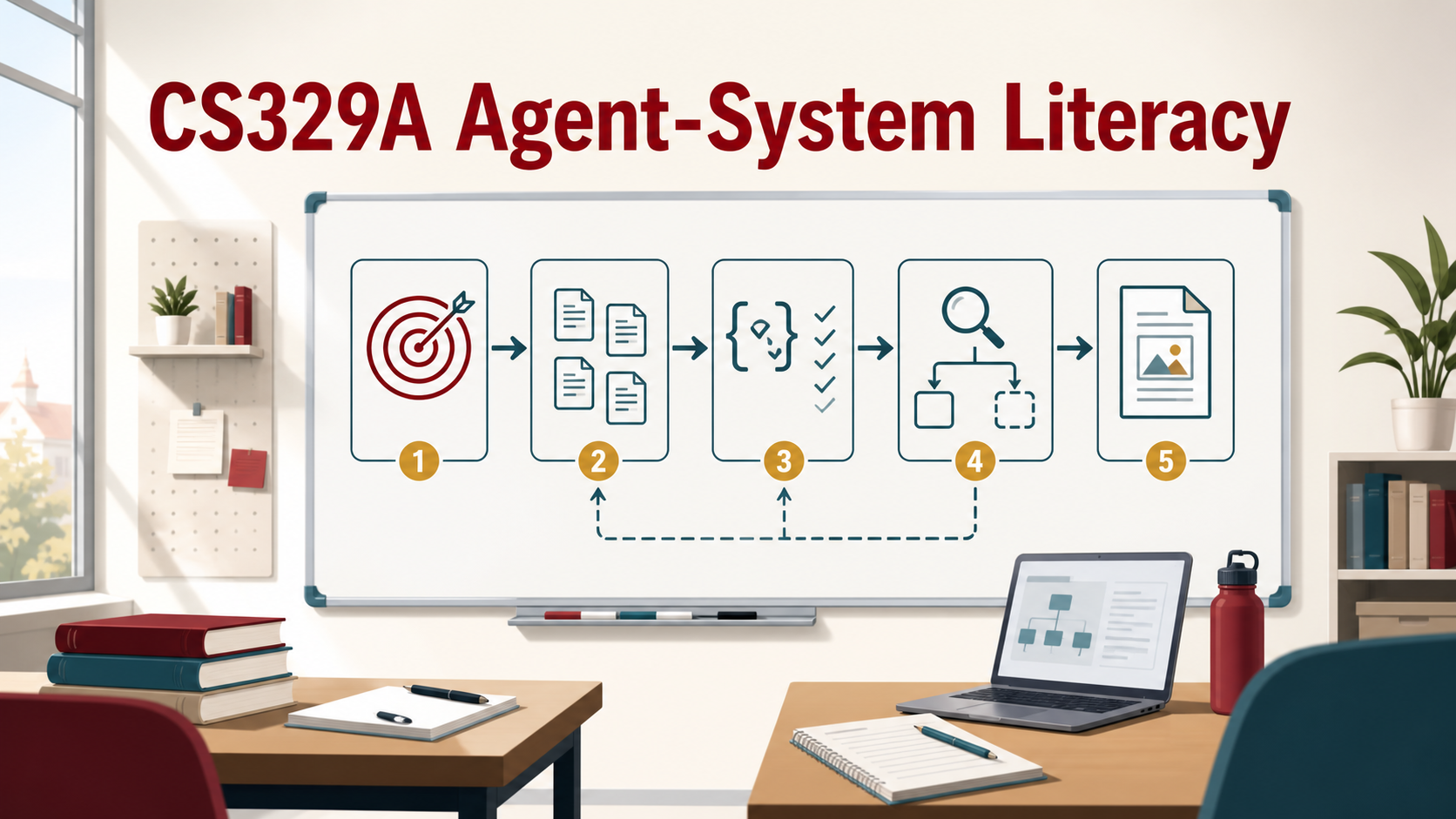
Stanford CS329A is useful for AI education because it moves the center of gravity from prompt literacy to agent-system literacy. The course is not only about asking a model better questions. It is about how self-improving AI agents use verifiers, test-time compute, search, tools, code, memory, planning, and evaluation loops. For students, that is the more important shift: they need to understand the system around the model, not just the words sent into the model.
| *Source: CS329A course site | Stanford Online Part 1: Course Overview | Stanford Online Part 2: Test-Time Compute Scaling | trigger post: Anatoli Kopadze on X* |
This is an educational interpretation of CS329A’s public materials, not an official Stanford summary.
Why This Deserves a Teaching Post
The X post framed the lecture as a clearer explanation of how AI agents work. That is directionally right, but the stronger educational angle is more specific.
Much introductory AI literacy material still emphasizes this loop:
student question -> prompt -> model answer -> student submits
CS329A points toward a different loop:
goal -> generate candidates -> verify -> revise/search -> act -> evaluate
That difference matters because agentic AI is not just chat. A coding agent, research assistant, or workflow agent succeeds or fails based on surrounding machinery: what tools it can call, what memory it has, what tests check it, what budget it spends at inference time, and what evidence tells it to stop.
So the student learning target changes:
prompt literacy        = can ask a model for help
agent-system literacy  = can reason about how an AI workflow produces, checks, and improves work
What CS329A Covers
The official course overview and schedule describe CS329A as a course on AI agents that can improve through interaction with themselves and the environment. The schedule starts with self-improvement techniques for LLMs, including constitutional AI, verifiers, test-time compute scaling, search with LLMs, and train-time scaling with reinforcement learning. It then moves into tool use, code, memory, multimodal interaction, multi-step planning, and robust evaluation frameworks.
That sequence is useful pedagogically because it does not treat agents as a vibe. It treats them as systems with moving parts.
| Course theme | Student-facing translation |
|---|---|
| Verifiers | The model needs external checks, not just confidence |
| Test-time compute | Spending more inference can improve answers, but only under constraints |
| Search with LLMs | Reasoning can be structured as exploration over candidates |
| Tool use and code | Agents act through environments, APIs, files, tests, and commands |
| Memory | Context becomes infrastructure, not just chat history |
| Planning and evaluation | The workflow must know what progress and failure look like |
This is exactly the layer students miss when AI education stays at the prompt-template level.
The Core Mental Model
A minimal agent-system picture looks like this:
                 task / goal
                     |
                     v
              candidate generator
                 /     |     \
                v      v      v
          answer A  answer B  answer C
                \      |      /
                 v     v     v
             verifier / critic / tests
                     |
             select, revise, or search
                     |
                     v
             action, answer, or artifact
The educational point is not that every student must build frontier agent infrastructure. The point is that students should be able to ask:
- What is being generated?
- What checks it?
- What can the agent do in the environment?
- What happens when a check fails?
- What evidence says the workflow is done?
Those questions are now as basic as “what prompt should I write?”
Test-Time Compute Is a Teaching Lever
The second Stanford Online video focuses on test-time compute scaling. The course readings include:
- Large Language Monkeys: Scaling Inference Compute with Repeated Sampling
- Scaling LLM Test-Time Compute Optimally can be More Effective than Scaling Model Parameters
- Archon: An Architecture Search Framework for Inference-Time Techniques
For students, the practical lesson is simple:
more thinking is not automatically better
better thinking = generation strategy + verification strategy + budget strategy
Repeated sampling can help when there is a way to recognize good outputs. Unit tests can verify code. A reward model or evaluator can rank candidate outputs or intermediate steps, depending on the setup. A critic can find flaws. A search procedure can allocate more work to promising branches. But if the verifier is weak, extra samples can produce more plausible wrong answers or make selection harder.
That is a clean classroom concept:
AI reliability is not a property of the answer alone.
It is a property of the answer plus the checking process.
From Prompt Assignments to Agent Assignments
This gives teachers a better assignment pattern.
Instead of:
Use ChatGPT to answer a question. Reflect on the answer.
Ask students to design the workflow:
1. Define the task.
2. Generate three candidate answers.
3. Define a verifier.
4. Run the verifier.
5. Revise or select based on evidence.
6. Explain what the verifier missed.
That assignment works across domains:
| Domain | Candidate generator | Verifier |
|---|---|---|
| Programming | AI writes solutions | Unit tests, lint, runtime behavior |
| Research writing | AI drafts summaries | Source checks, citation matching, contradiction search |
| Data analysis | AI proposes interpretations | Recomputed statistics, schema checks, plots |
| History | AI explains an event | Primary-source comparison, timeline consistency |
| Biology | AI proposes mechanism | Known pathway constraints, paper evidence |
The point is not to make students anti-AI. The point is to make AI use inspectable.
Why This Connects to Agentic Engineering
CS329A also connects directly to harness, loop, and graph engineering.
HARNESS
  What tools, files, memory, and permissions does the AI have?

LOOP
  What feedback signal lets it retry or stop?

GRAPH
  What path does the workflow follow through generation, checking, search, and action?
The course material on agentic workflows maps cleanly onto this:
workflow design
   |
   +--> harness: tools, code, memory, environment
   |
   +--> loop: verifier, critic, tests, reward model
   |
   +--> graph: branching, routing, parallel sampling, sequential revision
This is why CS329A is a better fit for AI education than a generic “agent tools” roundup. It gives teachers a principled vocabulary for the systems students are already using.
The Student Use Cases
Here are concrete ways students could use the CS329A frame.
| Use case | What students build | What they learn |
|---|---|---|
| AI research assistant | A workflow that searches, summarizes, and checks sources | Evidence beats fluent summary |
| Coding assistant | A small agent loop that writes code and runs tests | Verification is part of generation |
| Study assistant | A system that creates practice questions and grades answers | The grader needs its own reliability check |
| Literature review | A pipeline that extracts claims, methods, and limitations | Memory and source grounding matter |
| Project critique | A critic that reviews an artifact against a rubric | Evaluation criteria must be explicit |
The useful student slogan:
Do not only ask AI for an output.
Design the process that makes the output trustworthy.
Caveats
Three cautions matter.
First, I would not claim the X video gives us a full transcript of the lecture. The X video was inspected visually, and the matching Stanford Online uploads provide captioned lecture material. That is enough for a grounded post, but not enough to quote the X audio directly.
Second, test-time scaling is not magic. It helps most when the workflow has a strong verifier or task signal. If a domain has no reliable check, extra inference can amplify uncertainty.
Third, agent autonomy should not be the default educational goal. Many real systems should stay as simpler workflows with explicit human gates. Anthropic’s agent guidance makes a similar engineering point: start with simple, composable patterns, and add autonomy only when the task needs it.
Teaching Principle
The teaching principle is:
AI education should teach students to inspect the system,
not only to polish the prompt.
That means students should learn prompt writing, but also generation, verification, search, memory, tool use, and evaluation. CS329A is valuable because it points straight at that next layer.
Related Reading
- Stanford CS329A — Self-Improving AI Agents: Public Lecture Learning Path
- Stanford CS329A Part 1 — From Scaling to Self-Improving Agents
- Stanford CS329A Part 2 — Test-Time Compute Scaling
- Stanford CS329A Part 3 — Robust Verification
- Stanford CS329A Part 4 — Learning from Feedback with Tools and Code
- Stanford CS329A Part 5 — Planning and Multi-Step Reasoning
- Stanford CS329A Part 6 — Train-Time Scaling and Scaling RL
- Stanford CS329A Part 7 — Self-Improvement and Deep Research Agents
- Stanford CS329A Part 8 — Agentic Evaluations and Long-Horizon Tasks
- Stanford CS329A Part 9 — Future Research Areas
- AI Infrastructure Literacy - The Missing Bridge to Agentic Building
- Stanford CS336 - Language Modeling from Scratch
- Harness / Loop / Graph Engineering — Environment, Feedback, Flow
- What is Agentic Engineering? A Teaching Primer
- Anthropic - Building effective agents