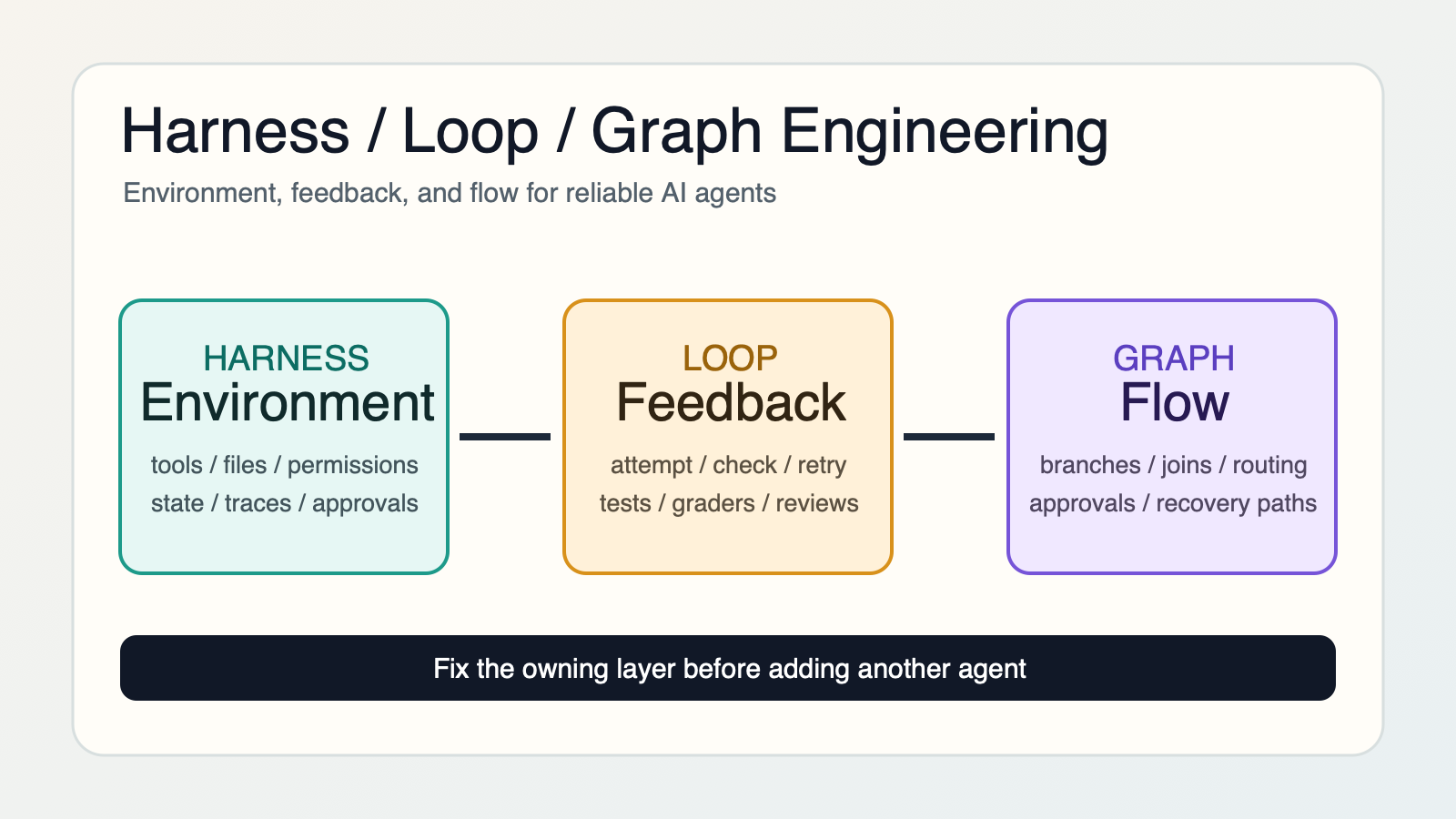
Reliable AI agents need more than a strong model. They need an environment that lets the model act safely, a feedback loop that checks whether the work is improving, and a flow that makes complex branching visible. The useful teaching shortcut is: harness = environment, loop = feedback, graph = flow.
These are diagnostic lenses, not competing architectures. The same agent system can use all three at once.
The X Article may require sign-in, so this entry treats it as the framing prompt and uses the public sources above for the durable engineering claims.
The Three Layers
The framing’s main value is not that it invents new terms. Its value is that it separates three problems teams often mix together:
| Layer | Short version | What it owns | Typical failure |
|---|---|---|---|
| Harness | Environment | Tools, files, memory, permissions, sandboxes, checkpoints, traces, human approvals | The agent cannot access the right thing, loses state, or acts too broadly |
| Loop | Feedback | Build-check-retry cycles, graders, test signals, reviewer comments, stopping rules | The first attempt is close but unreliable, or the agent keeps trying without new evidence |
| Graph | Flow | Nodes, branches, joins, parallel work, routing conditions, approvals, recovery paths | The process has hidden branches, unclear ownership, or impossible-to-debug multi-step failure |
model output
   |
   v
HARNESS: where can the model act?
   |
   v
LOOP: what evidence tells it to retry or stop?
   |
   v
GRAPH: what path is allowed to run next?
The same agent system can contain all three. A coding assistant has a harness because it can read files, run commands, and use a sandbox. It has a loop when it implements, tests, fixes, and tests again. It has a graph when separate planner, coder, reviewer, tester, and human approval steps run in a controlled route.
Harness: Environment
Harness engineering asks: what machinery surrounds the model so it can do useful work safely?
For a coding agent, the harness includes:
- system instructions and project rules
- available tools and APIs
- file access and shell access
- workspace state, session state, and memory
- cost, token, and timeout limits
- approval gates for risky actions
- logs, traces, diffs, screenshots, and test output
OpenAI’s Codex harness writeup frames the engineer’s job as designing environments, specifying intent, and building feedback loops so agents can do reliable work. Anthropic’s long-running-agent work makes the same point from another angle: agents spanning multiple context windows need initializer steps, progress artifacts, and structured handoffs so a later session does not have to guess what happened.
A practical harness rule:
If the agent lacks safe capability, durable state, or observable evidence,
fix the harness before blaming the model.
Loop: Feedback
Loop engineering asks: what repeats, what checks the result, and what stops the retry?
A useful loop has a bounded shape:
attempt
  -> check against evidence
  -> if pass: stop
  -> if fail: return specific feedback
  -> retry with a limit
Addy Osmani’s loop-engineering framing is useful because it moves the human from “prompting every next turn” to “designing the system that prompts, checks, and re-enters work.” HumanLayer’s 12-Factor Agents makes the same engineering point: good agents are mostly software, with LLM steps placed inside code-owned control flow rather than one giant prompt.
Good loop signals are concrete:
- tests pass or fail
- a schema validates
- a link resolves
- a number reconciles
- a reviewer flags a scoped issue
- a human approves a risky action
Bad loop signals are vague:
- “the model says it is done”
- “the answer sounds confident”
- “try again until it feels better”
- “self-review says the self-generated work is excellent”
The strongest teaching rule:
Loop on evidence, not confidence.
Graph: Flow
Graph engineering asks: what is allowed to happen next?
Use a graph when work has meaningful branches, parallel specialists, explicit joins, approvals, or recovery routes:
request
  -> plan
  -> research
  -> draft
  -> fact check
       |-- fail -> research
       `-- pass -> editorial review
                    |-- fail -> draft
                    `-- pass -> human approval
LangGraph describes this as low-level orchestration for long-running, stateful agents, with a key benefit: deterministic hand-coded steps and LLM-driven steps can live in the same graph. That distinction matters. The graph does not make the answer true; it gives you places to put checks, state, retries, and human gates.
The abstract of recent work on cyclic subtask graphs makes a similar caution: extra workflow flexibility can help with recovery and exploration, but it can also add coordination overhead and inference cost. The right graph is usually sparser than the first diagram you draw.
Graph structure only helps reliability when the nodes expose state and checks. A graph with weak node-level evidence is still just weak evidence in a nicer shape.
Diagnose the Failure First
Before changing the architecture, name the failure layer.
| Symptom | Start with | Better fix |
|---|---|---|
| The agent cannot access the right data safely | Harness | Narrow tool contract, permissions, sandbox, context injection |
| The agent forgets progress between sessions | Harness | Durable state, checkpoints, progress file, git commits |
| The first attempt is close but unreliable | Loop | External grader, deterministic tests, actionable feedback, bounded retry |
| The agent continues after success or stops before proof | Loop | Evidence-based terminal state and budget-aware stop rule |
| Specialists need controlled order or parallel work | Graph | Explicit nodes, edges, routing conditions, joins |
| A multi-step failure is impossible to locate | Graph + harness | Node-aligned traces and state snapshots |
| The process changes too quickly for a fixed diagram | Simpler harness | Trace first; formalize stable paths later |
This is the main reason to teach the three terms together. They prevent the common mistake of solving every failure by adding another agent.
Expensive Mistakes
Building the graph too early
Do not turn an imagined business process into a large graph before watching a strong agent try the work. Trace first. Formalize second.
Letting the maker grade itself
Self-review can be useful, but it may share blind spots with the original attempt. Prefer deterministic checks where possible and separate reviewer context where judgment is needed.
Defining the loop as “keep trying”
An unbounded retry loop is not reliability. It is a cost leak. Every loop needs new evidence, a maximum attempt count, and an escalation path.
Turning the harness into a warehouse
More tools do not automatically make a better agent. Broad permissions increase risk, noisy context increases confusion, and crowded tool lists increase selection errors.
Blaming the model first
A stronger model cannot reliably repair stale state, broken APIs, ambiguous tool schemas, or missing exit conditions. Check the harness, loop, and exit conditions before assuming the model is the bottleneck.
LearnAI Teaching Use
This page is best used as a short diagnostic primer before students design or review agent workflows:
- Week 2 agent foundations — introduce the vocabulary: environment, feedback, flow.
- Week 10 build loops — teach loop engineering through build-test-fix evidence.
- Week 12 advanced prompting — show when a workflow should stay a loop and when it needs a graph.
- Week 13 security review — ask students whether a failure is a harness issue, a loop issue, or a graph issue before asking an agent for another answer.
A simple classroom exercise:
1. Give students a failed agent trace.
2. Ask: what failed -- environment, feedback, or flow?
3. Require one fix at the owning layer.
4. Require evidence that the fix worked.
The learning outcome is not that students memorize new jargon. The outcome is that they stop treating agent reliability as a prompt-writing problem and start treating it as system design.
References
- rari — LOOP vs GRAPH vs HARNESS ENGINEERING
- OpenAI — Harness engineering: leveraging Codex in an agent-first world
- Anthropic — Effective harnesses for long-running agents
- Addy Osmani — Loop Engineering
- HumanLayer — 12-Factor Agents
- LangGraph overview
- Complete Cyclic Subtask Graphs for Tool-Using LLM Agents