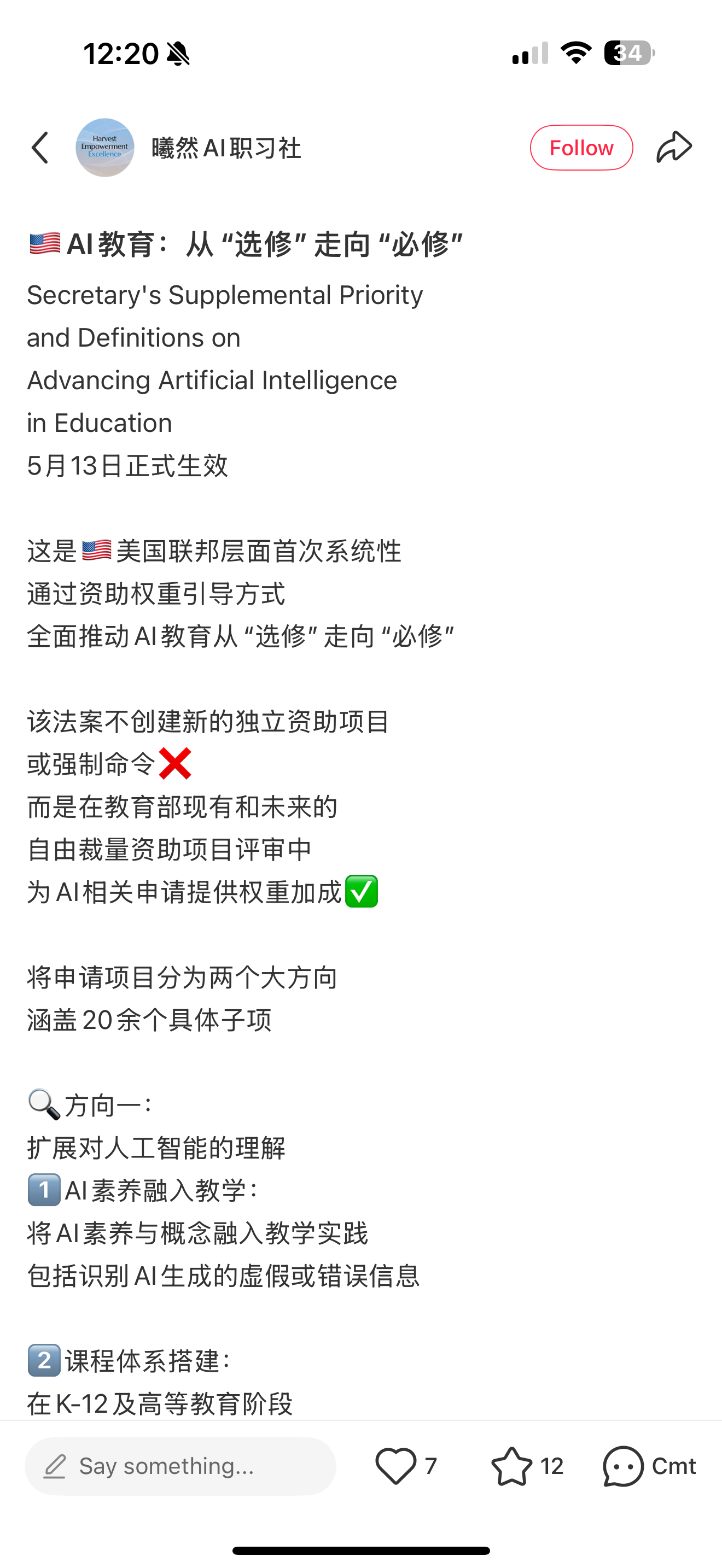
The Federal Register page dated April 13, 2026 describes the U.S. Department of Education’s final priority and definitions on advancing artificial intelligence in education, effective May 13, 2026. For LearnAI, the important point is not “the government says use AI.” The important point is that AI literacy, evidence building, privacy, workforce readiness, and age-appropriate learning are now part of the federal education conversation.
Source: Federal Register — Final Priority and Definitions on Advancing Artificial Intelligence in Education
What It Does
This notice gives the Secretary a priority and definitions that may be used in discretionary grant programs. That means it can shape which AI-related education projects receive preference in future competitions, but it does not by itself install AI tools in classrooms.
The Balanced Reading
The notice recognizes both sides:
| Opportunity | Risk |
|---|---|
| AI literacy for students and teachers | Student privacy and mental health |
| Workforce readiness | Uneven evidence for tool effectiveness |
| Access to high-quality learning opportunities | Vendor data governance concerns |
| Innovation and critical thinking | Need for human teaching relationships |
That balance is useful for students. AI policy is not just “adopt” or “ban.” It is a design problem: define the learning goal, evidence standard, privacy boundary, teacher role, and evaluation plan.
Course Discussion Prompt
Ask students to evaluate a proposed AI classroom tool using five questions:
- What learning outcome does the tool improve?
- What evidence would convince us it works?
- What student data does it collect?
- What can the teacher see, override, or explain?
- What failure mode would harm the student?
If students cannot answer these, the tool is not ready for class.
Why It Belongs Here
This is a durable policy anchor for the LearnAI education pages. It connects directly to:
- AI literacy
- teacher professional development
- responsible tool adoption
- educational data governance
- evidence-based pilots
Caveats
- This is a federal priority framework, not a universal classroom rule.
- State, district, institutional, FERPA, privacy, and procurement rules still matter.
- Before publishing a policy-facing update, re-check the Federal Register page for amendments or later guidance.