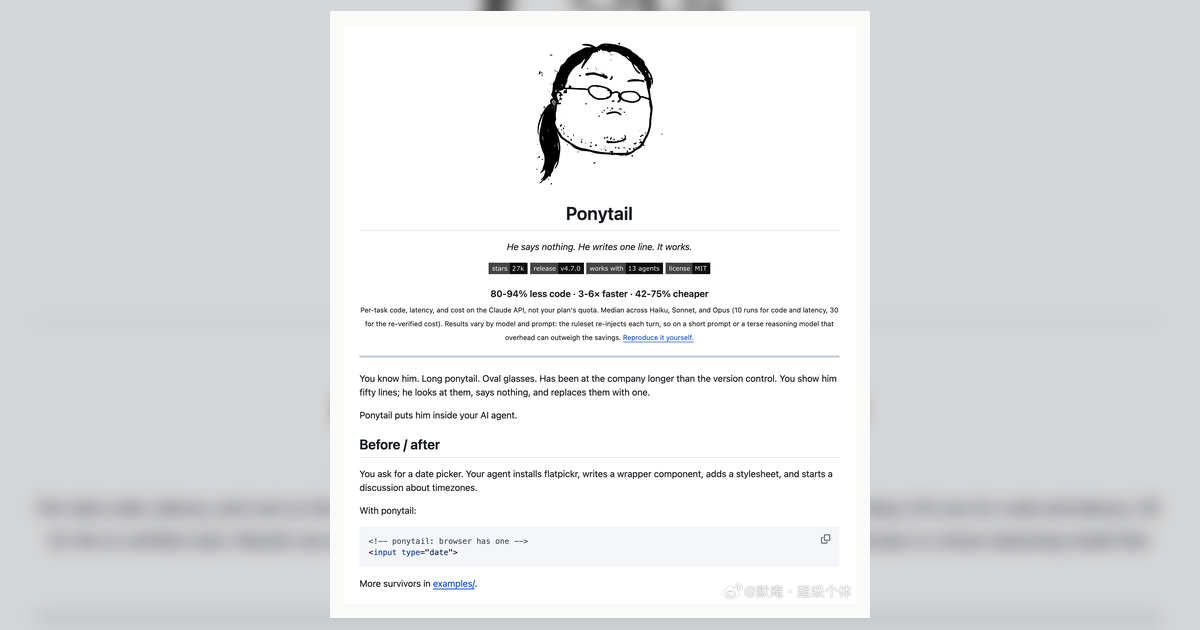
Ponytail is an installable skill/plugin that pushes coding agents toward the smallest correct change. Its core lesson is bigger than the repo: AI coding agents often overbuild because they can produce code cheaply. A good harness should make the agent ask whether the code needs to exist before it writes more of it.
| *Source: GitHub — DietrichGebert/ponytail | Benchmark writeup | July source screenshots: IMG_1153.JPG, IMG_2361.PNG* |
The ladder
Ponytail’s README describes a decision ladder the agent should climb before implementing:
1. Does this need to exist?
2. Is it already in this codebase?
3. Does the standard library do it?
4. Does the native platform do it?
5. Is there already an installed dependency?
6. Can one line do it?
7. Only then: write the minimum new code that works.
This is a very teachable pattern. It turns “write less code” from an aesthetic preference into an ordered decision procedure.
What problem it solves
Coding agents are prone to unnecessary machinery:
| Overbuild pattern | Simpler alternative |
|---|---|
| Add a dependency for a native input | Use the browser/platform feature |
| Create a wrapper component for one call site | Inline the small behavior |
| Add config before there is variation | Hard-code until variation exists |
| Invent a service layer for a tiny feature | Reuse the existing local pattern |
| Generate docs for code that should be obvious | Make the code obvious |
The point is not code golf. The point is to remove code that creates maintenance, security, dependency, and review cost.
Safety boundary
The README explicitly separates laziness from negligence: validation, security, data-loss handling, and accessibility are not supposed to be cut. That distinction matters in teaching:
Cut:
  duplicate wrappers
  unused abstractions
  speculative options
  dependencies for native features

Do not cut:
  input validation at trust boundaries
  auth and permission checks
  data migration safety
  accessibility behavior
  tests that prove risky behavior
This is the same lesson students need in ordinary software engineering: simplicity is not the same as carelessness.
Installation shape
Ponytail supports multiple agent harnesses, including Claude Code and Codex. The Codex install path in the README uses plugin commands:
codex plugin marketplace add DietrichGebert/ponytail
codex plugin add ponytail@ponytail
Because the plugin can use lifecycle hooks, a user should inspect and trust those hooks before enabling it in a real project. For classrooms, start with a disposable repository.
Important things to know
- Treat benchmark numbers as repo-reported results, not universal guarantees.
- The skill is most useful when agents are making small-to-medium code changes where overbuilding is common.
- It should run after the agent understands the codebase, not as a replacement for reading.
- Pair it with grill-me when the requirement is fuzzy; Ponytail minimizes implementation, not intent ambiguity.
How LearnAI Team Could Use This
- Code review exercise — give students an overbuilt agent diff and ask them to apply the ladder.
- Native-first lab — require students to find browser, OS, or standard-library features before adding dependencies.
- Agent-skill design lesson — compare Ponytail with Caveman: one reduces code, the other reduces output tokens. They solve different waste problems.
- Project rubric — add “minimum sufficient change” as a review criterion for AI-generated code.
Real-World Use Cases
| Scenario | Use |
|---|---|
| Frontend forms | Prefer native inputs and browser validation where appropriate |
| Internal tools | Avoid framework churn for one-off workflows |
| Refactors | Delete speculative layers before adding new ones |
| Student projects | Teach maintainability through smaller diffs |