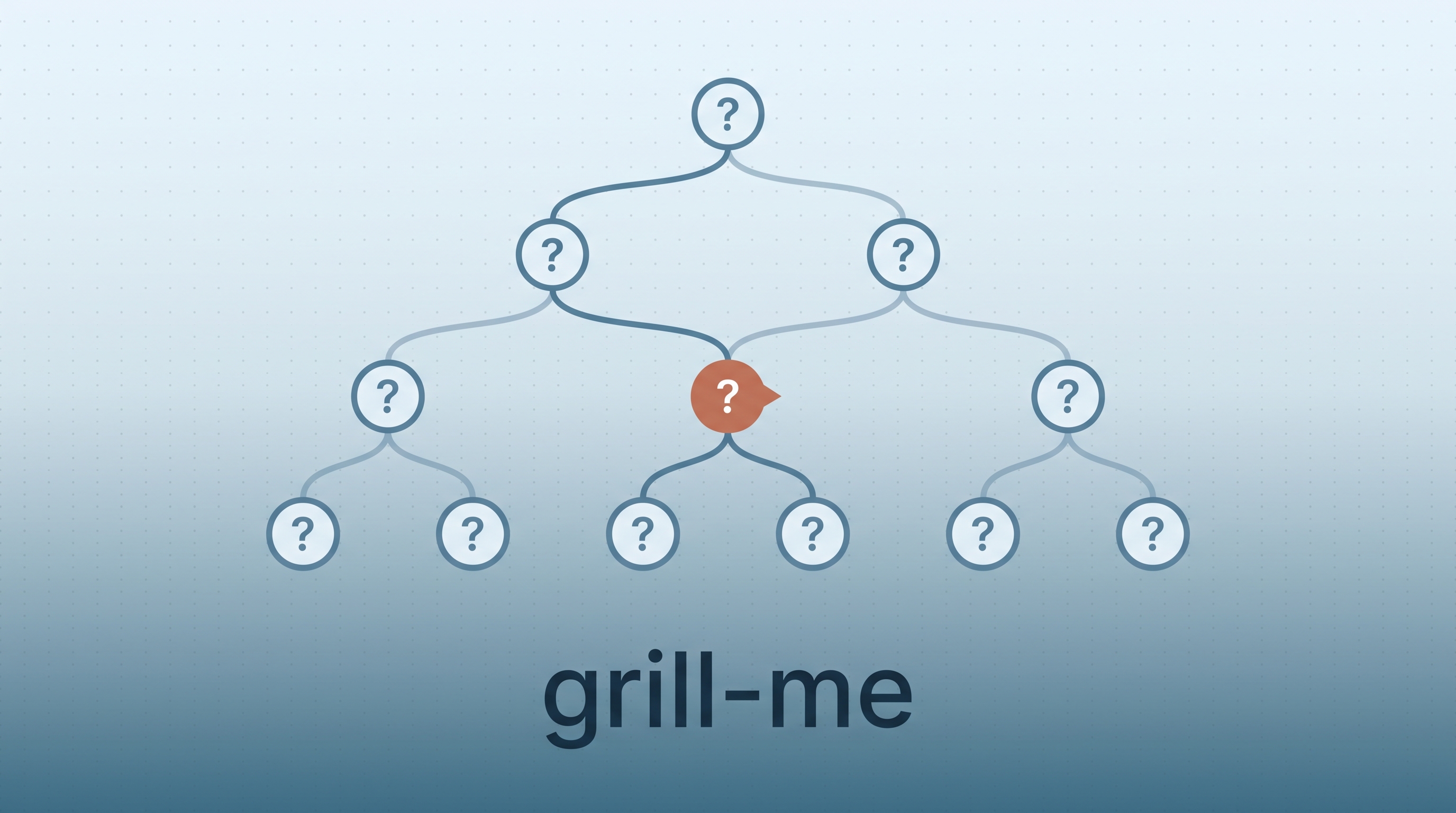
grill-me is a tiny Claude Code / Codex / agent-agnostic skill by Matt Pocock that flips the default agent dynamic: instead of you describing a feature and the agent immediately writing code, the agent interviews you — one question at a time, walking down each branch of the decision tree — until you’ve thought through every dependency. Matt’s repo mattpocock/skills is at about 82k stars (May 15, 2026), and grill-me is the most-cited piece. Matt himself calls it “the most flexible skill I’ve ever created” — he uses it for non-coding work too, like figuring out which course to build next.
| *Source: SKILL.md (mattpocock/skills) | Matt’s blog: My ‘Grill Me’ Skill Went Viral | Parent entry: Matt Pocock’s Skills* |
The entire skill, verbatim
The skill is famously small — about seven lines of prose plus YAML frontmatter. Here it is verbatim from the public SKILL.md:
---
name: grill-me
description: Interview the user relentlessly about a plan or design
  until reaching shared understanding, resolving each branch of the
  decision tree. Use when user wants to stress-test a plan, get
  grilled on their design, or mentions "grill me".
---

Interview me relentlessly about every aspect of this plan until we
reach a shared understanding. Walk down each branch of the design
tree, resolving dependencies between decisions one-by-one. For each
question, provide your recommended answer.

Ask the questions one at a time.

If a question can be answered by exploring the codebase, explore the
codebase instead.
Three paragraphs. That’s it. The skill produces a substantively different agent behavior than any “let me think through this with you” prompt because each directive does specific work:
| Directive | What it changes |
|---|---|
| “Interview me relentlessly” | Sets the agent’s role from helper to interrogator. No early agreement. |
| “Walk down each branch of the design tree” | Structures the conversation around dependencies, not the agent’s free-form curiosity |
| “Provide your recommended answer” | Stops the conversation devolving into pure Socratic loop; the agent supplies its best guess so you can react, not invent from scratch |
| “Ask the questions one at a time” | Prevents the seven-questions-in-one-message wall that paralyzes most planning sessions |
| “If a question can be answered by exploring the codebase, explore” | Cuts trivial lookups so the human time goes to the real decisions |
Why this one went viral
Out of 18 promoted skills in Matt Pocock’s repo (more if you count personal/in-progress entries — third-party indices show ~34 entries in the full tree), grill-me is the breakout. Three reasons in my reading:
-
It inverts the painful default. The default behavior of every coding agent is eager helpfulness — produce something fast, ask few questions. That looks productive and is responsible for a lot of agent-generated code that gets thrown away because it implemented the wrong thing. grill-me sells “slowness now, quality later” as a feature.
-
It modernizes a familiar practice. Matt’s framing: “Before AI came along, devs called this rubber ducking - talking through your idea until you figured out all the permutations.” Rubber ducking is older than most engineers. grill-me is rubber ducking with an opinionated duck.
-
The “recommended answer” trick is doing a lot of work. Most planning conversations stall when the human can’t answer a question without more context. grill-me requires the agent to guess first — which immediately gives the human something to react to. “No, not that, because…” is faster than “Hmm, I haven’t decided yet.”
What a session looks like
Matt reports that grilling sessions often last about 45 minutes. He doesn’t publish a phase breakdown, so the sketch below is illustrative (my synthesis based on running it myself), not a Matt-Pocock-prescribed structure:
Phase 1   Agent reads the request + skims any relevant code
          → composes its first question

Phase 2   Foundational branches: data model, ownership, lifecycle,
          error handling, who-calls-who. Agent proposes a recommended
          answer, you correct.

Phase 3   Edge cases: race conditions, retries, partial failures,
          auth boundaries, observability. Most surprises live here.

Phase 4   Synthesis: agent provides a summary of the plan with your
          decisions baked in. You either approve or send it back for
          one more pass.
If the session is shorter, the problem was probably already well-defined. If it stretches well past an hour, the agent is doing work that should happen later — pause, run the code on a piece, then resume.
Beyond coding — the part most reviews miss
The skill’s most interesting claim — Matt’s own — is that grill-me isn’t really about code. From his blog: “It’s also great for non-coding use cases. I’ve used it for figuring out what course to build next…” He calls it “the most flexible skill I’ve ever created.”
Concrete non-coding applications:
| Use case | What you’re grilling |
|---|---|
| Course / syllabus design (Matt’s own example) | What students already know, what they should know by week 8, what the assessments measure, which weeks can be cut if behind schedule |
| Conference talk outline | Who’s the audience, what’s the one thing they should remember, what’s the demo, what gets cut if you run long |
| Research-paper framing | What’s the actual contribution vs. claimed contribution, who’s the strongest critic, where’s the threats-to-validity section weakest |
| Workshop / lab plan | Pre-reqs, deliverable per hour, the “if anyone is stuck” fork, the assessment rubric |
| Migration / refactor scoping | What can break, what’s not in scope, what’s the rollback, what’s the proof-of-success check |
The non-coding angle is why this skill is worth understanding even for faculty / non-engineers — it’s a structured-planning tool that happens to ride inside an agent shell.
Important framing note: Matt’s repo README explicitly describes the skills as small, composable, and agent-agnostic — they work with Claude Code, Codex, and other AI agents, not just Anthropic’s stack. Don’t let “Claude Code skill” become a barrier if your colleague is on Codex or another harness.
July 2026 Extension: grill-me-codex
The July screenshot set also surfaced chaseai-yt/grill-me-codex, which is best treated as an extension to this entry rather than a separate wiki page. It keeps the original grill-me idea, then adds a cross-model review loop:
Act 1: Claude grills the human until the plan is clear
Act 2: Codex reviews the frozen plan adversarially
Act 3: optional role flip - Codex builds, Claude reviews the diff
The durable lesson is the same one in Cross-Model Code Review: the model that wrote the plan should not be the only judge of the plan. For students, this is a useful escalation path:
| Situation | Use |
|---|---|
| Idea is fuzzy | Plain grill-me |
| Project has established terminology and docs | grill-with-docs |
| Plan is high-risk or expensive to implement | grill-me-codex / codex-review |
| You want a second model to implement a reviewed spec | codex-build, with a clean git tree and proof command |
Keep the caveat clear: cross-model review reduces blind spots, but it is not proof. The proof is still the diff, the tests, and the human’s final review.
Install
# From within your project (or globally in your home directory):
npx skills@latest add mattpocock/skills

# Or copy just grill-me into ~/.claude/skills/:
git clone https://github.com/mattpocock/skills /tmp/mp-skills
cp -r /tmp/mp-skills/skills/productivity/grill-me ~/.claude/skills/
Then in any agent session: type “grill me” before describing what you want to build (or design, or plan). The agent will switch into interview mode.
The community ecosystem around this skill
Because the skill is tiny + MIT-licensed, forks and variants have proliferated. A non-exhaustive map:
| Variant | Distinctive twist |
|---|---|
mattpocock/skills (original) — the canonical upstream version |
Includes sister skill /grill-with-docs |
RobMitt/grill-me-skill |
Marketed for Claude Code / Cowork |
Jekudy/grillme-skill |
“Socratic deep interview … structured questioning waves” — more explicit phase structure |
vclimenco/claude-code-skills |
Mirror with light edits |
Pick the original unless a variant pitches a specific twist you need.
Limitations and honest caveats
- 45 minutes is real. This is not a 2-minute time-saver. Budget the time, or don’t use it for trivial requests.
- The agent’s “recommended answer” can anchor you wrong. When the agent proposes an answer you’re not sure about, treat it as a strawman to react to, not a default to accept. Anchoring is a real risk.
- My own caveat (not Matt’s): I find grill-me works best when you already have a rough shape of the idea. Matt’s blog suggests it works whether your idea is fully formed or very vague — try both ends and see what fits your style.
- Doesn’t replace documentation. grill-me’s sister skill
/grill-with-docsis the one that updatesCONTEXT.md(which the SKILL.md describes explicitly as “a glossary and nothing else”) and creates ADRs only when decisions are hard to reverse, surprising without context, and involve genuine trade-offs. Plain/grill-meis conversational; the decisions live in your chat history unless you save them out.
How LearnAI Team Could Use This
- Course-redesign workshops — assign faculty to run grill-me on one of their existing syllabi. Output: a list of design decisions they hadn’t explicitly thought through. Time: roughly an hour per faculty. Use as the prep artifact for a sit-down planning meeting, not a replacement for it.
- Student research-proposal grilling — before a student submits a CS-336 (Program Analysis for Security) project proposal, require they run grill-me on it. Submit the transcript with the proposal. Tells you in 30 seconds whether they actually thought through the problem or just picked a topic.
- LearnAI’s own internal projects — when scoping any new tool / curriculum module, run grill-me on the proposal. Cheap, fast, and the recommended-answer mechanic surfaces decisions the team is implicitly making.
- Faculty onboarding — pair grill-me with the non-coding-skills-claude-code entry as the “AI doesn’t just write code” demonstration. The non-coding angle is what gets non-engineer colleagues to actually try an agent shell.
Real-World Use Cases
| Scenario | Description |
|---|---|
| Pre-coding planning for a new feature | Run grill-me before describing the feature. Surfaces decisions that would otherwise show up as “you didn’t ask about X” surprises later |
| Stress-testing a research direction | Use it to identify the strongest objection to your hypothesis before you’ve spent months proving it |
| Course / syllabus design (Matt’s own example) | “What course should I build next?” — exactly the question grill-me was used for by its creator |
| Conference talk scoping | The “if you run long, what gets cut?” question alone often reshapes the talk |
| Onboarding documentation — grill yourself about your codebase | The transcript becomes the on-call runbook you never had time to write |
| Pre-mortem on a migration | Force the “what breaks?” question to be answered branch-by-branch, not waved off |
Important things to know
- This is widely considered the highest-leverage skill in Matt’s repo. If you only install one of his skills, install this one.
- Pair with
/grill-with-docsif you want decisions captured automatically./grill-mealone is conversational;/grill-with-docsupdatesCONTEXT.md(glossary) and writes ADRs for hard-to-reverse / surprising / trade-off decisions. - The “recommended answer” rule is the secret sauce. Without it, the skill is just structured rubber-ducking. With it, the conversation has momentum.
- Agent-agnostic: works in Claude Code, Codex, and other agent harnesses — not Claude Code-only.
- The skill produces a summary at the end (per Matt’s blog) — the agent restates the plan with your decisions baked in. Save that summary; it’s the artifact you’ll actually use.
- Companion deep-dives in this wiki:
- Matt Pocock’s Skills — Claude Code for Real Engineers — the parent repo entry, full skill list
- Karpathy Skills — Four Rules That Fix LLM Coding’s Worst Habits — adjacent philosophy on small/composable skills
- How Anthropic Uses Skills — Thariq’s 9-Category Framework & the Gotchas Pattern — the broader skills movement
- Claude Code · CLAUDE.md Practices — where grilling-output should land (CLAUDE.md / CONTEXT.md / ADRs)
- Claude Code 101 — why the non-coding use case matters for faculty