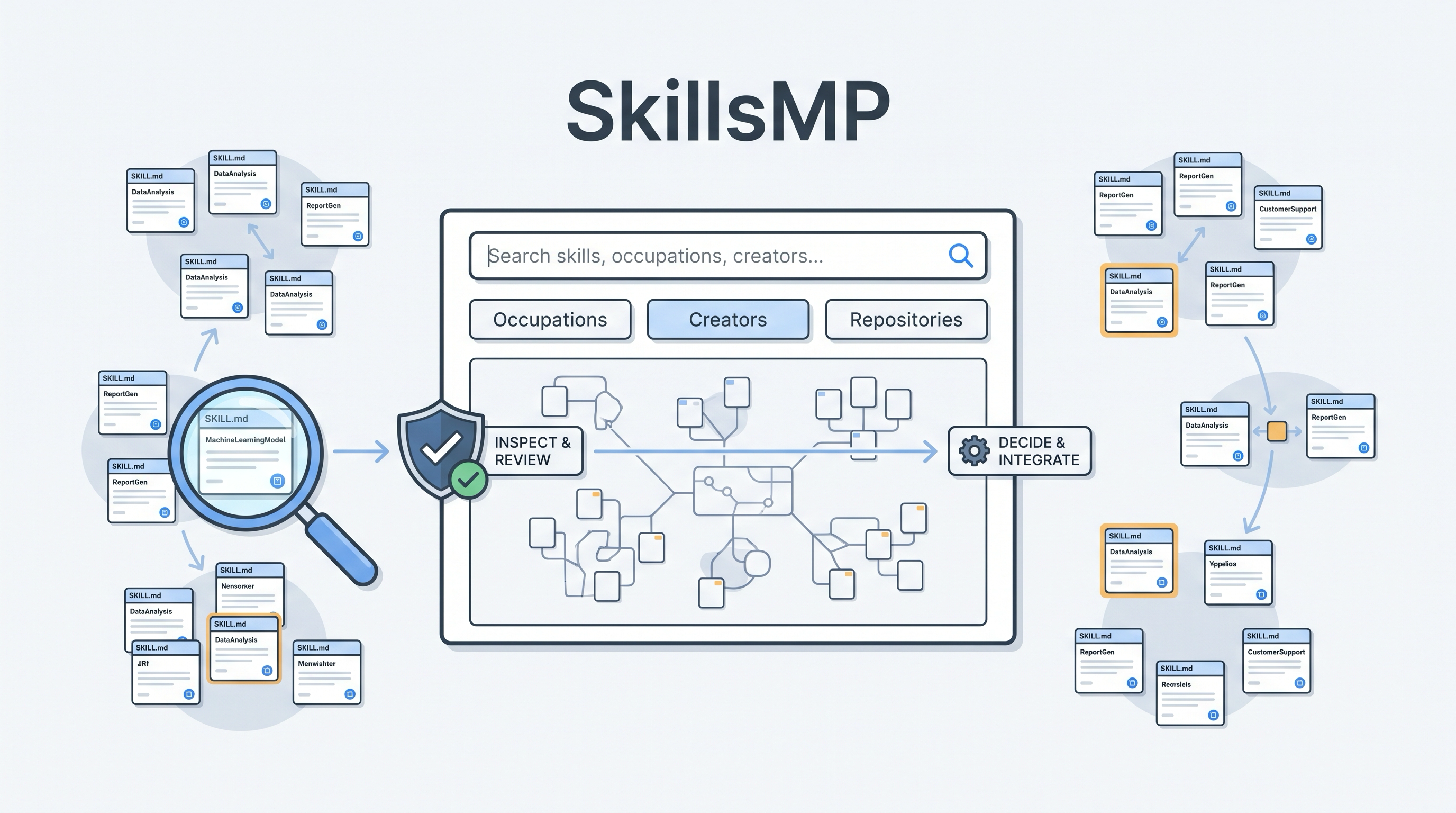
SkillsMP is an independent community map of public SKILL.md files across GitHub. Its value is not that every listed skill is good; it is that the skill ecosystem has grown too large to browse manually. SkillsMP gives students a way to search by occupation, creator, repository, and category before deciding what is worth opening, copying, or installing.
| *Source: SkillsMP | About SkillsMP | OpenAI: Build skills* |
The Problem
Skills started as small local playbooks. That scale is manageable:
~/.codex/skills/
~/.claude/skills/
repo/.agents/skills/
SkillsMP says it indexes 2M+ public skills, so discovery becomes its own problem:
| Without a map | What goes wrong |
|---|---|
| Search GitHub manually | You find popular repos, not necessarily relevant workflows |
| Install from a screenshot | You skip source review and inherit unknown assumptions |
| Trust star counts | A popular skill may still be unsafe, stale, or irrelevant |
| Keep adding skills | Overlapping descriptions make routing worse |
SkillsMP’s useful move is to treat skills as an ecosystem to inspect before installing.
What SkillsMP Maps
The current site describes three discovery paths:
| Path | Use it for |
|---|---|
| Occupations | Learn what workflows different fields are encoding as skills |
| Creators | See which people or teams maintain related skill sets |
| Repositories | Follow a skill back to GitHub before trusting it |
The “occupation” view is especially useful for teaching. It turns skills from a random plugin list into a question: what parts of real work are people trying to proceduralize for agents?
How To Evaluate A Skill Before Installing
Use this checklist before adding any third-party skill to Codex, Claude Code, or another agent:
| Check | Question |
|---|---|
| Trigger clarity | Does the description say exactly when the skill should run? |
| Scope | Is it one workflow, or a vague mega-skill? |
| Source quality | Is the GitHub repo active? Are issues and docs coherent? |
| Commands | Does it tell the agent to run shell commands? Which ones? |
| Permissions | Does it touch files, credentials, browsers, MCP servers, hooks, or external APIs? |
| Dependencies | Does it assume Node, Python, Playwright, cloud CLIs, API keys, or paid services? |
| Safety | Does it include verification, rollback, and “ask before destructive action” rules? |
| Overlap | Do you already have a skill that triggers on the same work? |
This is the same discipline as installing npm packages or browser extensions: search is not trust.
Why This Matters For Codex And Claude Code
OpenAI’s skill docs describe a skill as a directory with a SKILL.md file plus optional scripts/, references/, assets/, and other supporting files. OpenAI’s docs say name and description are required, and the description helps guide implicit invocation before the full skill is loaded.
That means a marketplace cannot be only a download button. It needs to answer:
What task does this skill handle?
When should it trigger?
What files/scripts does it carry?
What external tools does it assume?
Who maintains it?
What should I read before trusting it?
SkillsMP is useful when it sends you back to the source with better context.
Student Exercise: Skill Triage Lab
Give students one task, such as “build a rubric-based code review workflow.” Then ask them to find three candidate skills through SkillsMP and score them:
| Score area | What students inspect |
|---|---|
| Fit | Does the skill actually match the task? |
| Safety | Can it alter files or run commands? |
| Maintainability | Is the repo active and understandable? |
| Trigger design | Would the agent know when to use it? |
| Reuse | Would you install it, fork it, or write your own? |
The deliverable is not “install the best one.” The deliverable is a short technical judgment memo.
How LearnAI Team Could Use This
- Skill scouting — use SkillsMP as a first-pass map, then inspect GitHub sources manually.
- Curriculum examples — show students how different occupations translate work into agent procedures.
- Personal skill-stack cleanup — compare Q’s installed skills with public alternatives and remove overlap.
- Research question generator — use occupation/category browsing to study what people think can become agent-executable work.
Real-World Use Cases
| Scenario | Use |
|---|---|
| New project setup | Find candidate skills, then inspect their source before installing |
| Course assignment | Students compare three public skills and defend one install/fork/write decision |
| Team automation | Browse creators/repos to see how mature teams organize skill collections |
| Safety review | Identify skills that add hooks, scripts, or external service dependencies |
| Skill authoring | Study examples before writing a smaller, cleaner local skill |
Important Things To Know
- SkillsMP is independent. Its about page says it is not affiliated with Anthropic or OpenAI.
- Indexing is not endorsement. A listed skill can be stale, unsafe, or low quality.
- Always inspect source before install. Read
SKILL.md, scripts, hooks, dependencies, and repo activity. - Prefer fewer high-quality skills. A bloated skill catalog can make routing worse because descriptions overlap.
- Use marketplaces to learn patterns, not to outsource judgment. The best outcome may be writing a local skill tailored to your course or repo.