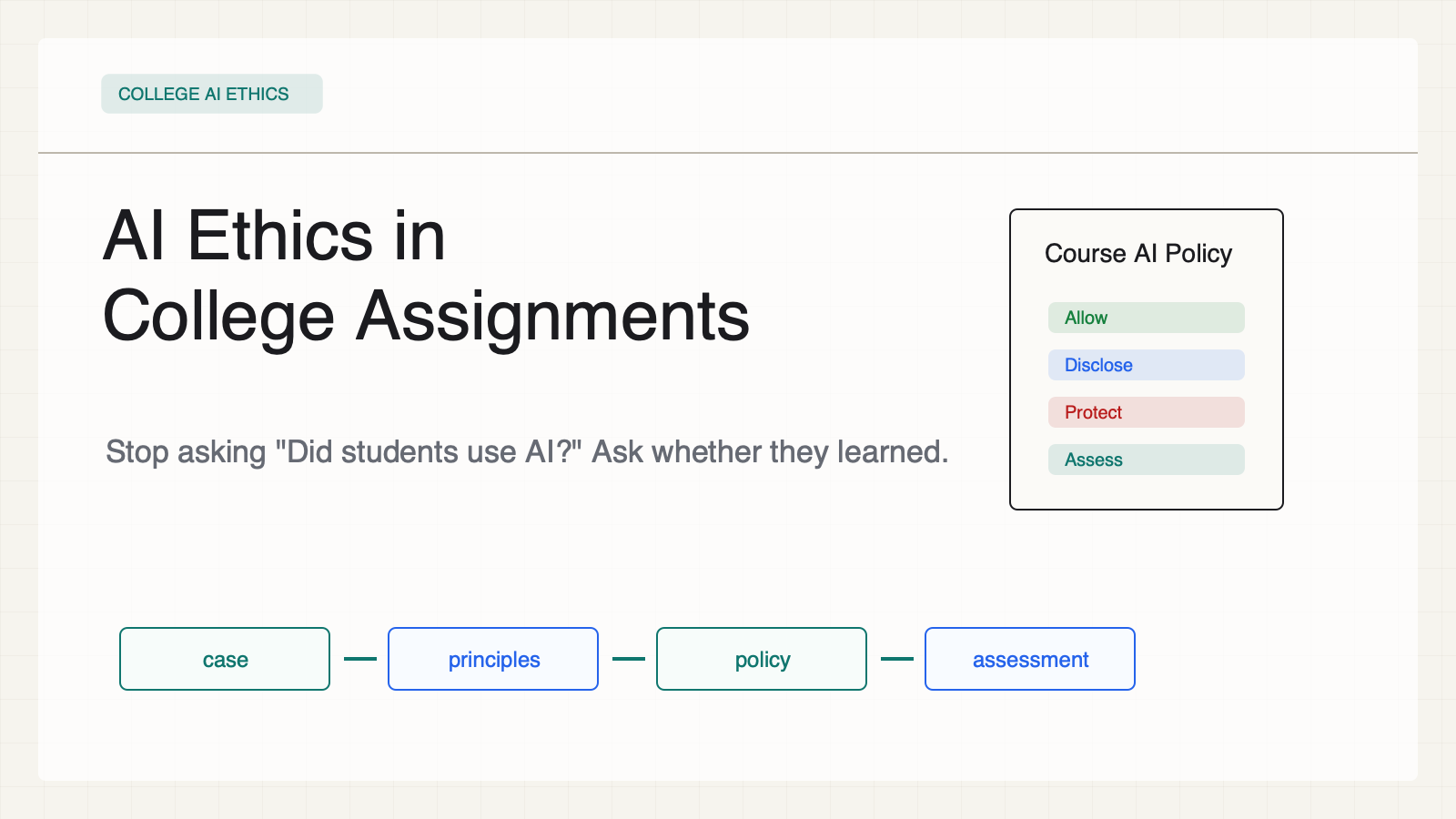
The debate about AI in college is often reduced to one question: should students be allowed to use it or not? That framing is already too small. In many classrooms, AI has turned teachers into police, students into suspects, and homework into evidence. The real issue is not simply whether a student used AI, but whether the assignment still shows learning, judgment, and accountability.
If universities want to prepare students for AI-mediated work and learning, they need more than bans or vague permission. They need a fair learning environment where AI strengthens thinking instead of replacing it.
Source basis: Jobin, Ienca, and Vayena, “The global landscape of AI ethics guidelines” (Nature Machine Intelligence, 2019); Corrêa et al., “Worldwide AI Ethics: A review of 200 guidelines and recommendations for AI governance” (Patterns, 2023), with project page; Giarmoleo et al., “What ethics can say on artificial intelligence: Insights from a systematic literature review” (Business and Society Review, 2024); Groen, Sharon, and Becker, “An overview of AI ethics: moral concerns through the lens of principles, lived realities and power structures” (AI and Ethics, 2026). This page is an educational synthesis for college AI-use policy. It does not claim that the four papers share one unified higher-education framework. Education-specific support also comes from UNESCO’s 2023 guidance for generative AI in education and research and the U.S. Department of Education’s 2023 report on AI and the future of teaching and learning.
Opening Case: The Student-AI Assignment
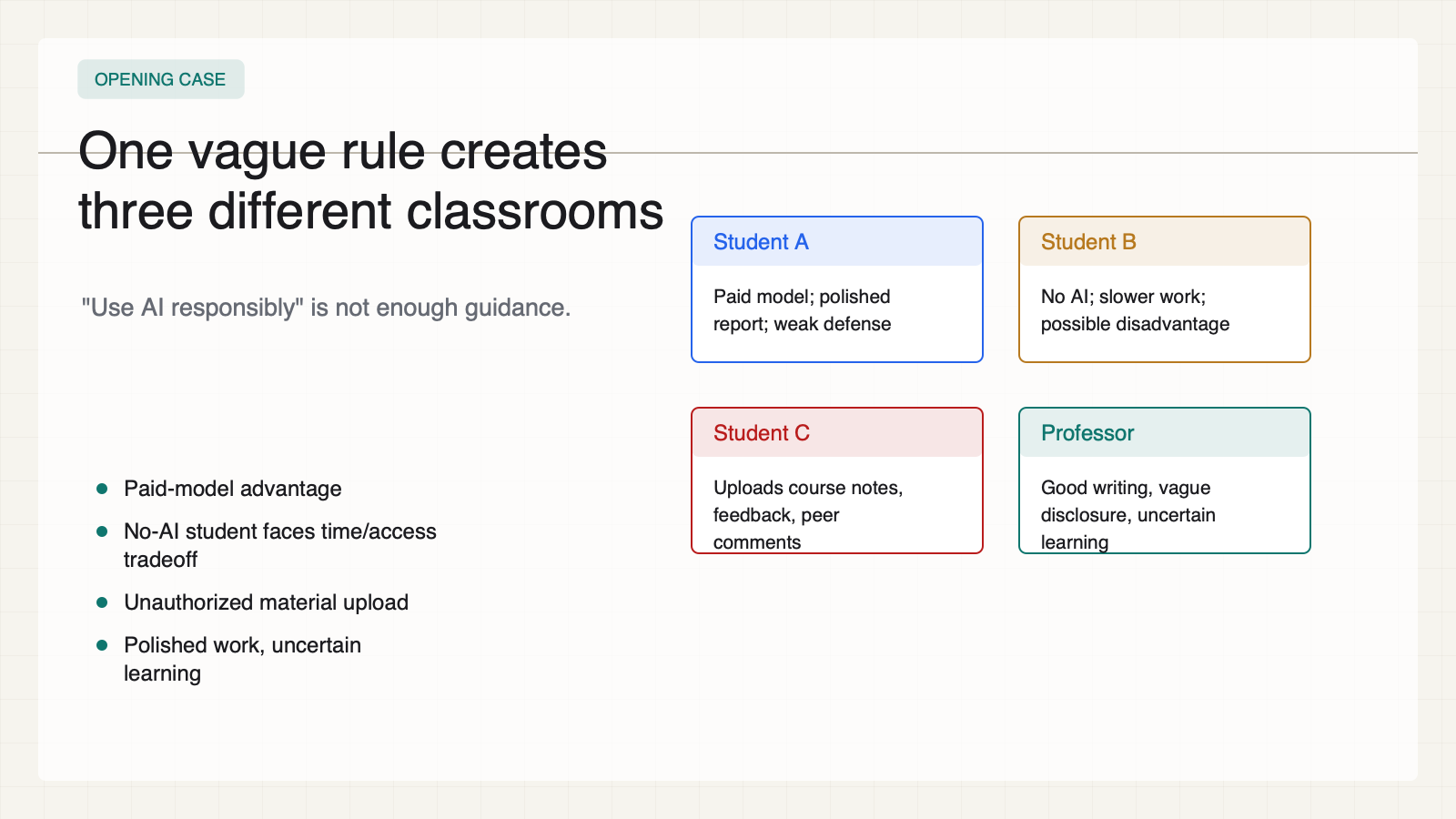
A professor assigns a short analytical report. The syllabus says: “Use AI responsibly and disclose any AI assistance.” It does not define responsible use, does not list approved tools, and does not explain what can or cannot be uploaded to a chatbot.
Three students respond differently.
| Student | What happens | Ethical pressure |
|---|---|---|
| Student A | Uses a paid model to brainstorm, outline, rewrite paragraphs, and polish arguments. The final report is strong, but the student cannot defend several claims in class. | Did AI strengthen learning, or replace it? |
| Student B | Uses no AI because they believe it is dishonest. Their work takes longer and they face a time/access tradeoff. | Is it fair if AI-fluent students gain an advantage without a shared policy? |
| Student C | Uploads the assignment sheet, lecture notes, teacher feedback, and peer comments into an unapproved AI tool. | Whose private or instructor-owned material was exposed? |
The professor sees good writing, vague disclosure, and uneven student understanding. The university has a broad academic-integrity policy, but no practical guidance on allowed tools, privacy boundaries, model access, or assessment redesign.
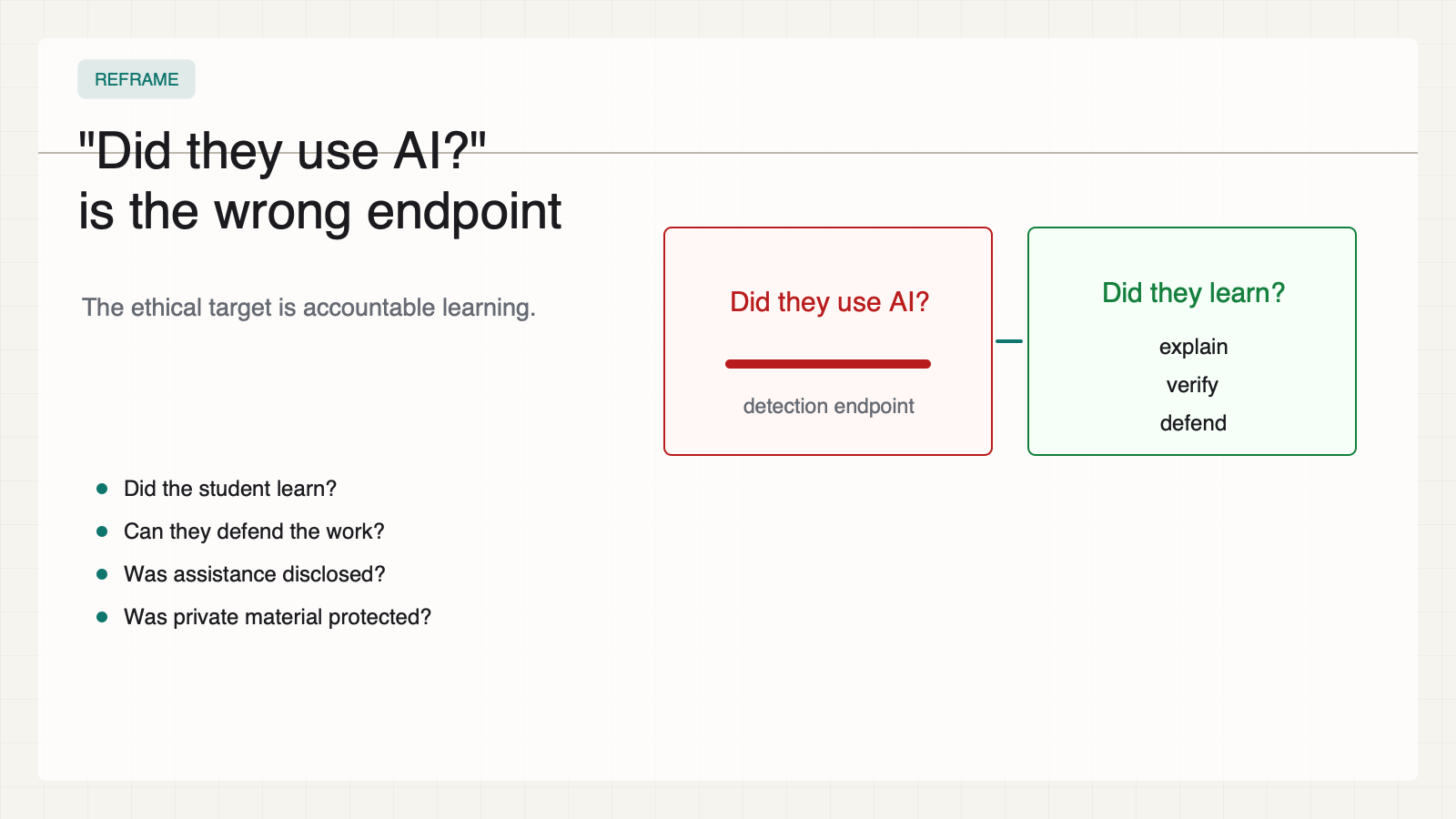
This case shows why “AI or no AI” is the wrong question. The real questions are:
What kind of AI use is allowed?
What must be disclosed?
What material must be protected?
What evidence proves the student learned?
Who is accountable when the policy is vague?
The Four Papers and Their Main Ideas
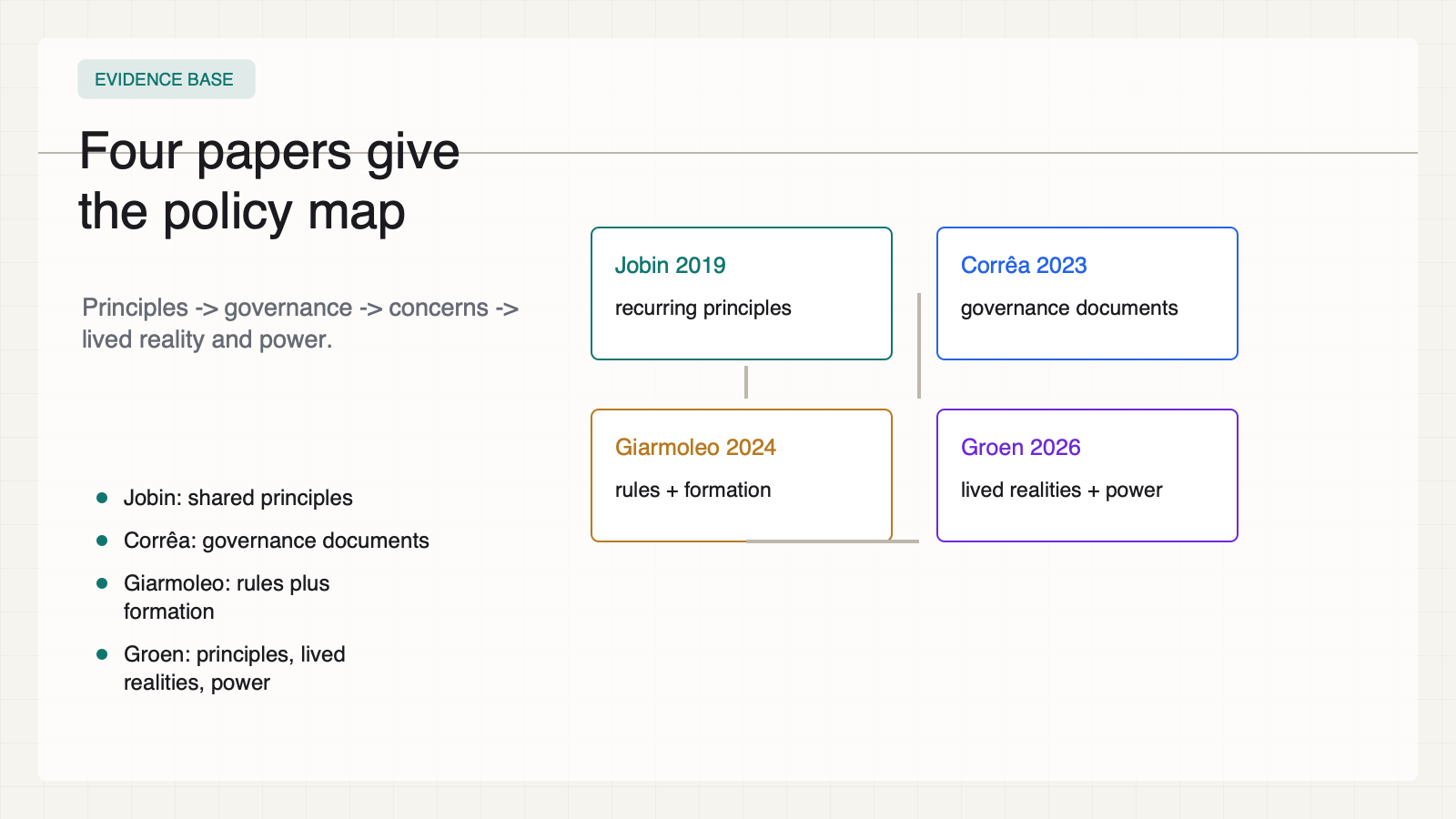
These four review papers are useful together because they move from principles, to governance, to literature concerns, to lived reality and power.
| Paper | Authors | Type | Main idea for this topic |
|---|---|---|---|
| “The global landscape of AI ethics guidelines” | Anna Jobin, Marcello Ienca, Effy Vayena | Review of 84 AI ethics guideline documents | AI ethics principles such as transparency, fairness, non-maleficence, responsibility, and privacy are common, but the same words are interpreted differently across documents. |
| “Worldwide AI Ethics” | Nicholas Kluge Corrêa et al. | Review of 200 AI governance guidelines and recommendations | AI governance documents repeat many principles, but most are soft-law recommendations; practical implementation and enforcement remain thin. |
| “What ethics can say on artificial intelligence” | Gaetano Giarmoleo, Ignacio Ferrero, Marta Rocchi, Massimiliano Pellegrini | Systematic literature review of 309 academic articles | AI ethics research discusses both design problems and human-AI interaction problems; proposed solutions split between act-centered rules and agent-centered human formation. |
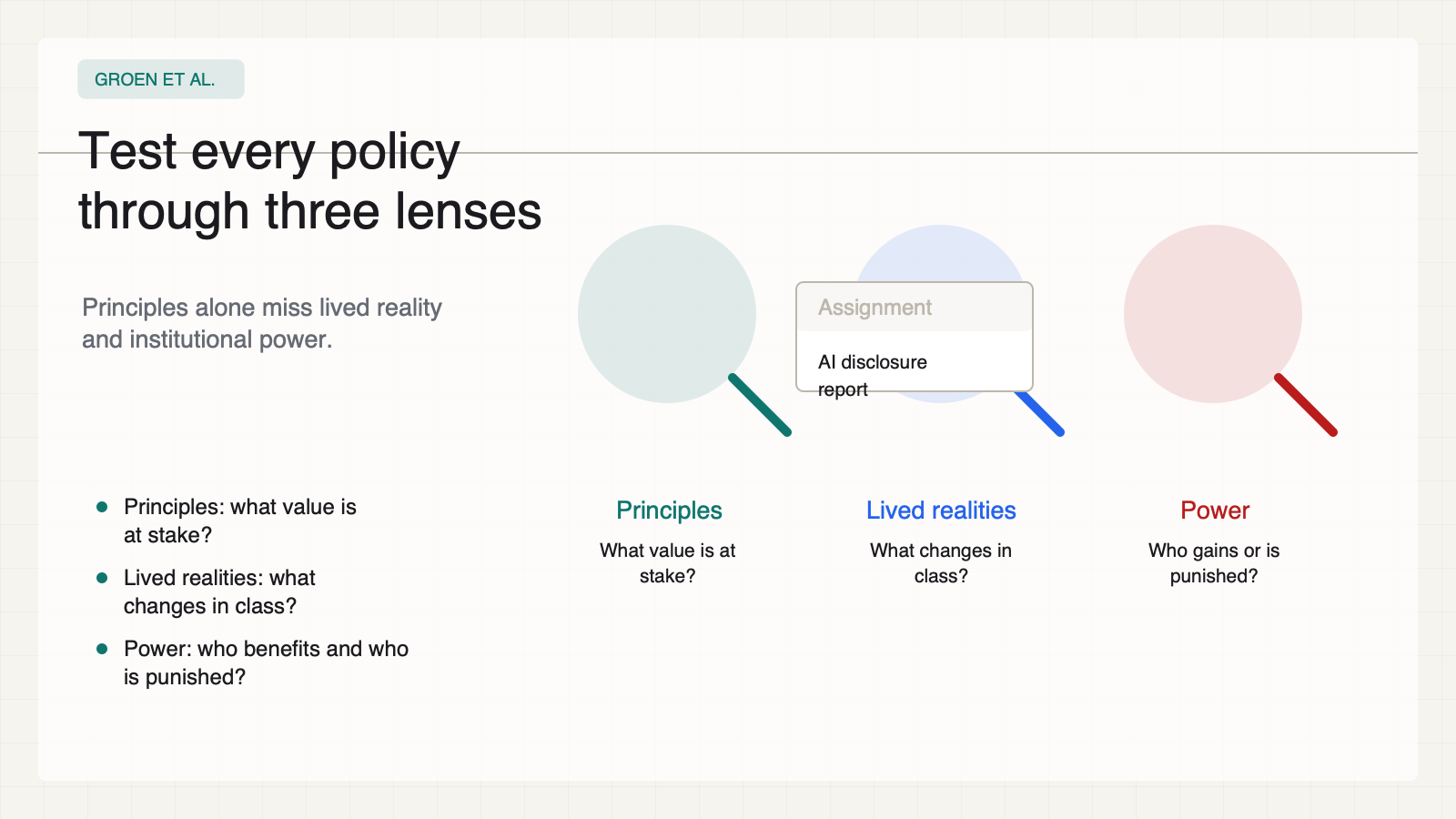
| “An overview of AI ethics” | Elizabeth M. Groen, Tamar Sharon, Marcel Becker | Narrative overview | AI ethics needs three lenses: principles, lived realities, and power structures. Principles alone miss how AI changes real people, institutions, and control. |
The teaching progression is:
principles
  -> governance commitments
  -> ethical concerns in systems and use
  -> lived classroom realities
  -> power structures around students, teachers, universities, and vendors
What the Papers Teach a College AI Policy
1. Jobin et al.: Shared Words Are Not Shared Rules
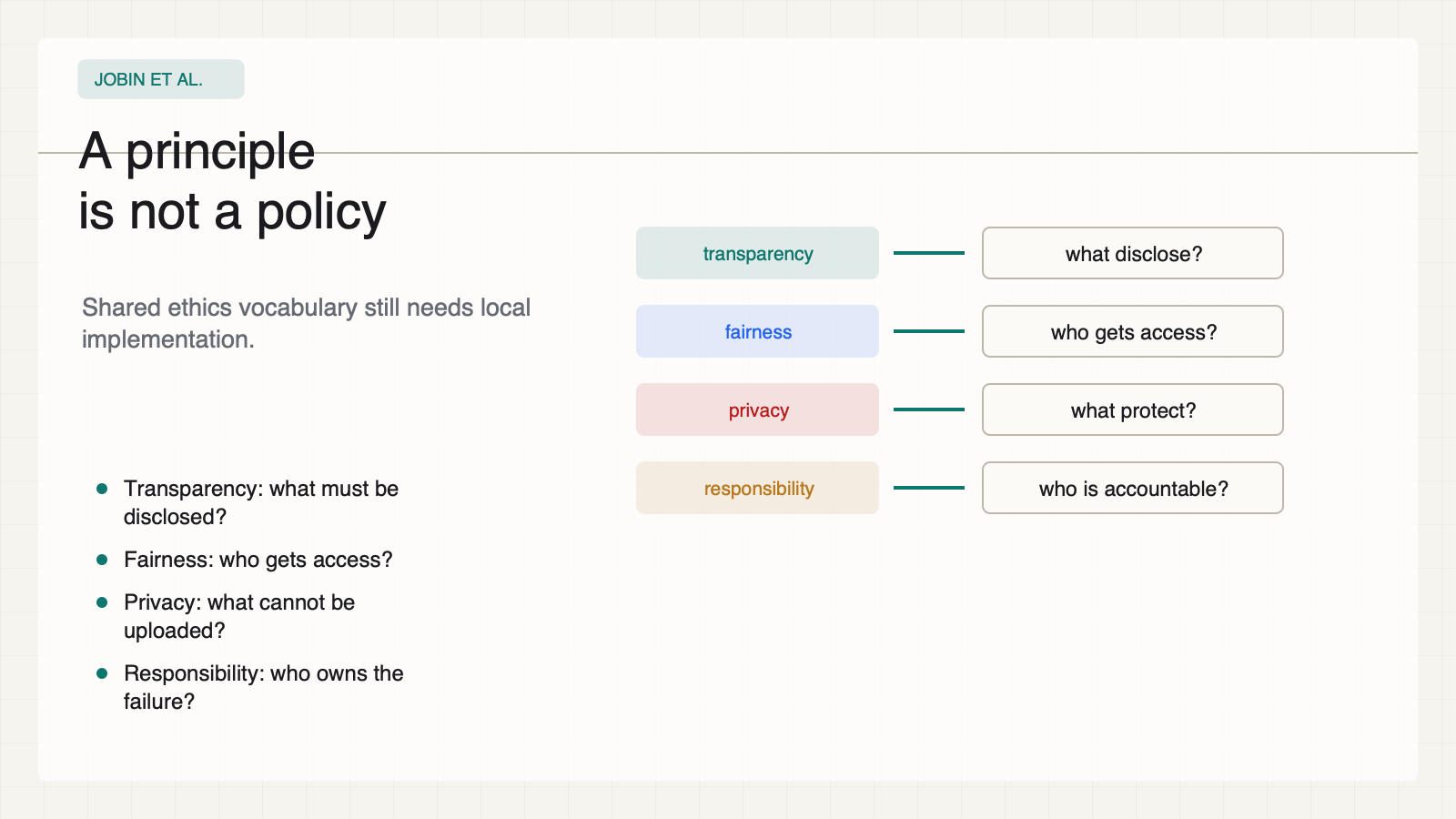
Jobin, Ienca, and Vayena show that many AI ethics guidelines mention familiar principles:
transparency
justice and fairness
non-maleficence
responsibility
privacy
For college AI use, this gives us the right vocabulary. A student assignment raises transparency because readers need to know how AI shaped the work. It raises fairness because students have unequal access, unequal AI literacy, and unequal beliefs about whether AI is acceptable. It raises privacy because students may upload instructor materials, peer comments, personal data, or drafts into third-party tools. It raises responsibility because a vague policy makes it unclear who must prevent misuse, who must teach proper use, and who bears punishment.
But the paper also shows the core weakness of principle lists: agreement on vocabulary does not produce agreement on practice. “Use AI responsibly” sounds clear until students, teachers, and administrators define responsibility differently.
So the first rule for college AI ethics is:
A principle is not a policy.
It is a pointer to a decision the institution still needs to make.
2. Corrêa et al.: Governance Needs Teeth
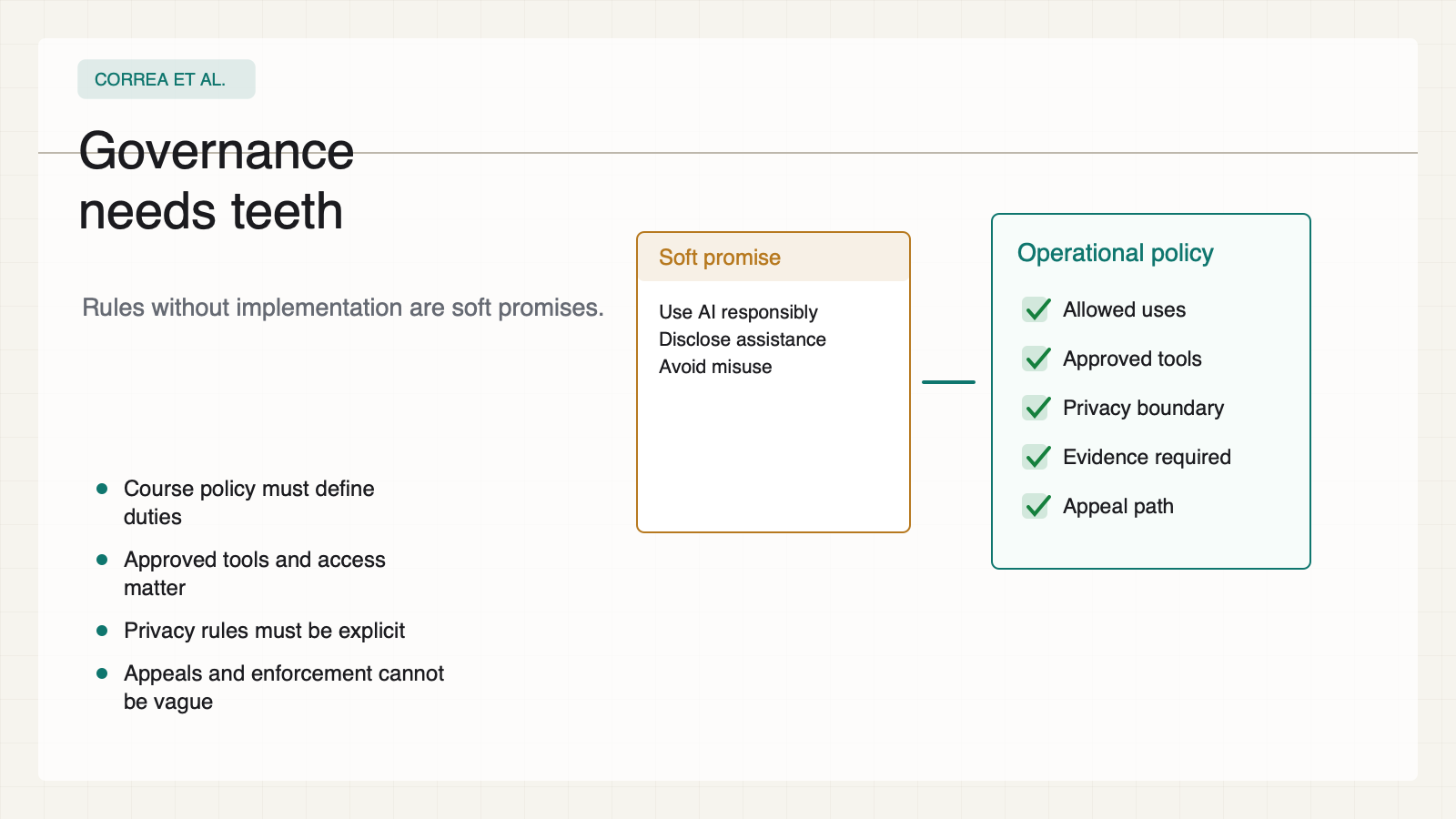
Corrêa et al. broaden the view by comparing 200 AI governance documents. The useful lesson for universities is that written principles often remain soft unless they become concrete obligations.
In a course policy, that means “responsible AI use” must become operational:
| Vague principle | Concrete university question |
|---|---|
| Transparency | What exactly must students disclose: tool, prompt category, copied text, generated ideas, editing help, citations checked? |
| Fairness | Does every student have access to comparable AI tools, or does the policy reward wealth and technical fluency? |
| Privacy | Which materials may never be uploaded to unapproved tools? |
| Accountability | Who teaches the rules, who grades process evidence, who handles appeals, and who audits inconsistent enforcement? |
| Safety | What kinds of AI use are unsafe because they create dependency, misinformation, data leakage, or false confidence? |
This is where university policy can fail. A rule can sound ethical while still forcing students to guess what it means in each assignment.
3. Giarmoleo et al.: Rules Are Necessary, But Judgment Must Be Taught
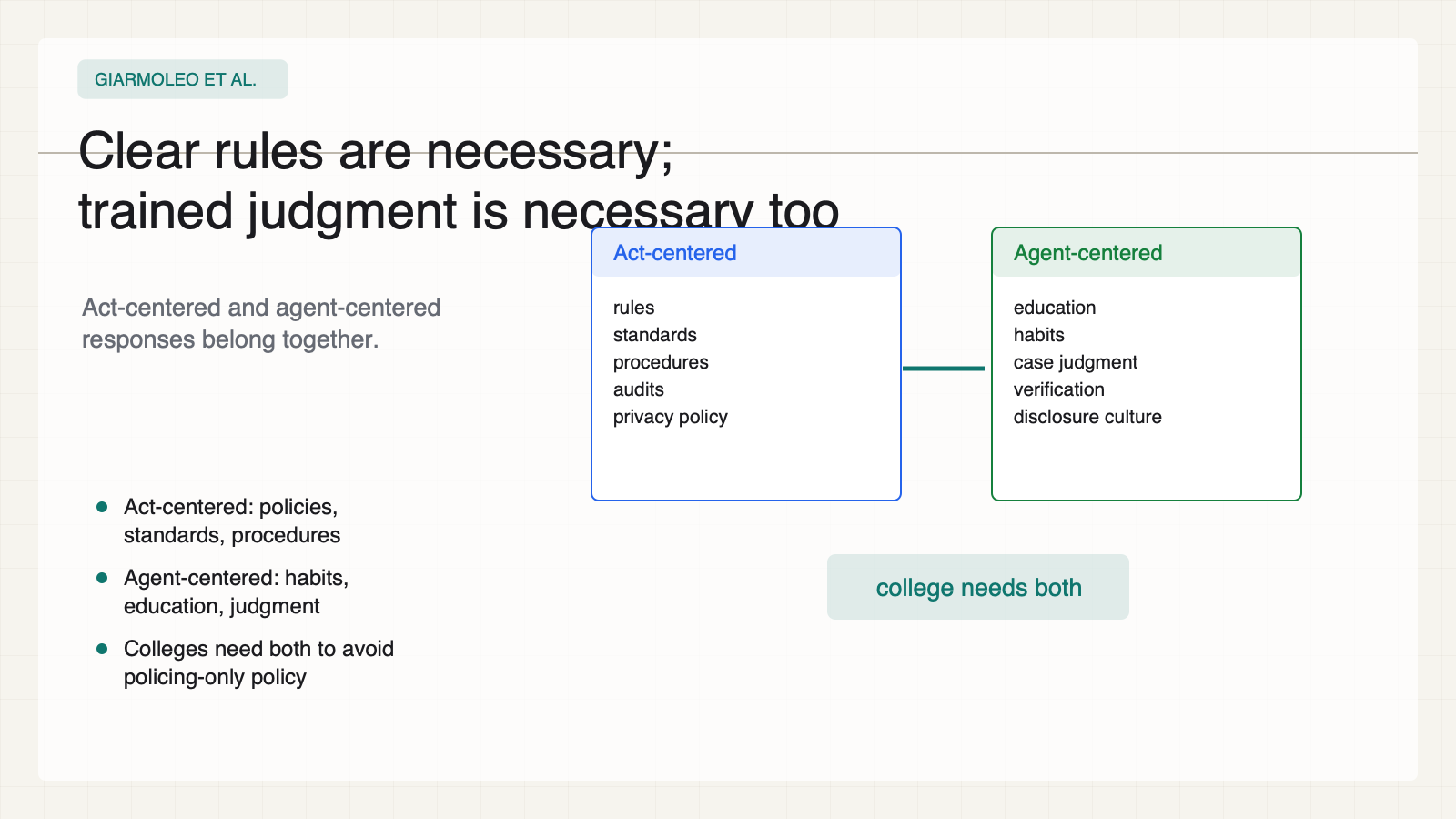
Giarmoleo et al. help separate two kinds of response:
act-centered responses: rules, standards, policies, audits, procedures
agent-centered responses: education, virtues, habits, judgment, responsible practice
Using the distinction from Giarmoleo et al., act-centered work in college AI policy includes:
- defining allowed and prohibited AI uses
- creating assignment-level disclosure rules
- protecting instructor, peer, and student privacy
- providing approved tools or access guidelines
- redesigning assessment so final text is not the only evidence of learning
Agent-centered work includes:
- teaching students how to use AI as a thinking partner
- training students to verify AI claims and citations
- making students explain where AI helped and where it was wrong
- asking students to judge borderline use cases
- helping teachers design assignments that reward understanding, not just polished output
The point is not to choose one side. A strong university needs both.
Act-centered: make the rules clear.
Agent-centered: build people who can apply the rules well.
4. Groen et al.: Principles, Lived Realities, and Power
Groen, Sharon, and Becker push the analysis beyond principle lists. Their three-lens frame is the best way to teach the student-AI problem.
| Lens | College-AI question |
|---|---|
| Principles | What values are at stake: fairness, transparency, privacy, accountability, safety? |
| Lived realities | How does the policy feel in the classroom: trust, anxiety, surveillance, opportunity, confidence, exclusion? |
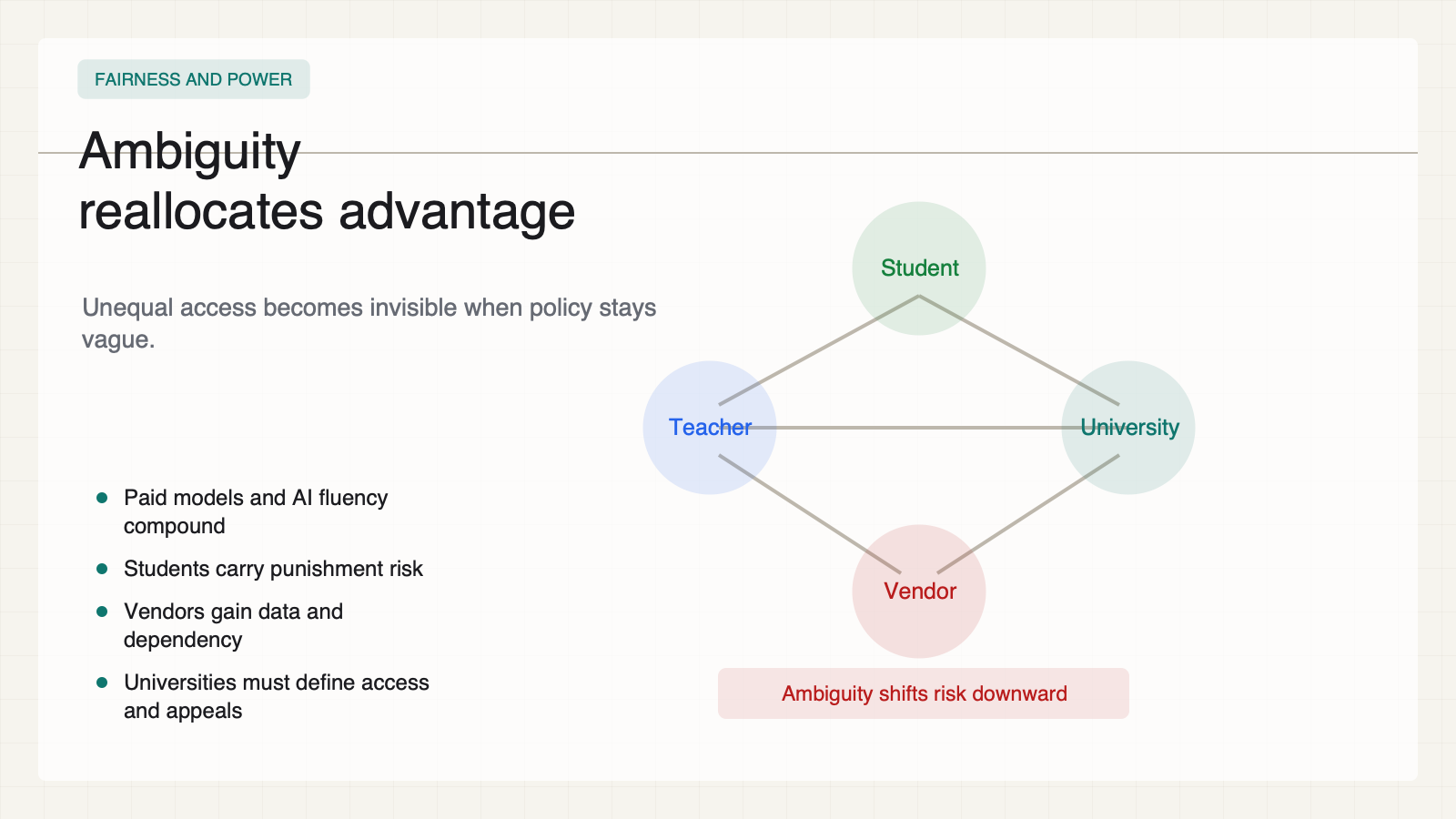
| Power structures | Who gains power from ambiguity: teachers, AI-fluent students, wealthier students, vendors, universities? Who carries punishment risk? |
This matters because an AI policy can look fair on paper while operating unfairly in practice. If wealthy students can pay for better models, if AI-fluent students quietly use agents, if professors grade with suspicion but no shared rubric, and if universities refuse to provide access or training, then the policy rewards hidden advantage.
The Core Thesis
The use of AI should not be simply forbidden or blindly allowed. The real task is to guide students to use AI to learn, think, plan, test, and explain.
Capability in the AI era includes the ability to work with AI without surrendering judgment. College should teach that capability directly.
The ethical goal is not:
Can we catch every student who used AI?
The better goal is:
Can we create a fair learning environment where AI strengthens thinking,
where students disclose meaningful assistance,
where private material is protected,
and where assessment still proves understanding?
Allowed, Borderline, and Prohibited Use
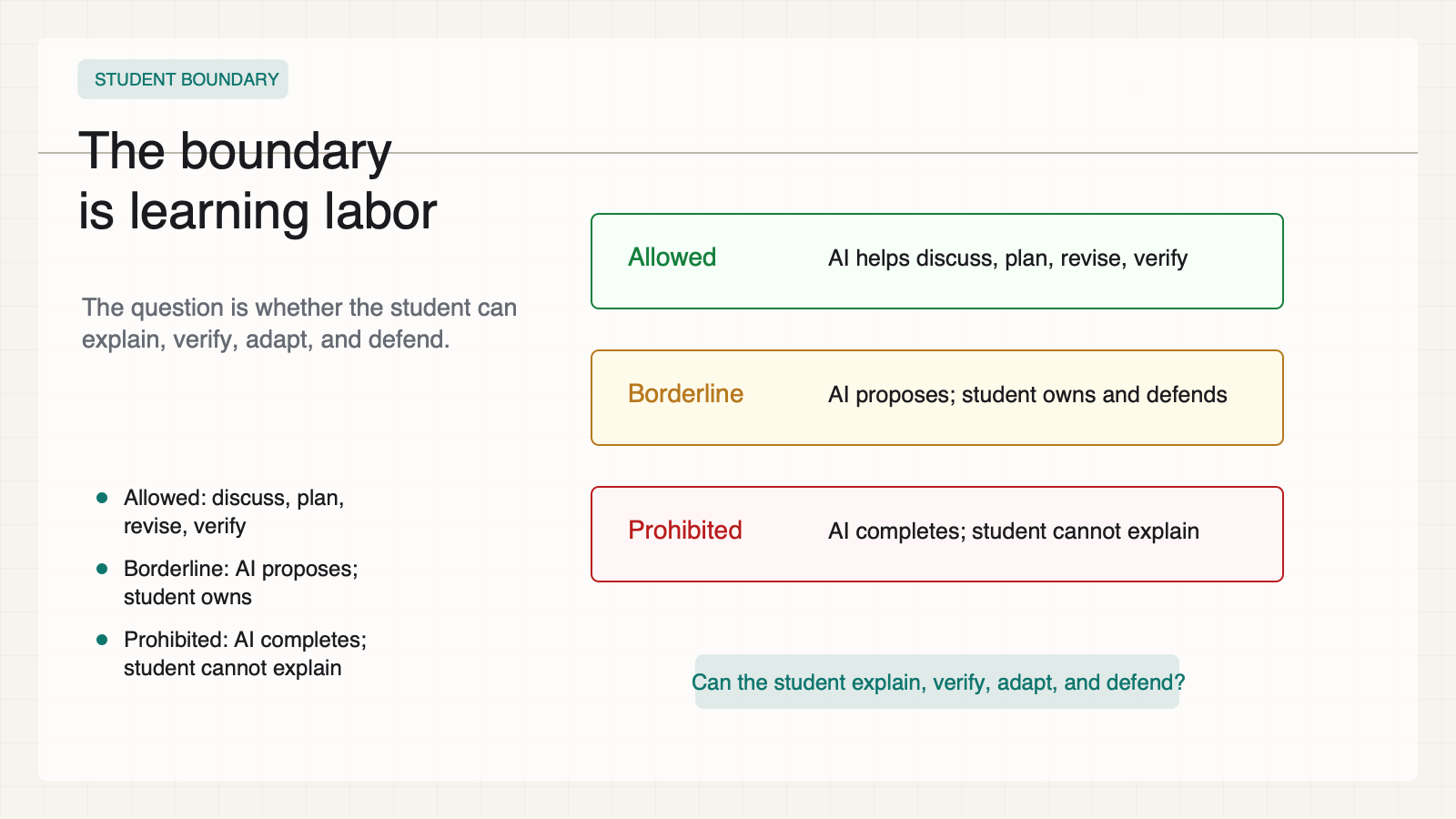
Students need a concrete boundary. One useful three-level model is:
| Level | Description | Policy stance |
|---|---|---|
| Allowed | Use AI to discuss ideas, clarify concepts, plan structure, question assumptions, get feedback, and then write or build in the student’s own words. | Allowed with disclosure when the assignment permits AI. |
| Borderline | Use AI to generate ideas or an initial solution, then study it, revise it, verify it, and take responsibility for the final work. | Often allowed only with stronger disclosure and defense, because authorship is mixed. |
| Prohibited | Ask AI to finish the assignment, generate the thesis, write the report, solve the homework, or produce code that the student cannot explain, verify, or defend. | Prohibited unless the assignment explicitly asks for AI-generated work as the object of study. |
The boundary is not whether AI touched the work. The boundary is whether the student still did the learning labor.
Can the student explain, verify, adapt, and defend the work without AI?
If yes, AI probably strengthened learning. If no, AI probably replaced learning.
A Four-Part College AI Policy
1. Allow
Students may use AI for:
- brainstorming and question generation
- explaining difficult concepts
- planning study schedules
- organizing notes
- getting feedback on drafts
- checking clarity, structure, and possible weaknesses
- daily learning assistance
- creative exploration and project planning
The policy should say that learning with AI is not automatically cheating. In many fields, the ability to use AI well is increasingly relevant to professional competence.
2. Disclose
Students should disclose meaningful AI assistance. Prompt summaries should be the default because raw prompts can expose private student thinking, personal data, or confidential course material. Instructors can request raw prompt excerpts only when the assignment genuinely needs them and privacy limits are clear.
A useful disclosure should include:
- which tool or model was used, if known
- what kind of help it provided
- whether AI generated text, code, thesis options, topic ideas, counterarguments, outlines, examples, feedback, or revision suggestions
- what the student changed after using AI
- what the student verified independently
Weak disclosure:
I used ChatGPT.
Better disclosure:
I used ChatGPT to brainstorm counterarguments and ask clarifying questions.
I wrote the final argument myself, checked the sources manually, and removed two unsupported claims.
No instructor slides, peer comments, or private feedback were uploaded.
3. Protect
Students should not upload unauthorized learning material from teachers or classmates without permission.
A practical privacy rule:
Students may not upload instructor materials, peer work, unpublished research,
personal data, grades, feedback, or confidential course/project materials
to unapproved AI tools. If AI support is allowed, use university-approved tools
or short de-identified excerpts.
Privacy is not only about the student using AI. One student’s upload can expose another student’s work, a teacher’s feedback, or unpublished course material.
De-identified means more than removing a name. Students should remove or paraphrase student names, emails, IDs, grades, feedback comments, institution-specific identifiers, unique case details, and any text that belongs to a teacher or peer unless permission has been granted.
4. Assess
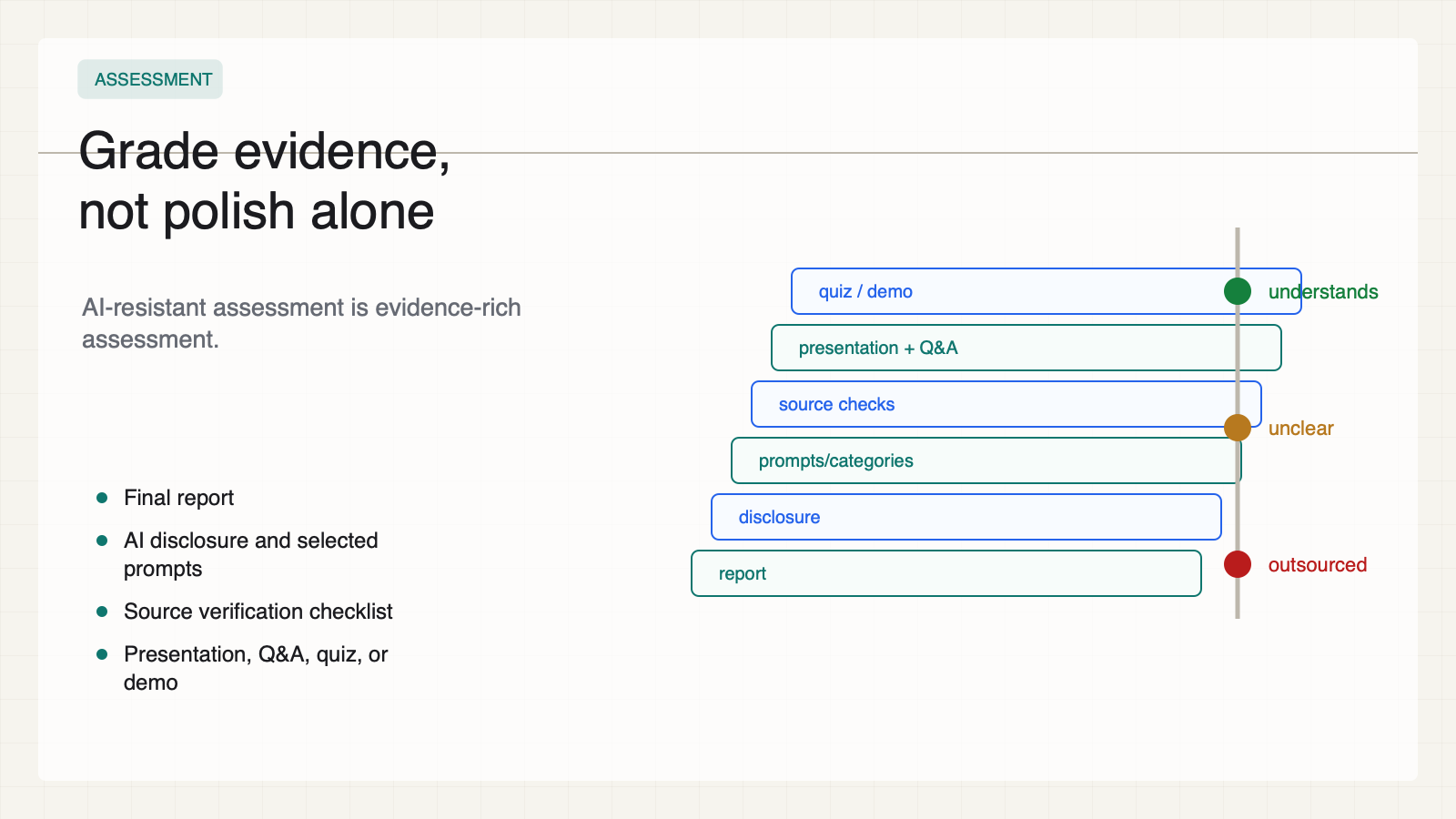
Teachers should not grade only the final polished output. They should grade evidence of understanding.
Useful evidence includes:
- the final report
- AI-use disclosure
- selected prompts or prompt categories
- source verification
- class presentation
- oral defense
- peer questions
- in-class quiz or paper exam
- live demo, if the assignment is a project
- ability to solve a related problem without network access
For some assignments, offline quizzes or in-person presentations are not anti-AI punishment. They are a way to verify that AI-supported work still produced student understanding.
Default Status
The cleanest default is assignment-specific:
AI study support is permitted unless the course forbids it.
AI contribution to graded submissions is allowed only when the assignment permits it.
Any meaningful AI assistance in submitted work must be disclosed.
Exams, closed-book quizzes, and no-network tasks allow no AI unless explicitly stated.
Unauthorized course, peer, personal, or confidential materials may not be uploaded to unapproved tools.
This default avoids two bad extremes: a blanket ban that hides real practice, and blanket permission that erases assessment integrity.
Accountability Map
Responsibility should not be dumped on one actor.
| Actor | Responsibility |
|---|---|
| Student | Use AI only in allowed ways, disclose meaningful assistance, protect private material, verify claims, and be able to defend the final work. |
| Teacher | Define assignment-level AI rules, teach safe and useful AI practices, assess understanding, and avoid vague grading standards. |
| University | Provide clear policy, approved tools or access guidance, privacy rules, appeal paths, and support for students who lack access or AI literacy. |
| Vendor | Explain data retention, training use, privacy settings, reliability limits, and institutional controls. |
The accountability failure in many universities is that the policy says “students are responsible” while the institution has not defined the rule, provided equitable access, taught the skill, or redesigned assessment.
Appeals matter because a fair AI policy cannot depend only on suspicion. If a student’s work is challenged, the acceptable evidence should be named in advance: disclosure appendix, draft history, source checklist, oral defense, presentation answers, in-class follow-up, or a related no-network task. AI detectors should not be treated as sole proof; TEQSA’s academic-integrity guidance similarly emphasizes that detector scores alone are insufficient and require additional evidence.
Fairness: Who Gains and Who Loses?
Ambiguous AI policy does not affect everyone equally.
People who can benefit:
- students who can pay for stronger models
- students who already know how to use agents well
- teachers who can grade by discretion without clear criteria
- universities that avoid the work of defining detailed rules
- vendors that benefit from unmanaged adoption
People who can be harmed:
- students who cannot afford good AI access
- students with low AI literacy
- students who avoid AI for ethical or religious reasons
- students who use AI openly while others use it secretly
- teachers who must grade inconsistent work without usable evidence
- students punished under rules they did not understand
This is why “ban AI” is not automatically fair. As AI-supported work becomes normal elsewhere, students in a ban-only environment may become less prepared. But “allow AI” is also not automatically fair if access, disclosure, privacy, and assessment are unmanaged.
Fairness requires a designed environment, not a slogan.
Interactive Classroom Lab
The companion classroom experience turns this argument into a 70-minute policy exercise for general undergraduate students. Students first create an individual, ungraded, no-AI baseline snapshot. They then work in groups through controlled access, privacy, and accountability variations; use Claude only after documenting their own ideas; evaluate its criticism; and defend a final policy.
- Open the student exercise: Who Did the Learning?
- Open the 70-minute facilitator guide
- Download the DOCX fallback report template
- Download the PDF fallback report template
The classroom route uses 13 substantive questions, half of the full grilling path below. The official student artifact is the report preview generated by the webpage and saved as PDF for eCampus. The pre-AI snapshot is formative and ungraded; the final report evaluates reasoning, revision, operational policy, source use, and the student’s judgment about AI advice.
Student-AI Assignment Design
A better assignment can force AI to become a thinking partner instead of a ghostwriter.
Assignment
Students write a short report on a course topic. AI use is allowed for brainstorming, explanation, planning, feedback, and revision support. Students must submit an AI disclosure appendix. The grade depends partly on an in-class presentation, peer questioning, and a short no-network quiz or oral defense.
Deliverables
| Deliverable | Purpose |
|---|---|
| Final report | Shows written argument and organization. |
| AI disclosure appendix | Shows how AI shaped the work and what was verified. |
| Selected prompts or prompt categories | Shows process without requiring invasive surveillance. |
| Source checklist | Shows that citations, facts, and claims were checked. |
| Presentation | Shows that the student can explain the work. |
| Peer Q&A | Tests whether the student can respond to questions. |
| Short in-class defense | Confirms understanding without AI assistance. |
| Demo, if project-based | Shows that the student can operate and explain the artifact. |
Rubric
| Criterion | Weight | What to look for |
|---|---|---|
| Final report quality | 30% | Clear argument, correct concepts, relevant evidence, original synthesis. |
| Understanding defense | 25% | Student can explain claims, answer questions, and solve a related problem without AI. |
| AI process and disclosure | 20% | Meaningful disclosure, clear boundary between AI help and student work, no hidden ghostwriting. |
| Verification and privacy | 15% | Sources checked, hallucinations removed, unauthorized materials not uploaded. |
| Reflection on learning | 10% | Student explains how AI strengthened or weakened their thinking. |
Minimum Viable Syllabus Policy
AI tools may be used in this course for studying, brainstorming, explanation,
planning, feedback, and revision support when the assignment permits it.
AI may not be used to complete exams, closed-book quizzes, or no-network tasks
unless explicitly stated.

For submitted assignments, disclose meaningful AI assistance: tool used if known,
type of help, whether AI generated ideas, outlines, examples, text, code, or feedback,
and what you verified independently. Prompt summaries are preferred; raw prompts
should be shared only when requested and when they do not expose private or
unauthorized material.

Do not upload instructor materials, peer work, unpublished research, grades,
feedback, personal data, or confidential course material to unapproved AI tools.
If a privacy-safe AI query is needed, use an approved tool or a short de-identified
excerpt.

Grades will be based on the final work plus evidence of understanding. The instructor
may use presentation, Q&A, source checks, draft/process evidence, oral defense,
demo, or a related no-network task to resolve uncertainty. If AI misuse is alleged,
students may respond through the course appeal process and provide learning evidence.
Homework for Students
Objective
Use one AI tool as a thinking partner while proving that the final learning remains yours.
Task
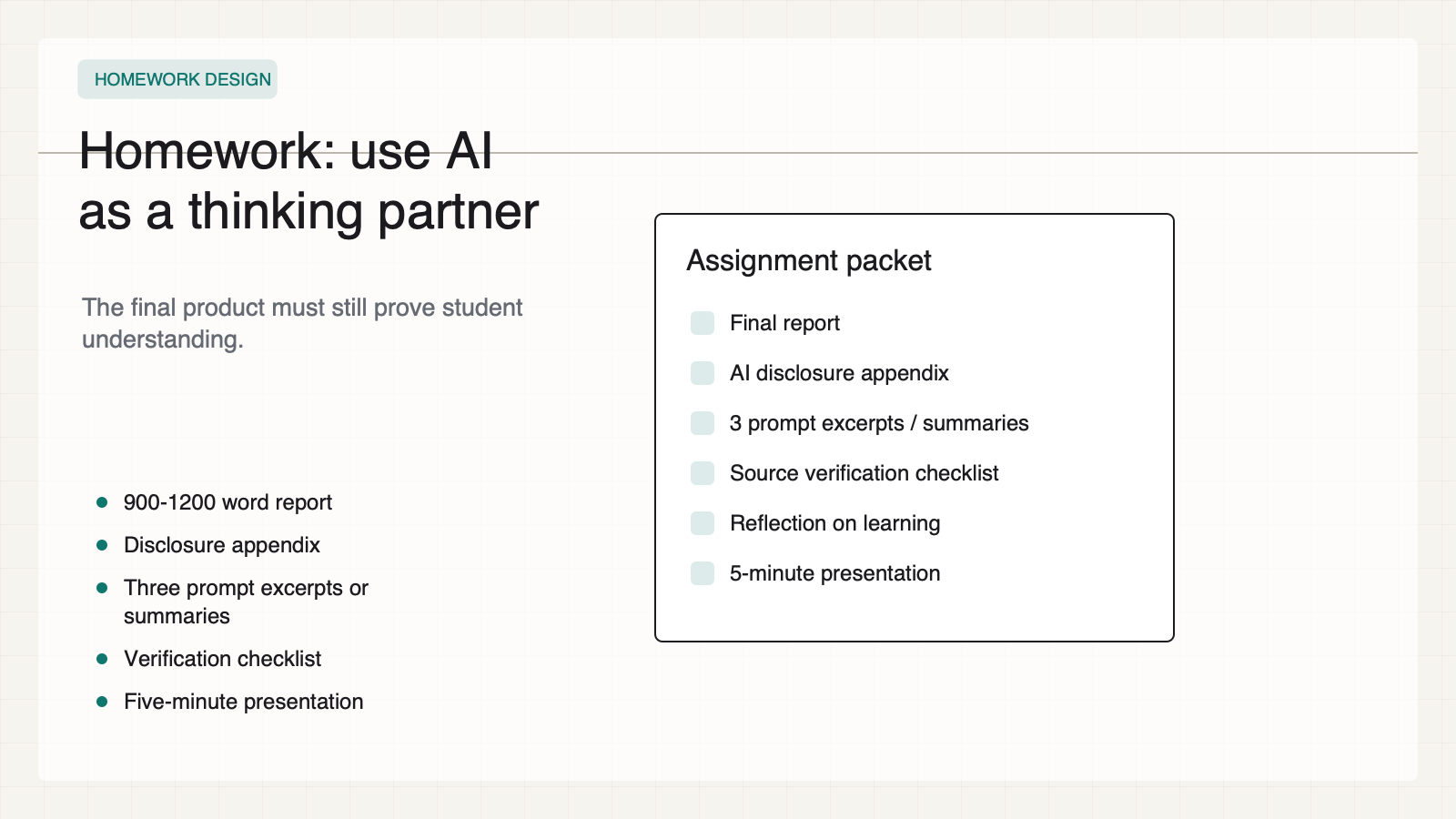
Choose one concept from the course. Write a 900-1200 word report that explains the concept, applies it to one real case, and evaluates one ethical tradeoff.
AI Rules
Allowed:
- ask AI to explain the concept
- ask AI for examples and counterexamples
- ask AI to question your first draft
- ask AI to help organize your outline
- ask AI to suggest weaknesses in your argument
Not allowed:
- ask AI to write the final report for you
- copy AI-generated paragraphs into the final report without explicit permission
- upload instructor slides, private feedback, peer work, grades, unpublished research, or personal data to unapproved AI tools
- cite sources you did not inspect yourself
- submit work you cannot explain in class
Submission
Submit:
- Final report.
- AI disclosure appendix.
- Three prompt excerpts or prompt summaries.
- Source verification checklist.
- One-page reflection: “Where did AI strengthen my thinking, and where did it tempt me to stop thinking?”
In-Class Component
Each student gives a 5-minute presentation and answers two peer questions. The instructor may ask one short no-network follow-up question to verify understanding.
Reflection Questions
- Which part of your work was easier because of AI?
- Which part became more dangerous because AI sounded confident?
- Did AI give you an idea you would not have found alone?
- Did you reject or correct anything AI suggested?
- Could you defend the final report without AI open?
- Did you upload any material that belonged to your teacher, classmates, or institution?
- If another student had no access to your AI tool, would the assignment still be fair?
The 26-Question Study Path
This section records the grilling path behind the wiki post. It is a learning transcript distilled into a study guide, not a set of claims directly made by the four papers.
| # | Question | Strong answer |
|---|---|---|
| 1 | Which AI ethics principles matter most in student-AI homework? | Transparency, fairness, privacy, accountability, and safety. The classroom case makes these concrete because AI changes authorship, access, data exposure, and grading. |
| 2 | Should we analyze the policy as act-centered or agent-centered? | Use both, but start with act-centered policy because students need clear rules before they can be fairly judged. |
| 3 | Who is responsible when a student misuses AI? | Students are responsible for their conduct, teachers for assignment rules and assessment, and universities for policy, access, training, privacy, and appeals. |
| 4 | What is the basic student-AI scenario? | A student uses AI on homework under a vague policy, submits polished work, and the teacher cannot tell whether learning happened. Other students face unequal access and unclear fairness. |
| 5 | Which principles are violated in the scenario? | Transparency and accountability are most obvious; fairness and privacy often appear once access differences and unauthorized uploads are examined. |
| 6 | Is banning AI fair? | Not necessarily. A ban can protect assessment integrity, but it can also disadvantage students if other institutions teach AI-supported productivity. |
| 7 | What uses should be allowed? | Study help, exam preparation, explanation, brainstorming, planning, organization, feedback, and revision support, when assignment rules permit it. |
| 8 | What uses should be prohibited? | Exams, copied AI-generated assignments, ghostwritten reports, unauthorized use of instructor materials, and work the student cannot explain or defend. |
| 9 | What did the four papers say? | Jobin maps common principles; Corrêa maps governance documents; Giarmoleo maps concerns and act/agent solutions; Groen adds principles, lived realities, and power structures. |
| 10 | What does Jobin/Correa teach before answering policy questions? | Their work shows that “responsible AI” is too vague unless the institution defines duties, disclosure, enforcement, and implementation. |
| 11 | Why is “responsible AI use” unclear? | Students and teachers can define responsibility differently: using AI to learn may be responsible, while using AI to complete homework without understanding is not. |
| 12 | How can we draw the boundary? | Allowed: AI helps discuss and organize ideas. Borderline: AI generates ideas that the student then understands and owns. Prohibited: AI creates the work and the student does not understand it. |
| 13 | What assignment design can test learning? | Require a written report with AI disclosure, then grade partly through in-class presentation, peer Q&A, and instructor follow-up. |
| 14 | What are Giarmoleo’s act-centered and agent-centered responses? | Act-centered means rules, standards, policies, and procedures. Agent-centered means forming people who can judge cases responsibly. A college needs both. |
| 15 | What is the five-sentence argument? | Current AI policy often focuses too much on policing cheating. This is too narrow because it does not teach valid AI use. Jobin and Corrêa show vague principles need concrete obligations. Giarmoleo shows rules and judgment must work together. Groen shows principles must be tested against lived reality and power. |
| 16 | What is the strongest counterargument? | Allowing AI without redesign can outsource thinking and writing. The answer is not blind permission; it is assessment that requires drafts, reflection, defense, quiz, presentation, and unaided reasoning. |
| 17 | When does AI strengthen judgment, and when does it replace it? | It strengthens judgment when students can plan better, build more ambitious projects, verify sources, and explain decisions. It replaces judgment when students receive high marks but cannot answer class or quiz questions. |
| 18 | What should teachers grade? | Final report, AI disclosure, prompts or prompt categories, source verification, privacy behavior, presentation, Q&A, demo, and ability to solve a related task. |
| 19 | What is the privacy problem? | Assignments, teacher feedback, peer comments, unpublished materials, drafts, and personal data may be leaked to AI vendors without permission. |
| 20 | What is the privacy rule? | Students may not upload unauthorized instructor materials, peer work, unpublished research, personal data, grades, feedback, or confidential material to unapproved tools. |
| 21 | Who is most vulnerable? | Students are vulnerable because they are judged under rules they did not design, using tools they may not understand, while institutions and vendors control policy and infrastructure. |
| 22 | Who benefits from ambiguity? | AI-fluent students, wealthier students, teachers with discretionary grading power, universities avoiding hard policy work, and AI vendors. |
| 23 | Who is harmed by ambiguity? | Poor students, students without AI access, low-AI-literacy students, students who reject AI on principle, professors trying to grade consistently, and students punished under unclear rules. |
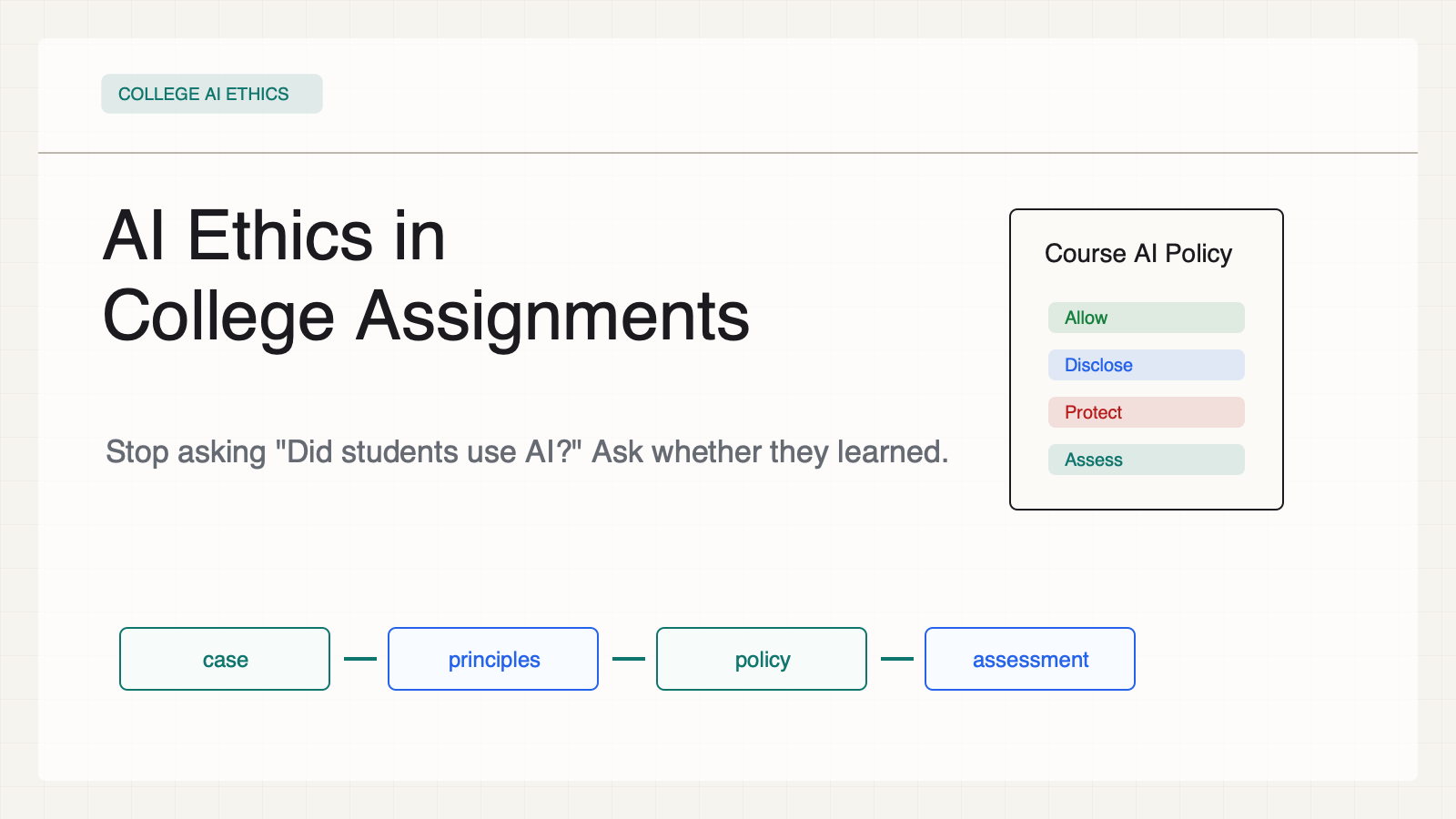
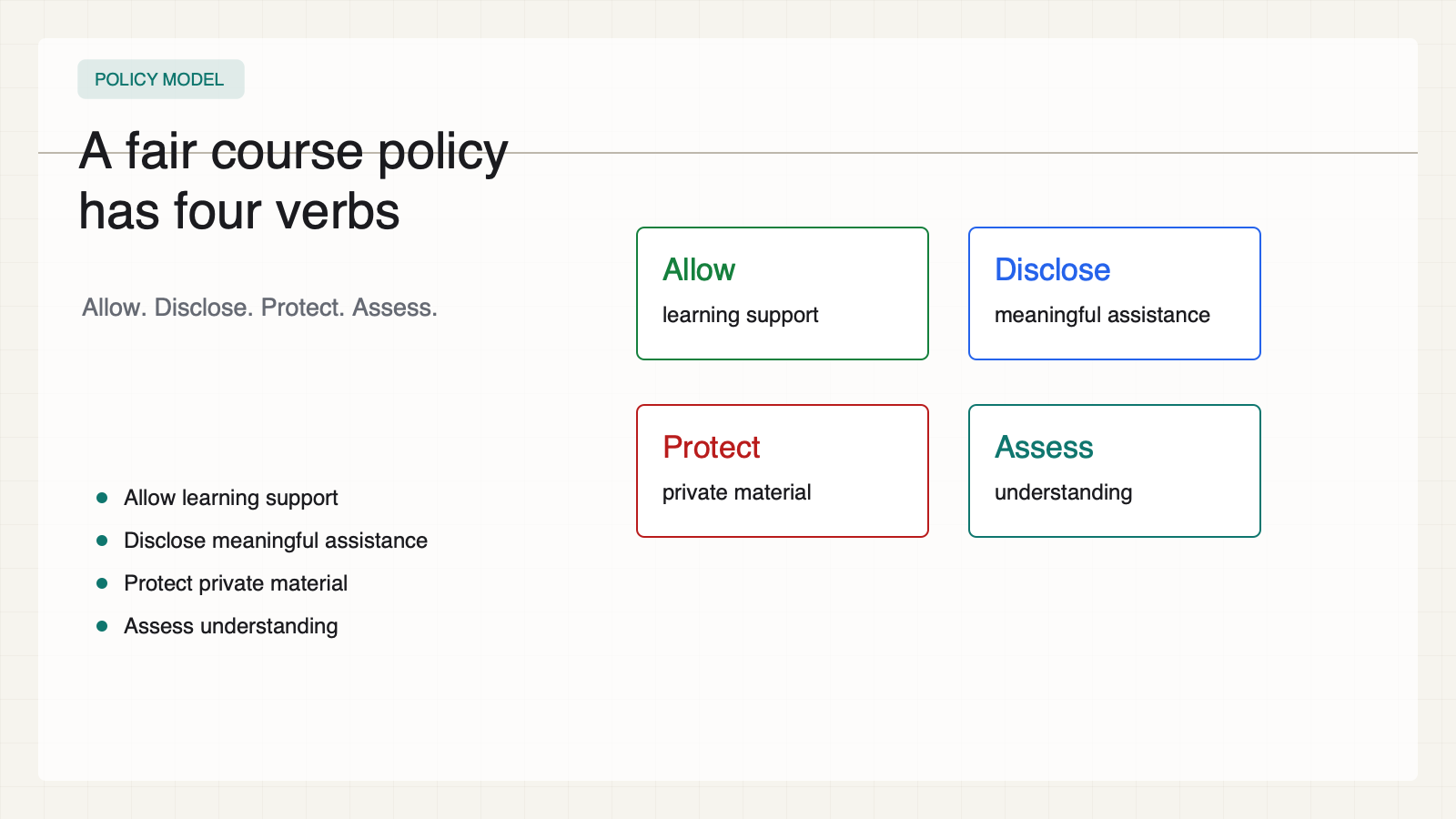
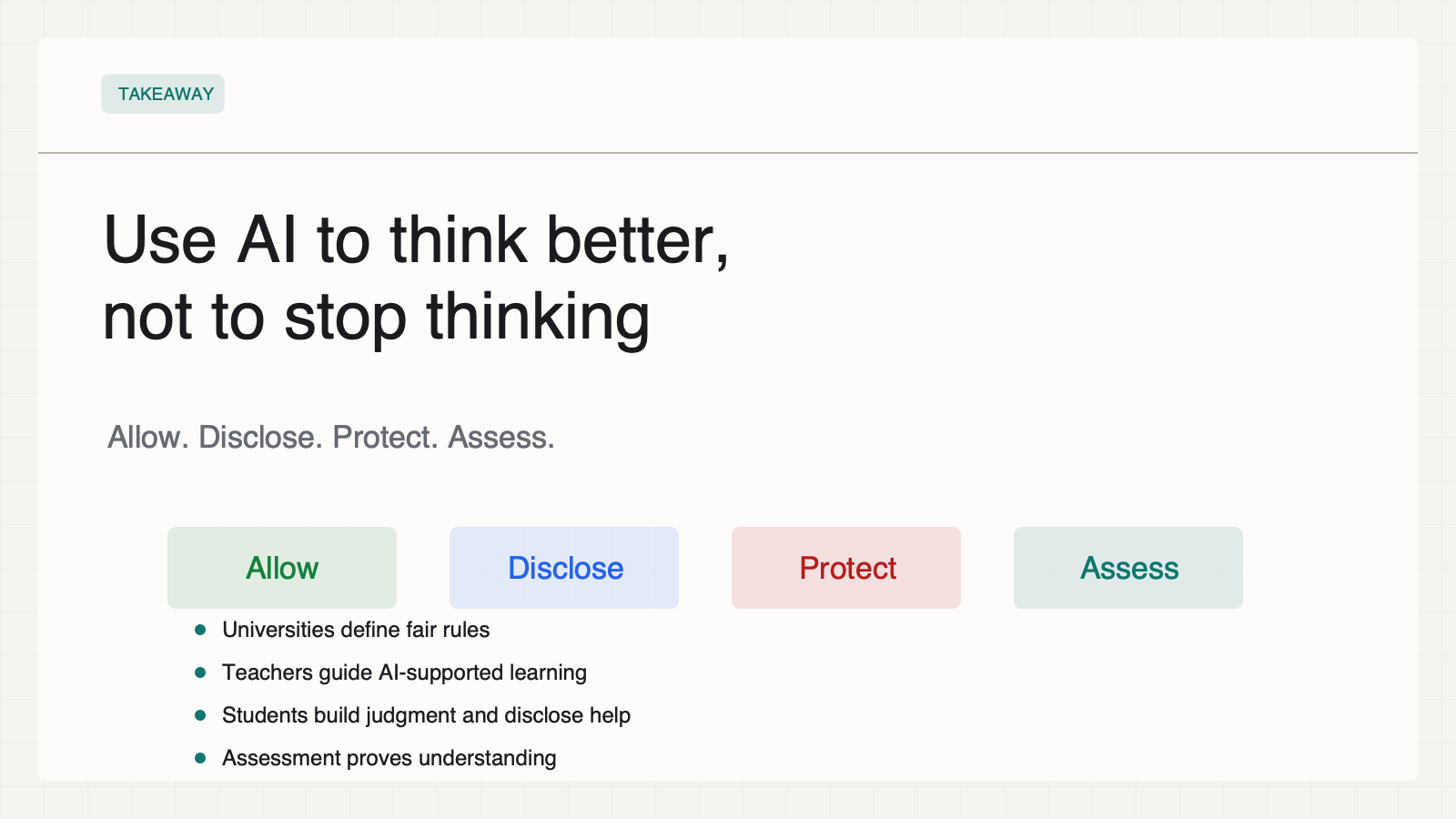
| 24 | What is the four-part policy thesis? | Allow useful learning support, require meaningful disclosure, protect private and unauthorized material, and assess understanding rather than polished output alone. |
| 25 | What title captures the argument? | “Stop Asking ‘Did Students Use AI?’ Ask Whether They Learned.” |
| 26 | What is the opening paragraph? | College AI ethics should move beyond forbid/allow. Every role must adapt: universities define fair rules, teachers guide AI-supported learning, and students learn to use AI to strengthen thinking instead of stopping thinking. |
Slide Deck
This article also includes a teaching deck for class discussion.
| Format | Link | Notes |
|---|---|---|
| ai-ethics-college-policy.pdf | Best for reading and classroom sharing. | |
| PPTX | ai-ethics-college-policy.pptx | Image-based slides with prompt notes, not fully editable text/shapes. |
Slide Gallery
References
- Jobin, A., Ienca, M., & Vayena, E. (2019). “The global landscape of AI ethics guidelines.” Nature Machine Intelligence, 1, 389-399. DOI: 10.1038/s42256-019-0088-2.
- Corrêa, N. K., et al. (2023). “Worldwide AI Ethics: A review of 200 guidelines and recommendations for AI governance.” Patterns, 4(10), 100857. DOI: 10.1016/j.patter.2023.100857. Project page.
- Giarmoleo, G., Ferrero, I., Rocchi, M., & Pellegrini, M. M. (2024). “What ethics can say on artificial intelligence: Insights from a systematic literature review.” Business and Society Review. DOI: 10.1111/basr.12336.
- Groen, E. M., Sharon, T., & Becker, M. (2026). “An overview of AI ethics: moral concerns through the lens of principles, lived realities and power structures.” AI and Ethics, 6, Article 121. DOI: 10.1007/s43681-025-00955-7.
- UNESCO. (2023). “Guidance for generative AI in education and research.”
- U.S. Department of Education, Office of Educational Technology. (2023). “Artificial Intelligence and the Future of Teaching and Learning: Insights and Recommendations.”
- Tertiary Education Quality and Standards Agency. (2026). “Detecting plagiarism of AI-generated text in student assessments and securing take-home written assessments.”
Related Reading
- AI Ethics - From Principles to Power Structures
- AI Education Search-Space Design - Make Students Wider Before Faster
- Learning in the AI Era: Amplify Your Thinking, Don’t Outsource It
- What Researchers Should and Shouldn’t Use LLMs For
- Anti-AI Exam Designer - A Claude Code Skill for AI-Resistant Exams